roadwise.Open study app

Oregon driving lesson · Sharing the Road

Pedestrians and Crosswalks

A 4-minute lesson from the Oregon course. Read the rules and examples, follow the handbook page references, and check your understanding before you move on.

Read time
4 minutes
Course unit
Sharing the Road
Checkpoint questions
6
Source pages
54, 55, 56

People walking, rolling and riding are vulnerable: they can be hard to see and have no protection in a crash. Oregon's crosswalk law is strict and specific — you stop for pedestrians at every crosswalk, marked or not, and wait until they're a set distance clear.

Vulnerable road users

Pedestrians, people riding bicycles and motorcycles, highway workers, and people using skateboards or scooters in a public way, crosswalk or highway shoulder.

Handbook p. 54 ↗

Pedestrian

People walking, and people rolling with skateboards, scooters, wheelchairs and similar devices.

Handbook p. 54 ↗

Know the rule

You must stop for pedestrians crossing at any marked or unmarked crosswalk. A pedestrian is crossing once any part or extension of them — cane, wheelchair, bicycle — moves onto the road.

Handbook p. 54 ↗

Stop and stay stopped for a pedestrian in a crosswalk who is:

  • In your lane of travel
  • In a lane next to yours, including a bike lane
  • In the lane you are turning into
Handbook p. 54 ↗

When you're turning, before you begin the pedestrian must be:

When you're turning, before you begin the pedestrian must be:
IntersectionPedestrian position
With a traffic signal6 feet or more from the lane you're turning into
Without a traffic signalPast the lane you're turning into, plus the next lane
Handbook p. 55 ↗

Know the rule

Passing a vehicle stopped at a crosswalk is against the law — the driver may be waiting for a pedestrian.

Handbook p. 55 ↗

Know the rule

You don't have to stop if the pedestrian is in a crosswalk on the other side of a safety island.

Handbook p. 55 ↗

Know the rule

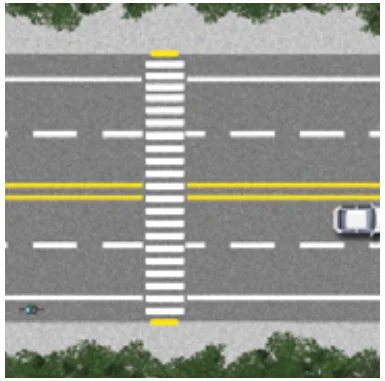
There's a crosswalk at every intersection, even without painted lines. Imagine the corner's sidewalk or shoulder extending across. An unmarked crosswalk is at least 6 feet wide and exists even with no sidewalk or shoulder.

Handbook p. 55 ↗
Crosswalk
Mid-block crosswalk

Know the rule

A mid-block crosswalk may have a flashing yellow light meaning a pedestrian is crossing or about to cross.

Handbook p. 55 ↗

Know the rule

Don't stop with any part of your vehicle overhanging a crosswalk — it forces pedestrians around your vehicle into danger.

Handbook p. 55 ↗

Know the rule

When crossing a sidewalk to enter or leave a parking lot, alley or driveway, stop before the sidewalk and yield to pedestrians and bicyclists.

Handbook p. 55 ↗

Know the rule

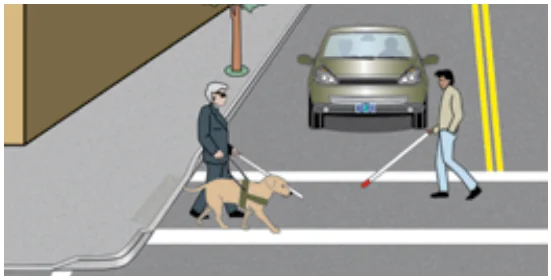
Yield to a pedestrian who is blind or deaf-blind carrying a white cane or using a guide dog, or anyone with limited vision. Stop if they're about to cross or crossing, and stay stopped until they've crossed the entire road — even on a green light.

Handbook p. 56 ↗
Pedestrian with a guide dog and white cane at a crosswalk
White cane and guide dog

Put it into practice

You're turning right on a green signal. A pedestrian in the crosswalk you'll drive through is walking away and is now more than 6 feet from the lane you're turning into. At a signal, that's enough — turn with care. Without a signal, they'd have to be past your lane plus the next lane.
Check your understanding

Read the question, decide on an answer, then open it to check the explanation. These are Roadwise study questions based on the source handbook.

You must stop for a pedestrian crossing the road at:
  1. Only marked crosswalks
  2. Only crosswalks with a signal
  3. Any marked or unmarked crosswalk
  4. Only where a pedestrian crossing sign is posted

Answer: Any marked or unmarked crosswalk

Stop for pedestrians at both marked and unmarked crosswalks.

Handbook p. 54 ↗
At an intersection with a traffic signal, before you begin a turn, a pedestrian in the crosswalk must be at least how far from the lane you are turning into?
  1. 3 feet
  2. 10 feet
  3. 20 feet
  4. 6 feet

Answer: 6 feet

Pedestrians must be 6+ feet from the lane you're turning into.
Handbook p. 55 ↗
At an intersection with no traffic signal, before you begin a turn, a pedestrian must be:
  1. Past the lane you are turning into, plus the next lane
  2. Just past the curb line
  3. At least 6 feet away
  4. Anywhere, as long as they are moving

Answer: Past the lane you are turning into, plus the next lane

At unsignaled intersections, the clearance rule is stricter.

Handbook p. 55 ↗
An unmarked crosswalk exists:
  1. Only where a sidewalk physically exists
  2. Only in school zones
  3. At every intersection, even without painted lines
  4. Nowhere; only marked crosswalks count

Answer: At every intersection, even without painted lines

Every intersection has an unmarked crosswalk, painted or not.

Handbook p. 55 ↗
If you see a pedestrian with a white cane crossing the road, you must:
  1. Stop only until they pass your lane
  2. Stay stopped until they have fully crossed
  3. Proceed carefully around them
  4. Stop until they reach the center line, then proceed

Answer: Stay stopped until they have fully crossed

Remain stopped until the person fully crosses, even with a green light.

Handbook p. 56 ↗
Are you required to stop for a pedestrian crossing on the far side of a safety island from you?
  1. Yes, always, regardless of the island
  2. Only if your light is red
  3. No, you need not stop
  4. Only if the pedestrian signals to you

Answer: No, you need not stop

Pedestrians on the far side of a safety island don't require a stop.

Handbook p. 55 ↗
Take the lesson checkpoint in the app

More in Sharing the Road