roadwise.Open study app

Oklahoma driving lesson · Lane Usage and Maneuvers

Turn signals and the six steps of turning

A 3-minute lesson from the Oklahoma course. Read the rules and examples, follow the handbook page references, and check your understanding before you move on.

Read time
3 minutes
Course unit
Lane Usage and Maneuvers
Checkpoint questions
6
Source pages
36

Turning looks simple, but it takes attention in all directions at once, planning and preparation, and good timing. In 2008, 4,813 Oklahoma collisions were caused by drivers who made improper or illegal turns.

4,813

Collisions in 2008 caused by improper or illegal turns

Handbook p. 36 ↗

Know the rule

Turn signals warn other drivers that you intend to turn left or right, change lanes, slow down, pull off or onto the roadway, or stop.

Handbook p. 36 ↗

Know the rule

It is illegal to turn without signaling. Signal for at least 100 feet or 1/3 of a block before you turn, slow down or stop.

Handbook p. 36 ↗

Know the rule

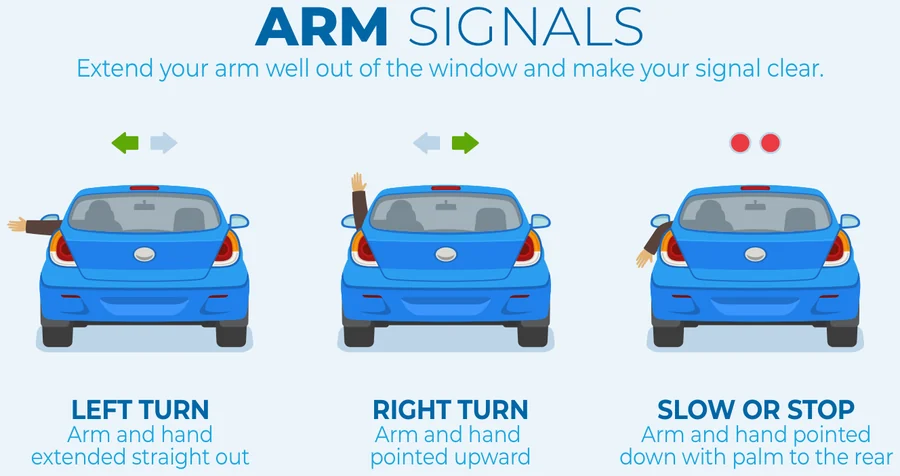
You may use turn indicators or arm signals. With arm signals, extend your arm well out of the window, make the signal clear, and bring your arm in during the actual turn to keep control of the wheel.

Handbook p. 36 ↗

Arm signals

Arm signals
SignalArm and hand
Left turnExtended straight out
Right turnPointed upward
Slow or stopPointed down, palm to the rear
Handbook p. 36 ↗
Arm signals (left turn, right turn, slow or stop)
Arm signals: left turn, right turn, slow or stop

Six steps for a good turn:

  • Signal what you intend to do
  • Look behind and on both sides to see where other vehicles are
  • Move into the correct lane as soon as possible; the faster the traffic, the sooner
  • Slow down before the stop line or crosswalk; select the proper gear and accelerate slightly through the turn
  • Make the turn correctly
  • Finish the turn in the proper lane
Handbook p. 36 ↗

Know the rule

Don't brake or press the clutch while turning, and don't shift gears in the intersection.

Handbook p. 36 ↗

Don't:

  • Turn unless the turn is permitted and can be made easily
  • Turn from the wrong lane: go to the next intersection and turn from the proper lane, circling back if you must
  • Turn your steering wheel left while waiting for oncoming traffic to pass
Handbook p. 36 ↗

Know the rule

On a left turn, turn when oncoming traffic is clear and watch behind you for cars trying to pass you while you're turning.

Handbook p. 36 ↗

Put it into practice

You're waiting in the intersection to turn left while oncoming cars pass. Keep your wheels pointed straight. If you're hit from behind with wheels turned, you'll be pushed into oncoming traffic. Turn the wheel only when you're sure you can complete the turn.

Check your understanding

Read the question, decide on an answer, then open it to check the explanation. These are Roadwise study questions based on the source handbook.

How far before a turn must you signal?
  1. At least 500 feet
  2. At least 100 feet, or 1/3 of a block
  3. At least 25 feet
  4. Only once you start turning

Answer: At least 100 feet, or 1/3 of a block

Signal at least 100 feet, or 1/3 of a block, before you turn, slow down or stop.
Handbook p. 36 ↗
While waiting to make a left turn, you should turn your wheels left immediately so you're ready to go.
  1. True
  2. False

Answer: False

If hit from behind with wheels already turned, you could be pushed into oncoming traffic; wait until you can complete the turn.

Handbook p. 36 ↗
What should you never do with the clutch or gears while actually turning?
  1. Select the proper gear before entering the intersection
  2. Accelerate slightly through the turn
  3. Signal your intention to turn
  4. Shift gears in the intersection

Answer: Shift gears in the intersection

Select your gear before the intersection; don't brake or shift gears while actually turning.

Handbook p. 36 ↗
You're not in the correct lane for the turn you want to make. What should you do?
  1. Turn at the next intersection instead
  2. Turn anyway from the wrong lane, carefully
  3. Stop and reverse to the correct lane
  4. Cut across traffic to reach the right lane

Answer: Turn at the next intersection instead

If you're not in the proper lane, drive to the next intersection rather than turning from the wrong lane.

Handbook p. 36 ↗
What are turn signals used to communicate to other drivers, besides turning?
  1. That you're letting others pass you
  2. That you'll change lanes, slow down or stop
  3. That you have a mechanical problem
  4. Nothing besides a turn

Answer: That you'll change lanes, slow down or stop

Turn signals also warn other drivers you intend to change lanes, slow down, or stop.

Handbook p. 36 ↗
You should accelerate slightly through a turn rather than braking or shifting gears mid-turn.
  1. True
  2. False

Answer: True

Select the proper gear beforehand and accelerate slightly through the turn instead of braking mid-turn.

Handbook p. 36 ↗
Take the lesson checkpoint in the app

More in Lane Usage and Maneuvers