roadwise.Open study app

Oklahoma driving lesson · Lane Usage and Maneuvers

Expressway speed and lane use

A 3-minute lesson from the Oklahoma course. Read the rules and examples, follow the handbook page references, and check your understanding before you move on.

Read time
3 minutes
Course unit
Lane Usage and Maneuvers
Checkpoint questions
6
Source pages
33, 35

Oklahoma has many miles of limited-access highways: freeways, toll roads, turnpikes and expressways built for uninterrupted travel at higher speeds. They're safer than ordinary highways, but their rules are different, starting with a minimum speed.

Know the rule

Expressways have no stop signs, traffic signals or railroad crossings, and usually no steep hills or sharp curves that limit your view.

Handbook p. 33 ↗

Limited access

You enter or leave the roadway only at entrances and exits, called interchanges, without ever crossing the path of other traffic.

Handbook p. 33 ↗

Know the rule

If your car isn't in good condition, or you can't or don't want to drive at or above the minimum speed limit, don't use the expressway.

Handbook p. 33 ↗
40 mph

Usual expressway minimum speed

Handbook p. 33 ↗
55-75 mph

Usual range of expressway maximum speed limits

Handbook p. 33 ↗
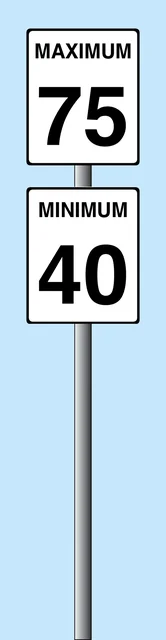
Maximum and minimum speed limit
Maximum 75 / Minimum 40 speed signs

Know the rule

Driving too slowly is against the law because it's dangerous. Always drive at a safe speed for conditions such as traffic flow, rain or snow.

Handbook p. 33 ↗

Speed habits on the expressway:

  • Maintain a constant speed; don't speed up or slow down without good reason
  • Adjust your speed and lane to let others enter safely
  • Move to the right to let faster vehicles pass
Handbook p. 33 ↗

Use the proper lane:

  • Right-hand lane when you're slower than other traffic
  • Middle or left-hand lane if you're faster than other traffic
  • Stay in the middle of your lane; don't weave in and out of traffic
  • Don't travel alongside other vehicles at the same speed; avoid packs
  • Stay out of other drivers' blind spots
  • Change speed and/or lanes so you don't block the normal flow of traffic
Handbook p. 33 ↗

Know the rule

On a road divided into four or more lanes, you may not impede normal traffic flow by driving in the left lane, unless traffic flow or road configuration (such as merging traffic) requires using other lanes.

Handbook p. 35 ↗

Put it into practice

You're doing 65 mph in the left lane of a four-lane turnpike and a line of faster cars builds up behind you. Signal, check your blind spot and move right so they can pass; the right lane is for traffic moving slower than the flow.

Check your understanding

Read the question, decide on an answer, then open it to check the explanation. These are Roadwise study questions based on the source handbook.

What is the usual minimum speed on an Oklahoma expressway?
  1. 25 mph
  2. 55 mph
  3. 30 mph
  4. 40 mph

Answer: 40 mph

Expressway speeds usually range from a 40 mph minimum to a 55-75 mph maximum.
Handbook p. 33 ↗
Which of these do controlled-access expressways NOT have?
  1. Interchanges
  2. Acceleration and deceleration lanes
  3. Stop signs or traffic signals
  4. Exit ramps

Answer: Stop signs or traffic signals

Expressways are limited-access and don't have stop signs, signals or railroad crossings.

Handbook p. 33 ↗
On the expressway, when should you change your speed or lane according to the manual?
  1. Only when directed by a sign
  2. Only when exiting the expressway
  3. Only in construction zones
  4. So you don't block traffic flow

Answer: So you don't block traffic flow

Change speed and/or lanes as needed to avoid blocking the normal traffic flow.

Handbook p. 33 ↗
Why does the manual warn against traveling in a 'pack' of cars at the same speed on the expressway?
  1. It keeps you in others' blind spots
  2. It's illegal on Oklahoma turnpikes
  3. It drops the pack below the minimum speed
  4. It forces you into the left lane

Answer: It keeps you in others' blind spots

Avoid traveling alongside other vehicles at the same speed, since it can trap you in blind spots.

Handbook p. 33 ↗
You're driving slower than the flow of traffic on the expressway. Which lane should you use?
  1. The middle lane
  2. The left-hand lane
  3. The right-hand lane
  4. Whichever lane has less traffic

Answer: The right-hand lane

Use the right-hand lane when you're driving slower than other traffic on the expressway.

Handbook p. 33 ↗
What is a 'limited access' highway?
  1. One entered or left only at interchanges
  2. One for certain vehicle types
  3. One with a toll booth at every exit
  4. One with a lower speed limit than usual

Answer: One entered or left only at interchanges

Limited access means entering or leaving only at interchanges, never crossing another vehicle's path.

Handbook p. 33 ↗
Take the lesson checkpoint in the app

More in Lane Usage and Maneuvers