Roadwise States Oklahoma Driving lessons Passing Oklahoma driving lesson · Lane Usage and Maneuvers
Passing A 3-minute lesson from the Oklahoma course. Read the rules and examples, follow the handbook page references, and check your understanding before you move on.
Read time 3 minutes
Course unit Lane Usage and Maneuvers
Checkpoint questions 6
Source pages 35 Passing on a two-lane road puts you in the path of oncoming traffic, so it's allowed only when you can see far enough and the markings permit it. You may never exceed the speed limit to pass another vehicle.
Know the rule
You may not exceed the speed limit to pass another vehicle.
Handbook p. 35 ↗ Passing on the left: Don't move left until sure it's safe: check for at least 200 feet of clear road, no No Passing Zone Don't get so close to a large truck or bus that it blocks your view ahead Make sure no one is passing or about to pass you; check mirror and blind spots Signal a left turn and, when clear, move into the left lane Don't return right until you can see the passed car in your rearview mirror Signal and pull into the right lane; turn off your signal once in the lane Handbook p. 35 ↗ You may pass on the right when: The road has two or more lanes each direction, with no parked cars or other obstructions You are on a one-way road The vehicle ahead is making, or about to make, a left turn Handbook p. 35 ↗ Know the rule
You can never legally pass on the right by driving off the pavement or the main part of the highway.
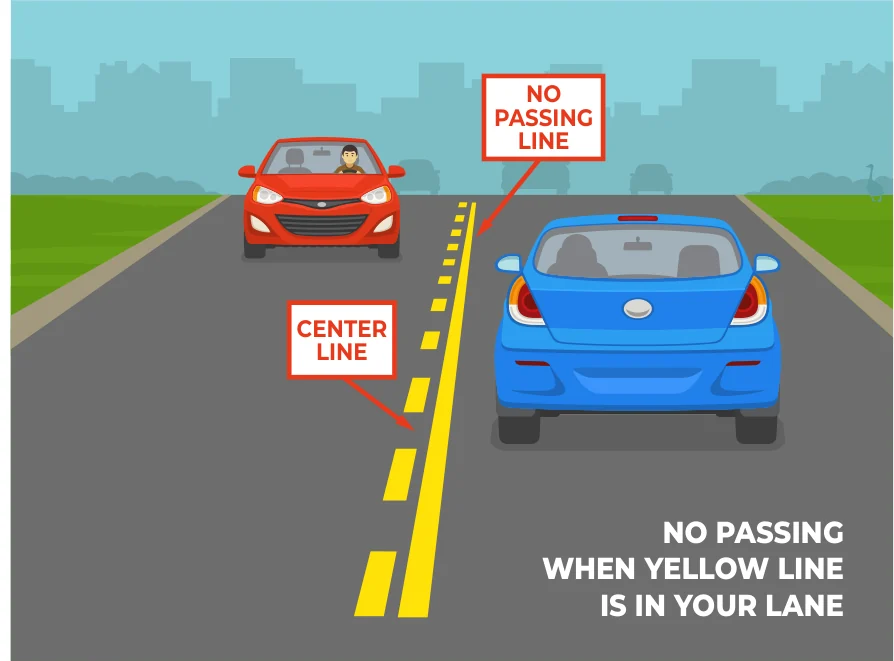
Handbook p. 35 ↗ You MUST NOT pass: When the solid yellow line is in your lane (double yellow, or solid plus dashed) On hills or curves, even if the road is not marked Within 100 feet of an obstructed view, or where vehicles or pedestrians might cross your path Handbook p. 35 ↗ 100 feet No passing within this distance of bridges, viaducts, tunnels, overpasses, railroad crossings, intersections and crosswalks
Handbook p. 35 ↗ No passing when the yellow line is in your lane When someone is passing you: Help the other driver pass you safely Stay in your lane, and move right if being passed on the left Don't increase your speed If a car approaches from the other direction, slow down and let the passer pull in front of you Handbook p. 35 ↗ Put it into practice
On a two-lane highway the car ahead is doing 50 in a 65 zone, and a railroad crossing sign is visible about 80 feet ahead. Don't pass: you're within 100 feet of a railroad crossing. Wait until you're past it and have at least 200 feet of clear road.
Check your understanding Read the question, decide on an answer, then open it to check the explanation. These are Roadwise study questions based on the source handbook.
How much clear roadway should you check for before passing on the left? At least 50 feet At least 500 feet At least 200 feet At least 20 feet Answer: At least 200 feet
Check for at least 200 feet of clear roadway without a No-Passing Zone before passing.
Handbook p. 35 ↗ Within how many feet of an obstructed view or intersection is passing illegal? 50 feet 200 feet 300 feet 100 feet Answer: 100 feet
Do not pass within 100 feet of an obstructed view, intersection, bridge, or crosswalk.
Handbook p. 35 ↗ When may you legally pass on the right? When the vehicle ahead is turning left Whenever traffic is moving slowly On any two-lane road When the shoulder is wide and paved Answer: When the vehicle ahead is turning left
You may pass on the right when the vehicle ahead is making or about to make a left turn, among other narrow conditions.
Handbook p. 35 ↗ A solid yellow line in your lane means you may not pass, even if the line in the other lane is dashed. True False Answer: True
Passing is prohibited whenever the solid yellow line is in your lane.
Handbook p. 35 ↗ May you exceed the speed limit in order to complete a pass? No, not even to complete a pass Yes, up to 10 mph over the limit Yes, if the road is otherwise empty Only on undivided highways Answer: No, not even to complete a pass
You may not exceed the speed limit to pass another vehicle, even to finish the maneuver quickly.
Handbook p. 35 ↗ While someone else is passing you, what should you avoid doing? Staying in your lane Increasing your speed Moving right if being passed on the left Letting the driver merge back in Answer: Increasing your speed
Don't increase your speed while being passed; help the other driver complete the pass safely.
Handbook p. 35 ↗ Previous lesson Entering, leaving and stopping on the expressway Next lesson Turn signals and the six steps of turning More in Lane Usage and Maneuvers About the source Roadwise’s Oklahoma course uses the driver handbook edition supplied with this study pack. This lesson cites source pages 35. The linked PDF is a third-party mirror of the handbook, rather than a government-hosted page.
Open the handbook source PDF · View the source edition
For current application requirements, fees, appointments, and the format that applies to your age or license type, check Oklahoma’s Service Oklahoma. Roadwise provides study material and does not issue permits or licenses.