Roadwise States Oklahoma Driving lessons Trucks Oklahoma driving lesson · Sharing the Road
Trucks A 4-minute lesson from the Oklahoma course. Read the rules and examples, follow the handbook page references, and check your understanding before you move on.
Read time 4 minutes
Course unit Sharing the Road
Checkpoint questions 6
Source pages 54, 55 Trucks haul more freight more miles than any other kind of transportation, so you'll always be sharing the road with them. Truck drivers are watching for smaller vehicles, but their size means big blind spots, wide turns and slow speeds uphill.
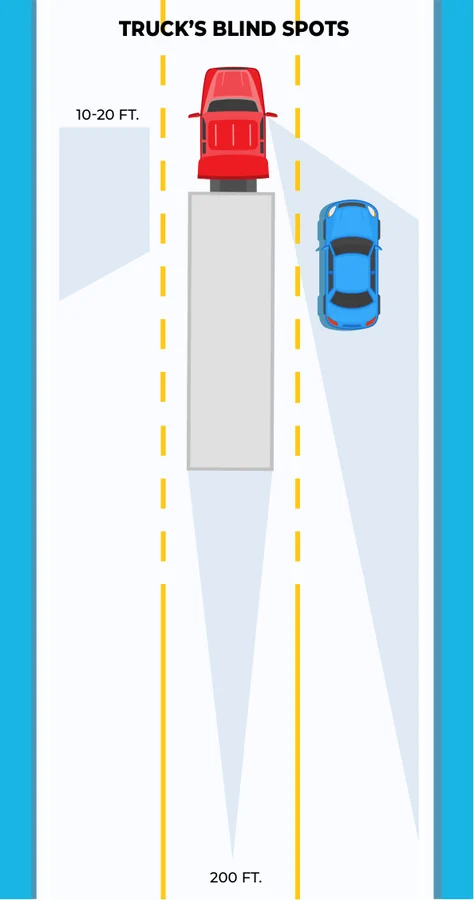
Following a truck safely: Stay far enough back to see the road ahead clearly Stay out of the blind spot; if you can't see the truck's mirror, the driver can't see you Stopped behind a truck on an uphill grade: stay left in your lane, leave extra space in case it rolls back Dim your lights at night; bright lights in the mirrors can blind the driver In rain, stay back; spray from the rear wheels can cover your windshield Handbook p. 54 ↗ 200 feet How far a truck's rear blind spot can extend (there are also blind spots on either side of the cab)
Handbook p. 54 ↗ 10-20 feet Road in front of the bumper a trucker with a long hood may not be able to see
Handbook p. 54 ↗ A truck's blind spots: 10-20 feet ahead and up to 200 feet behind Passing a truck: Pass only in a legal passing zone when clear; blink your headlights to tell the driver, especially at night Trucks go faster downhill and slower uphill; you may need more speed to pass downhill Complete the pass quickly and don't linger alongside; then keep your speed up If the truck blinks its lights after you pass, you're clear to pull in Move back only when you can see the truck's front in your rearview mirror Handbook p. 54 ↗ Know the rule
When a truck passes you, keep to the far side of your lane and reduce speed slightly. Never speed up as a truck is passing.
Handbook p. 54 ↗ Know the rule
When meeting a truck from the opposite direction, keep as far right as possible to avoid being sideswiped and to reduce wind turbulence. The turbulence pushes vehicles apart; it does not suck them together.
Handbook p. 54 ↗ Know the rule
Two-trailer trucks are just as safe as single-trailer trucks; with care and skill you can pass them without fear.
Handbook p. 54 ↗ Know the rule
Trucks make wide right turns and often must leave an open space on the right. Don't move into that space or pass a truck that may be turning right; between the truck and the curb, you can be crunched or sideswiped.
Handbook p. 55 ↗ Know the rule
Never try to cross behind a truck preparing to back up. You'll be in the driver's blind spot; give plenty of room and wait for the maneuver to finish.
Handbook p. 55 ↗ Put it into practice
A semi ahead signals right and swings left at an intersection, opening a gap at the curb. Don't pull into that gap. Stay back and wait: the truck needs that space to complete its wide right turn.
A useful reminder If you can't see the truck's mirrors, the driver can't see you.
Check your understanding Read the question, decide on an answer, then open it to check the explanation. These are Roadwise study questions based on the source handbook.
About how far behind a truck does its rear blind spot extend? About 50 feet About 20 feet About 500 feet About 200 feet Answer: About 200 feet
A truck's blind spot extends up to 200 feet behind it.
Handbook p. 54 ↗ A truck is making a wide right turn and leaves space on its right side. What should you do? Stay out of that space and don't pass Pass on the right through that space Pass the truck quickly on the left Honk so the driver sees you, then pass Answer: Stay out of that space and don't pass
Trucks make wide right turns; don't move into the open space or try to pass, because the driver may not see you.
Handbook p. 55 ↗ Wind turbulence from a passing truck tends to pull smaller vehicles in closer, not push them apart. True False Answer: False
Turbulence pushes vehicles apart; it does not suck them together.
Handbook p. 54 ↗ If a tractor has a long hood, how far in front of the bumper might the driver be unable to see? 50-60 feet 2-5 feet 10-20 feet 100 feet Answer: 10-20 feet
A long-hood tractor may block the driver's view of the first 10-20 feet in front of the bumper.
Handbook p. 54 ↗ You're stopped behind a truck on an uphill grade. Where should you position your car? Directly behind the truck's bumper As far right as possible It doesn't matter on an uphill grade Stay left, so you're visible Answer: Stay left, so you're visible
Stay to the left in your lane on an uphill stop so the truck driver can see you in the mirror.
Handbook p. 54 ↗ A truck you just passed blinks its headlights at you. What does this mean? It's warning you to speed up further It's signaling you're clear to pull back in It's a request for you to slow down immediately It has no specific meaning Answer: It's signaling you're clear to pull back in
A truck driver blinking lights after you pass signals that you're clear to move back in front.
Handbook p. 54 ↗ Previous lesson Motorcycles Next lesson Trains: why you always yield About the source Roadwise’s Oklahoma course uses the driver handbook edition supplied with this study pack. This lesson cites source pages 54, 55. The linked PDF is a third-party mirror of the handbook, rather than a government-hosted page.
Open the handbook source PDF · View the source edition
For current application requirements, fees, appointments, and the format that applies to your age or license type, check Oklahoma’s Service Oklahoma. Roadwise provides study material and does not issue permits or licenses.