A 3-minute lesson from the Oklahoma course. Read the rules and examples, follow the handbook page references, and check your understanding before you move on.
Most car-motorcycle crashes aren't the rider's fault: drivers turn in front of a motorcycle they never saw, or saw too late. A motorcycle is narrow and short, so it's hard to spot and hard to judge for distance and speed.
Two-thirds
of car/motorcycle collisions are caused by the driver who turned in front of the motorcycle, not the motorcyclist
Motorcycles have the right to use the full width of the lane to handle hazards such as potholes, shifting traffic and wind blasts. Don't try to share a lane with a motorcycle.
At intersections, where most collisions and injuries occur, wait until the rider's intentions (turning or going straight) are absolutely clear before moving into their path. Be even more careful in rain, on wet or icy roads and in heavy wind.
Motorcycles must have a windshield that protects the operator from foreign objects; otherwise the operator must wear ANSI-approved goggles or face shield material.
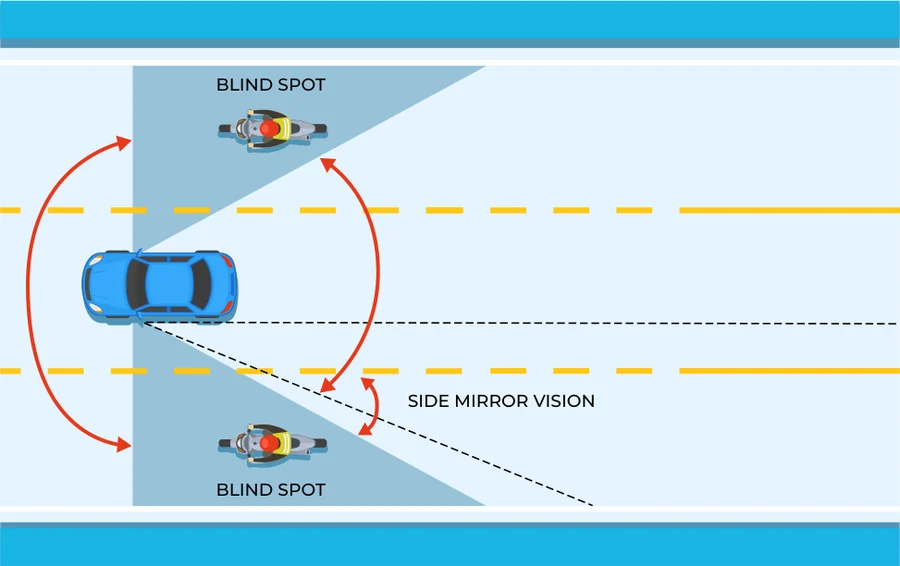
Motorcycles can hide in your blind spots outside side-mirror vision
Put it into practice
You're waiting to turn left and see a single headlight approaching. Don't assume it's far away or will stop. Wait until you're sure whether the rider is turning or going straight, then turn only with a clear gap.
Check your understanding
Read the question, decide on an answer, then open it to check the explanation. These are Roadwise study questions based on the source handbook.
What endorsement must every motorcycle operator have?
A Class B endorsement
An M endorsement
A hazmat endorsement
No endorsement is needed
Answer: An M endorsement
All operators of motorcycles must have an M endorsement on their license.