Roadwise States Oklahoma Driving lessons Bicycles Oklahoma driving lesson · Sharing the Road
Bicycles A 4-minute lesson from the Oklahoma course. Read the rules and examples, follow the handbook page references, and check your understanding before you move on.
Read time 4 minutes
Course unit Sharing the Road
Checkpoint questions 6
Source pages 51, 52 Bicyclists have the same rights and responsibilities on the street that you do, and in most cases they must share the lane. Expect sudden moves: trash, an oil slick, a pothole, a barking dog or an opening car door can make a rider swerve right in front of you.
3 feet Minimum distance to leave when overtaking and passing a bicycle, until you are safely past (Title 47-11-1208-A)
Handbook p. 51 ↗ Driving near bicycles: Watch for riders, especially children, turning in front of you without looking or signaling Don't pass between a bicyclist and oncoming vehicles on a two-lane road; slow down and wait Never pass a bicycle if the street is too narrow; wait until there is enough room Watch for bikes coming out of driveways or from behind parked cars On a narrow road, if the rider may not know you're there, honk briefly; don't blast or startle Handbook p. 51 ↗ Know the rule
At night, watch the side of the road for bicyclists. They must have a front light and a rear reflector, but glare from approaching traffic can make them hard to see.
Handbook p. 51 ↗ Know the rule
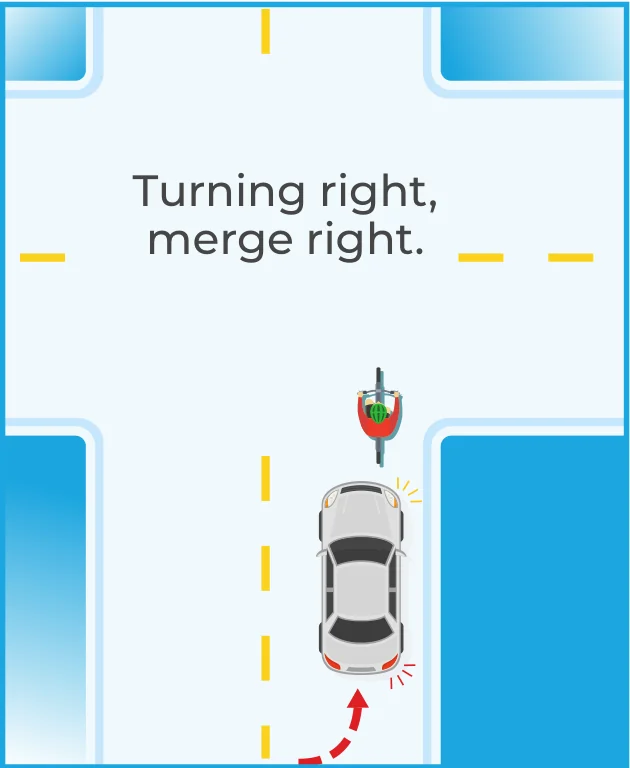
Preparing for a right turn, merge with bicycle traffic. Don't turn directly across a bicyclist's path.
Handbook p. 51 ↗ Turning right, merge right behind the bicycle Know the rule
Bicyclists must ride as far right in the lane as possible only when the lane can be safely shared by a car and a bicycle side by side.
Handbook p. 52 ↗ A bicyclist may use the full lane when: Overtaking and passing another vehicle going the same direction Getting in place for a left turn at an intersection or into a private road or driveway There are unsafe conditions: parked or moving vehicles, obstacles, pedestrians, animals, potholes, debris The lane is too narrow for a car and a bicycle to share safely Handbook p. 52 ↗ Know the rule
If you see a flag on a bicycle, slow down: the rider may have impaired hearing. All bicyclists must ride in the correct lane of traffic.
Handbook p. 52 ↗ Immediate hazard A vehicle approaching a bicyclist at a speed or distance that could lead to a potential collision.
Handbook p. 52 ↗ Bicyclists at stop signs: Must slow down when approaching Must stop before entering if there's a risk of danger Should yield to pedestrians and other traffic May proceed without stopping if no danger is present Handbook p. 52 ↗ Bicyclists at red lights: Must stop before entering the intersection Must yield to oncoming traffic that poses an immediate hazard, then may proceed if safe May turn right on red after slowing and yielding May turn left onto a one-way street after stopping and yielding to oncoming traffic Handbook p. 52 ↗ Put it into practice
On a two-lane road you come up behind a cyclist while a car approaches in the other lane. Don't squeeze between them. Slow down, let the oncoming car pass, then move left and give the rider at least 3 feet as you pass.
Check your understanding Read the question, decide on an answer, then open it to check the explanation. These are Roadwise study questions based on the source handbook.
How much clearance must you give when passing a bicyclist going the same direction? At least 1 foot At least 6 feet At least 3 feet At least 10 feet Answer: At least 3 feet
Oklahoma law requires at least 3 feet of clearance when passing a bicycle.
Handbook p. 51 ↗ When may a bicyclist legally take the full lane? When the lane is too narrow to share Whenever traffic is light Only on residential streets Never, they must always ride at the edge Answer: When the lane is too narrow to share
A bicyclist may take the full lane when the lane can't be safely shared side-by-side with a car.
Handbook p. 52 ↗ When must a bicyclist ride as far right in the lane as possible? At all times, with no exceptions Only on residential streets Only if it can be safely shared Never, they may always use the center of the lane Answer: Only if it can be safely shared
Riding far right is only required when the lane is wide enough to safely share with a car.
Handbook p. 52 ↗ At a stop sign, if there's no danger present, what may a cyclist legally do? They must always come to a full stop like a car Proceed without stopping They must dismount and walk the bike through They must wait for a car to go first Answer: Proceed without stopping
Under Oklahoma's bicycle safety guidelines, if no danger is present, a cyclist can proceed through a stop sign without stopping.
Handbook p. 52 ↗ May a cyclist make a right turn on red? No, cyclists can't turn right on red Only where a sign allows it Yes, after slowing down and yielding to traffic Only during daylight hours Answer: Yes, after slowing down and yielding to traffic
Cyclists can make a right turn on red after slowing down and yielding to traffic, just like drivers.
Handbook p. 52 ↗ A bicyclist may take the full lane when unsafe conditions like potholes or debris are present. True False Answer: True
Unsafe roadway conditions are one of the situations where a bicyclist may take the full lane.
Handbook p. 52 ↗ Previous lesson Pedestrians Next lesson Motorcycles About the source Roadwise’s Oklahoma course uses the driver handbook edition supplied with this study pack. This lesson cites source pages 51, 52. The linked PDF is a third-party mirror of the handbook, rather than a government-hosted page.
Open the handbook source PDF · View the source edition
For current application requirements, fees, appointments, and the format that applies to your age or license type, check Oklahoma’s Service Oklahoma. Roadwise provides study material and does not issue permits or licenses.