roadwise.Open study app

Oklahoma driving lesson · Sharing the Road

Crossing tracks safely and escaping a stalled car

A 4-minute lesson from the Oklahoma course. Read the rules and examples, follow the handbook page references, and check your understanding before you move on.

Read time
4 minutes
Course unit
Sharing the Road
Checkpoint questions
6
Source pages
57

Most crossing crashes come from impatience or misjudgment. Expect a train on any track at any time, never try to beat one, and know exactly what to do if your car stalls on the tracks: get out.

At every highway-rail crossing:

  • Slow down, keep alert and watch for the crossing sign or signal
  • Look both ways and listen; you may have to stop
  • Expect a train on any track at any time
  • Never move onto the tracks unless you're sure you can get across; once started, keep going
  • Never race a train
Handbook p. 57 ↗

Know the rule

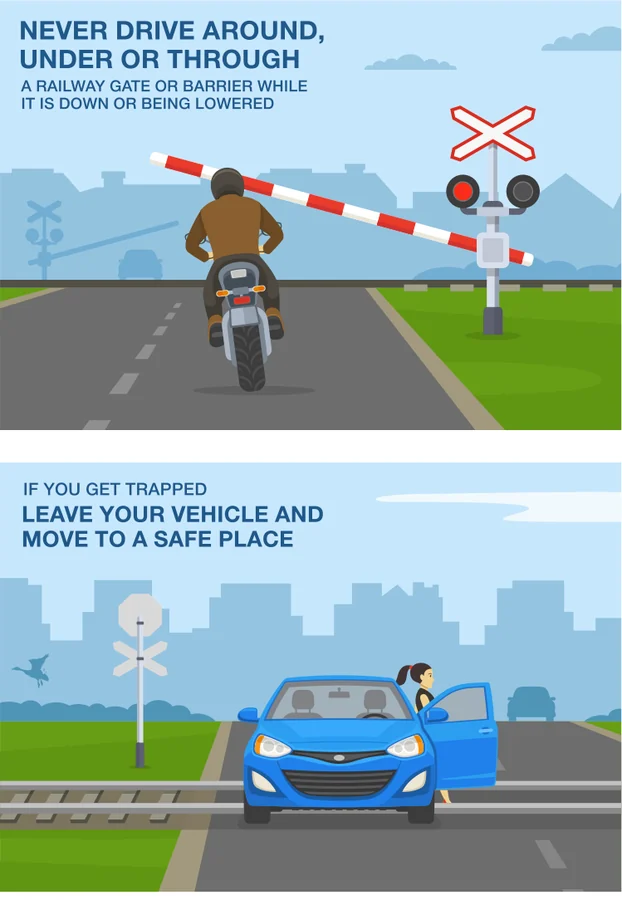
Never drive around the gates; it's against the law to drive through lowered gates. Stop behind the gate and don't cross until the gates are raised and the lights stop flashing.

Handbook p. 57 ↗

Know the rule

If the lights start flashing or the gates start coming down while you're crossing, don't stop: KEEP MOVING. The signals allow enough time to finish crossing, and the far-side gate will not block you in. If you stop and try to back up, your vehicle may stall.

Handbook p. 57 ↗

Know the rule

At a multiple-track crossing, after the last car of the train passes, don't go until you're sure no other train is coming on another track from either direction.

Handbook p. 57 ↗
20 seconds

Minimum time for a train to reach the crossing after the warning lights activate

Handbook p. 57 ↗

Know the rule

If your vehicle stalls on the tracks, get out. Run at a 45-degree angle away from the tracks in the direction the train is coming from, then immediately dial 911.

Handbook p. 57 ↗

ENS (Emergency Notification System)

A blue and white sign on the crossing post or metal control box with a unique number that tells the railroad the exact crossing location.

Handbook p. 57 ↗

Know the rule

Stuck on the tracks with no warning lights yet? Get out, call 911 and the ENS number. Give the location, crossing number (if posted) and road, and say a vehicle is on the tracks.

Handbook p. 57 ↗

Be prepared to stop behind vehicles that must stop at crossings:

  • Trucks carrying hazardous materials
  • School buses
  • Church buses
  • Passenger buses
Handbook p. 57 ↗

Know the rule

Never pass at a highway-rail crossing, not even a bicyclist: bike tires can catch in the tracks and throw the rider into your path.

Handbook p. 57 ↗

Know the rule

Trains look slower than they are because of their size, and speed and distance are very hard to judge at night. If you see or hear a train, STOP and WAIT.

Handbook p. 57 ↗
Railroad crossing gate and vehicle evacuation safety
Never drive around gates; if trapped, leave your vehicle

Put it into practice

Your car stalls on the tracks and the lights begin flashing. Get everyone out of the vehicle now and run away from the tracks at a 45-degree angle toward the direction the train is coming from, then call 911.

Check your understanding

Read the question, decide on an answer, then open it to check the explanation. These are Roadwise study questions based on the source handbook.

Once crossing warning lights activate, what is the minimum time it may take a train to reach the crossing?
  1. About 20 seconds
  2. About 30 seconds
  3. About 60 seconds
  4. About 2 minutes

Answer: About 20 seconds

Twenty seconds is the minimal time a train takes to reach a crossing once lights activate.
Handbook p. 57 ↗
If your car stalls on the tracks and a train is coming, you should try to drive it off the tracks even against traffic.
  1. True
  2. False

Answer: False

Get out immediately and run at a 45-degree angle away from the tracks in the direction the train is coming, then call 911.

Handbook p. 57 ↗
You're already partway across railroad tracks when the warning lights start flashing. What should you do?
  1. Stop immediately on the tracks
  2. Back up off the tracks
  3. Keep moving through the crossing
  4. Speed up only if a train is visible

Answer: Keep moving through the crossing

Warning signals allow time to finish crossing; don't stop once you've started.

Handbook p. 57 ↗
Once a crossing gate has been lowered, you may drive around it if you can see no train coming.
  1. True
  2. False

Answer: False

It's against the law to drive around lowered gates, no matter how clear the tracks look.

Handbook p. 57 ↗
What is the ENS at a railroad crossing?
  1. A type of flashing red light
  2. A speed limit sign for trains
  3. A backup gate mechanism
  4. A blue-and-white sign with a unique crossing number

Answer: A blue-and-white sign with a unique crossing number

The ENS is a blue and white sign identifying the exact crossing location if you need to call for help.

Handbook p. 57 ↗
At a multiple-track crossing, after the last car of a passing train goes by, what should you do?
  1. Check no other train is coming first
  2. Cross immediately since the train has passed
  3. Wait exactly 60 seconds before crossing
  4. Honk before crossing to check for trains

Answer: Check no other train is coming first

Watch out for a second train on another track before crossing a multiple-track crossing.

Handbook p. 57 ↗
Take the lesson checkpoint in the app

More in Sharing the Road