roadwise.Open study app

Oklahoma driving lesson · Parking

Securing your car, angle and parallel parking

A 4-minute lesson from the Oklahoma course. Read the rules and examples, follow the handbook page references, and check your understanding before you move on.

Read time
4 minutes
Course unit
Parking
Checkpoint questions
6
Source pages
46, 47

Not all collisions are driving errors: an improperly parked car can roll, gain speed, destroy property or kill someone. Parking well means securing the vehicle every time, getting fully off the road, and moving slowly and carefully into and out of spaces.

Every time you leave your car, truck or van:

  • Set the parking brake
  • Put the gear in low, reverse or "park"
  • Turn off the motor
  • Lock the ignition and remove the key
Handbook p. 46 ↗

Know the rule

It's always good practice to lock your car, even in your own driveway.

Handbook p. 46 ↗

Know the rule

Where parking on a highway is permitted, signal, slow down and drive completely off the pavement. If you break down, move completely off the highway and turn on your emergency flashers. Watch for fast traffic as you get out, and keep children away from traffic.

Handbook p. 46 ↗

Entering an angle parking space:

  • Watch for vehicles and pedestrians both ahead and behind
  • Signal and begin slowing down
  • Make sure the rear of your car will clear the parked car
  • Steer sharply into the space, then straighten the wheels, centering your car
Handbook p. 46 ↗

Backing out of an angle parking space:

  • Make sure nothing is in your way (in a supermarket lot, check for carts)
  • Look both ways and double-check; be extra careful if a truck or van blocks your view
  • Move back slowly, making sure the lane you're backing into is clear
  • Tap the horn to warn nearby pedestrians
  • When you can see past the tops of the cars beside you, stop and look again
Handbook p. 46 ↗

Know the rule

Unless signs prohibit parking or the curb is painted yellow, you may park parallel to any curb, within 18 inches of the curb.

Handbook p. 47 ↗
18 inches

Maximum distance from the curb when parallel parked

Handbook p. 47 ↗

Parallel parking steps:

  • Choose a space large enough; signal, then pull up even with the car in front, about 2 feet out
  • When your front wheels are opposite its rear bumper, turn the wheel all the way left
  • Back slowly into position alongside the curb, within 18 inches
  • Make sure you won't interfere with oncoming traffic, turn the wheels all the way right, back toward the curb
  • Straighten the front wheels and drive into the final position, centered in the space
Handbook p. 47 ↗
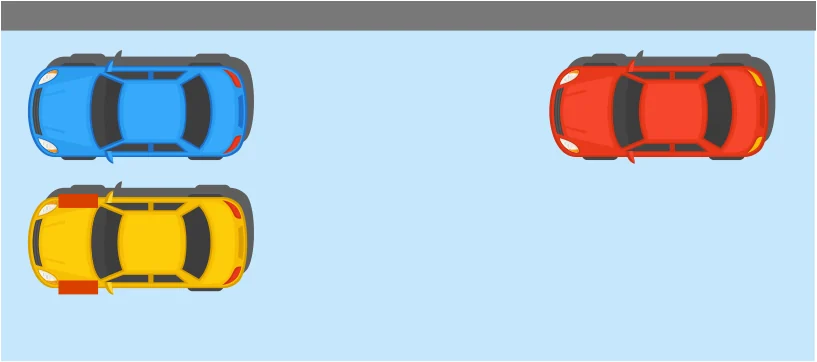
Parallel parking space selection
Parallel parking: pull up even with the car ahead, about 2 feet out

Know the rule

The front of your car swings opposite to the direction of your turn and can hit the car next to you. Back slowly while turning until your left front wheel passes the rear bumper of the car parked on the left, then straighten the wheels as you come back into the lane.

Handbook p. 47 ↗

Know the rule

Too close to the car ahead, or cutting right too soon, puts you too near its rear bumper. Too far out, and you can't get close to the curb. Cutting left too late hits the curb. Each time you pull out or back up, signal, watch for oncoming traffic and move slowly.

Handbook p. 47 ↗

Put it into practice

You're backing out of a supermarket angle space with a van parked beside you. Check for carts and people, tap the horn, and back very slowly. When you can see past the tops of the neighboring cars, stop and look both ways again before continuing.

Check your understanding

Read the question, decide on an answer, then open it to check the explanation. These are Roadwise study questions based on the source handbook.

What should you do before backing out of an angle parking space?
  1. Back out quickly to clear traffic
  2. Only check your rearview mirror
  3. Rely on your backup lights to warn others
  4. Look both ways, then tap your horn

Answer: Look both ways, then tap your horn

Look both ways, double-check for traffic, and tap your horn to warn nearby pedestrians.

Handbook p. 46 ↗
How close to the curb must you park when parallel parking legally?
  1. Within 18 inches
  2. Within 24 inches
  3. Within 30 inches
  4. Within 3 feet

Answer: Within 18 inches

Legal parallel parking must be within 18 inches of the curb.

Handbook p. 47 ↗
You should set the parking brake and turn off the motor every time you leave your car, even in your own driveway.
  1. True
  2. False

Answer: True

When you leave your car, set the parking brake, put it in gear or park, turn off the motor and remove the key; the manual adds it's good practice to lock it even in your own driveway.
Handbook p. 46 ↗
When entering an angle parking space, what should you make sure of before pulling in?
  1. That your front bumper touches the curb
  2. That your hazard lights are on
  3. That your rear will clear the parked car
  4. That your wheels are turned left

Answer: That your rear will clear the parked car

Make sure your rear will clear the parked car before steering into the angle space.

Handbook p. 46 ↗
About how far out from the car ahead should you position your car when preparing to parallel park?
  1. About 2 feet out
  2. About 6 inches out
  3. About 5 feet out
  4. About 4 feet out

Answer: About 2 feet out

Drive up even with the car ahead and about 2 feet out from it before backing in.

Handbook p. 47 ↗
When your front wheels are opposite the rear bumper of the car ahead during parallel parking, what should you do?
  1. Turn your steering wheel all the way to the right
  2. Turn your steering wheel all the way to the left
  3. Keep your wheels straight
  4. Shift into a lower gear

Answer: Turn your steering wheel all the way to the left

At that point, turn your wheel all the way left and back slowly into position.

Handbook p. 47 ↗
Take the lesson checkpoint in the app

More in Parking