roadwise.Open study app

Oklahoma driving lesson · Parking

Parking and starting on a hill

A 3-minute lesson from the Oklahoma course. Read the rules and examples, follow the handbook page references, and check your understanding before you move on.

Read time
3 minutes
Course unit
Parking
Checkpoint questions
6
Source pages
47, 48

A car parked on an incline can roll downhill, forward or backward, if the parking brake isn't set or working or the car isn't braced against the curb. Turning your front wheels the right way means the curb, or the roadside, stops a runaway car.

To park on a hill:

  • Parallel park as usual, but stop within six inches of the curb
  • Brace the wheels against the curb
  • Set the parking brake
  • Put the car in the proper gear: reverse, low gear or "park"
  • Turn off the switch
Handbook p. 47 ↗
6 inches

Distance from the curb when parking on a hill

Handbook p. 47 ↗

Which way to turn your wheels

Which way to turn your wheels
SituationWheelsThen
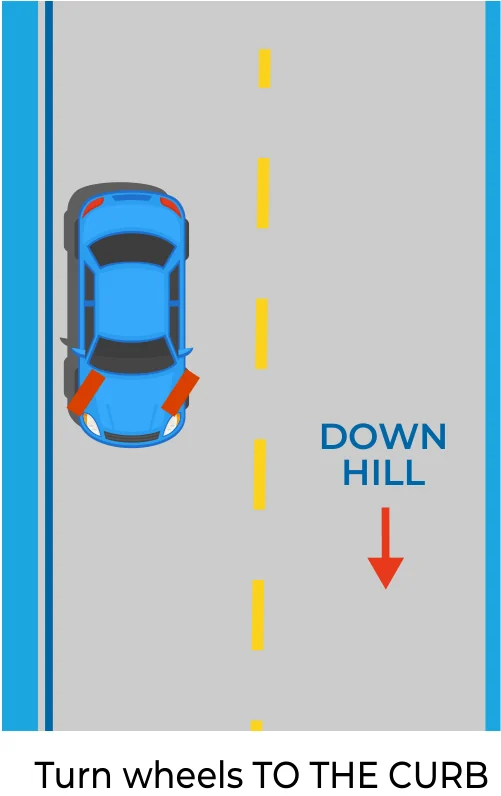
Facing downhillToward the curb; roll forward to itReverse or "park"
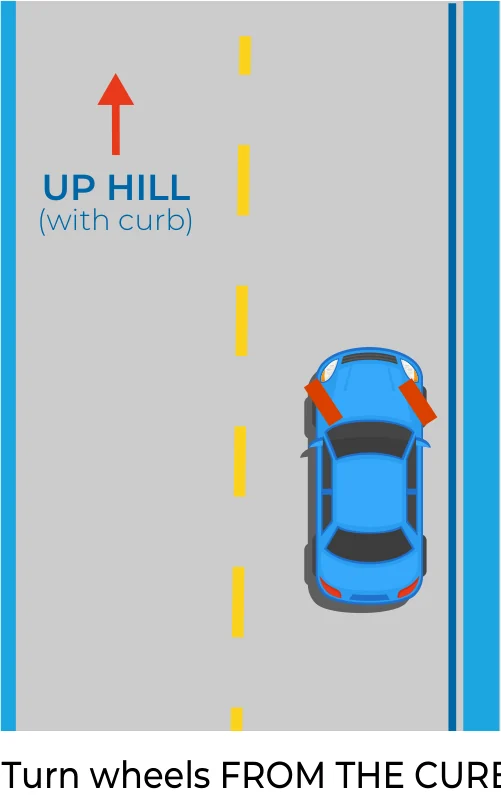
Uphill, with a curbSharply away; back until tire meets curbLow gear or "park"
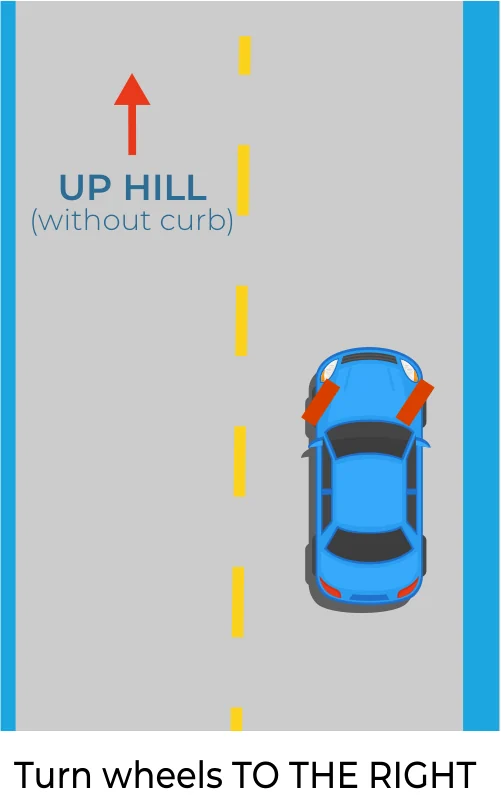
Uphill, no curbSharply to the rightLow gear or "park"
Handbook p. 48 ↗
Parking downhill with a curb
Downhill: turn wheels toward the curb
Parking uphill with a curb
Uphill with curb: turn wheels away from the curb
Parking uphill without a curb
Uphill without curb: turn wheels to the right

Know the rule

Uphill without a curb, turning the wheels right means that if the car rolls, it rolls away from the flow of traffic.

Handbook p. 48 ↗

To start on a hill:

  • Start the motor
  • Shift to the proper gear
  • Signal
  • Look in the rearview mirror and look to the rear
  • Release the parking brake
  • Check again for oncoming traffic; when the lane is clear, drive out
Handbook p. 48 ↗

Know the rule

Drivers already traveling have the right-of-way; it's your job to wait for an opening and move safely into the proper lane.

Handbook p. 48 ↗

Know the rule

With a standard transmission, accelerate and release the clutch at the same time as you release the brake, to keep the car from rolling.

Handbook p. 48 ↗

Put it into practice

You parallel park facing uphill on a street with a curb. Stop within six inches of the curb, turn the wheels sharply away from it, and let the car roll back until the rear of the front tire rests against the curb. Set the parking brake, shift into park, and turn off the engine.

Check your understanding

Read the question, decide on an answer, then open it to check the explanation. These are Roadwise study questions based on the source handbook.

Facing downhill next to a curb, which way should you turn your wheels?
  1. Away from the curb
  2. Toward the curb
  3. Straight ahead
  4. It doesn't matter

Answer: Toward the curb

Facing downhill, turn wheels toward the curb so a rolling car is stopped by it.
Handbook p. 48 ↗
Facing uphill with no curb, which way should you turn your wheels?
  1. Sharply to the left
  2. Straight ahead
  3. Sharply to the right
  4. Toward oncoming traffic

Answer: Sharply to the right

With no curb, turn wheels sharply right so a rolling car moves away from traffic.

Handbook p. 48 ↗
When parking on a hill against a curb, stopping within 18 inches of the curb is close enough.
  1. True
  2. False

Answer: False

To park on a hill, parallel park as usual but stop within six inches of the curb.

Handbook p. 47 ↗
What is the first step listed for starting your car on a hill?
  1. Release the parking brake
  2. Check for oncoming traffic
  3. Start the motor
  4. Shift into the proper gear

Answer: Start the motor

The listed steps begin with starting the motor, then shifting, signaling, checking, and releasing the brake.

Handbook p. 48 ↗
With a standard transmission, how do you keep your car from rolling back when starting uphill?
  1. Release the clutch first
  2. Rev the engine in neutral first
  3. Drive with the parking brake on
  4. Accelerate and release the clutch together

Answer: Accelerate and release the clutch together

Accelerate and release the clutch together so the car doesn't roll back as the brake releases.

Handbook p. 48 ↗
Facing uphill against a curb, you turn your wheels away from the curb. How far do you back up?
  1. Exactly one car length
  2. Until the front tire touches the curb
  3. Don't back up; pull forward to the curb
  4. Until the rear of the tire touches the curb

Answer: Until the rear of the tire touches the curb

Turn the wheels away from the curb and back up slowly until the rear tire touches it.

Handbook p. 48 ↗
Take the lesson checkpoint in the app

More in Parking