roadwise.Open study app

Oklahoma driving lesson · Stopping and Following

Following distance and rear-end collisions

A 3-minute lesson from the Oklahoma course. Read the rules and examples, follow the handbook page references, and check your understanding before you move on.

Read time
3 minutes
Course unit
Stopping and Following
Checkpoint questions
6
Source pages
44, 45

Give yourself a "cushion of safety": open space in front, behind and on the sides. Stay far enough behind the next vehicle that if it stops suddenly, you can stop safely. Speed, traffic, road and weather all affect how much space you need.

Two ways to judge a safe following distance:

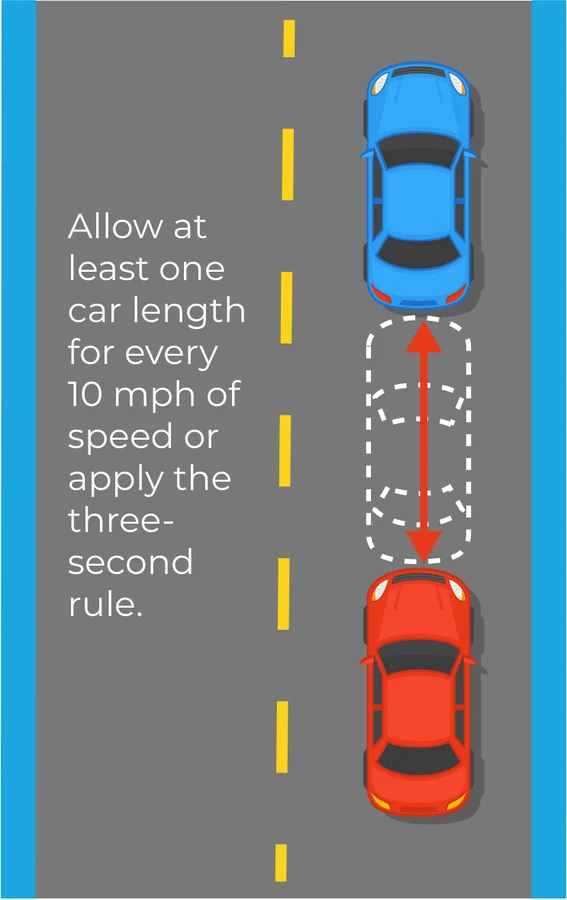
  • Allow one car length for every 10 miles per hour of speed, OR
  • Use the three-second rule; in bad weather or poor road conditions, count four seconds
Handbook p. 44 ↗

Three-second rule

Pick a fixed object ahead. When the car ahead passes it, count "one thousand one, one thousand two, one thousand three"; you shouldn't reach the object before you finish.

Handbook p. 44 ↗
Following distance (one car length per 10 mph)
Allow at least one car length for every 10 mph or use the three-second rule

Know the rule

Cars sometimes bunch up and travel in a pack. It's much safer to avoid the pack and keep your cushion of safety.

Handbook p. 44 ↗
200 feet

Minimum space between vehicles in a caravan or motorcade (such as a funeral procession) outside business or residential areas

Handbook p. 44 ↗

Know the rule

Trucks take longer to stop than cars because of their size, but at higher speeds or on wet pavement they may have better traction and stop more quickly. Follow too closely and you may rear-end one.

Handbook p. 44 ↗

To avoid rear-end collisions:

  • Pay strict attention when following another car
  • Watch brake lights four or five cars ahead; move your foot to the brake when you see them
  • Watch for shrinking distance between you and the car ahead
  • Watch for stopped vehicles on the shoulder; compare a distant car to a fixed object
  • Look for problems developing for the driver ahead
  • Leave plenty of space as a safety cushion
  • If the car ahead signals a left turn, slow down and prepare to stop
Handbook p. 45 ↗

If someone is tailgating you:

  • Flash your brake lights, if braking won't cause a collision
  • Slow down and encourage the driver behind you to pass
  • If that fails, pull over, stop and let the tailgater pass; keep your doors locked
  • Stop where there are other people, such as a convenience store; at night, a well-lighted area
Handbook p. 45 ↗

Put it into practice

At 50 mph, the car ahead passes a road sign and you reach it at "one thousand two." You're too close. Ease off the gas until you count to three, or four seconds if it's raining.

Check your understanding

Read the question, decide on an answer, then open it to check the explanation. These are Roadwise study questions based on the source handbook.

How many seconds should you count behind the vehicle ahead under normal conditions?
  1. 1 second
  2. 3 seconds
  3. 5 seconds
  4. 10 seconds

Answer: 3 seconds

Use the three-second rule under normal conditions, increasing to four in bad weather.
Handbook p. 44 ↗
How much space should you leave between vehicles in a funeral procession outside business/residential areas?
  1. 50 feet
  2. 500 feet
  3. 200 feet
  4. 20 feet

Answer: 200 feet

Leave at least 200 feet between vehicles in a motorcade so other cars can enter the line safely.

Handbook p. 44 ↗
Watching brake lights several cars ahead, not just the car directly in front, gives you more time to react.
  1. True
  2. False

Answer: True

Watching farther ahead increases your response time to slowing traffic.

Handbook p. 45 ↗
What's an alternative to the three-second rule for keeping a safe following distance?
  1. One car length for every 30 mph of speed
  2. A fixed 50 feet at all times
  3. One car length for every 10 mph of speed
  4. Two car lengths regardless of speed

Answer: One car length for every 10 mph of speed

The manual offers one car length per 10 mph as an alternative to the three-second count.

Handbook p. 44 ↗
The car ahead of you signals for a left turn. What should you do?
  1. Speed up to pass before they turn
  2. Honk to warn them not to turn
  3. Slow down and prepare to stop
  4. Change lanes immediately without checking

Answer: Slow down and prepare to stop

If the car ahead signals a left turn, slow down and prepare to stop behind it.

Handbook p. 45 ↗
A tailgater is following you closely. Besides flashing your brake lights, what else can you do?
  1. Speed up to open distance between you
  2. Turn on your hazard lights
  3. Flash your high beams repeatedly at them
  4. Pull over and let them pass

Answer: Pull over and let them pass

Pull over somewhere safe, like a convenience store, and let the tailgater pass.

Handbook p. 45 ↗
Take the lesson checkpoint in the app

More in Stopping and Following