roadwise.Open study app

Ohio driving lesson · Sharing the Road

Pedestrians

A 2-minute lesson from the Ohio course. Read the rules and examples, follow the handbook page references, and check your understanding before you move on.

Read time
2 minutes
Course unit
Sharing the Road
Checkpoint questions
6
Source pages
17, 37

Everybody has a right to the road. Pedestrians are hard to see, hard to predict, and have no protection in a crash — so the burden is on you, the driver, to yield and to expect the unexpected.

Know the rule

Pedestrians don't always obey signals or use marked crosswalks, so as a driver you must yield to pedestrians.

Handbook p. 37 ↗

Know the rule

Pedestrians who are visually impaired or blind — carrying a white cane or using a guide dog — have the right-of-way.

Handbook p. 37 ↗

Use caution:

  • Yield to pedestrians when turning
  • Watch for pedestrians near parked or stopped vehicles
  • Look for pedestrians and other objects before backing up
  • Be cautious near playgrounds and in residential areas; be ready to stop quickly
Handbook p. 37 ↗

Know the rule

School zones: when lights are flashing or children are present, you must obey a slower speed limit. Obey crossing guards at intersections near a school.

Handbook p. 37 ↗
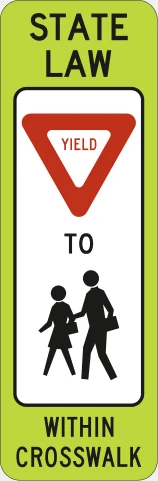
State law yield to pedestrians in crosswalk
STATE LAW: yield to pedestrians within crosswalk
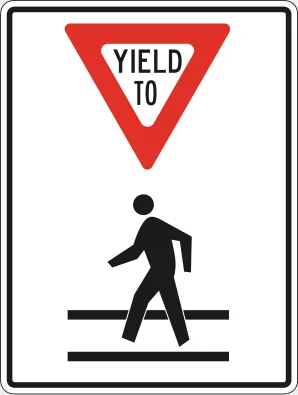
Yield to pedestrians
Yield to pedestrians sign

Know the rule

You must yield the right-of-way to pedestrians entering or in a crosswalk.

Handbook p. 17 ↗

Put it into practice

You're turning right on a green light and a man with a white cane steps off the curb into your path. Stop and let him cross — blind pedestrians have the right-of-way, and you must yield to pedestrians when turning.

Check your understanding

Read the question, decide on an answer, then open it to check the explanation. These are Roadwise study questions based on the source handbook.

What is true of pedestrians who are visually impaired, carrying a white cane or using a guide dog?
  1. They have the right-of-way
  2. They must wait for a crossing guard
  3. They must cross only at marked crosswalks
  4. They have no special right-of-way

Answer: They have the right-of-way

Pedestrians who are visually impaired or blind, using a white cane or guide dog, have the right-of-way.
Handbook p. 37 ↗
When must you yield to pedestrians while turning?
  1. Only if they are in a marked crosswalk
  2. Always, even on a green light
  3. Only if a crossing guard is present
  4. Only in school zones

Answer: Always, even on a green light

Drivers must yield to pedestrians when turning, regardless of the signal or right-of-way.

Handbook p. 37 ↗
What should you do near a school zone when lights are flashing or children are present?
  1. Maintain the regular posted limit
  2. Speed up to clear the area quickly
  3. Obey the slower posted speed limit
  4. Only slow down if a crossing guard signals

Answer: Obey the slower posted speed limit

You must obey a slower speed limit in school zones when lights are flashing or children are present.

Handbook p. 37 ↗
Why can pedestrians be especially difficult to predict as a driver?
  1. They always move at a constant, predictable speed
  2. They are required to signal their intentions
  3. They must always yield to vehicles
  4. They may ignore signals and crosswalks

Answer: They may ignore signals and crosswalks

Pedestrians don't always obey traffic signals or walk in marked crosswalks, so drivers must remain cautious.

Handbook p. 37 ↗
A pedestrian with a guide dog begins crossing outside a marked crosswalk. Do you still have to yield?
  1. Yes, blind pedestrians have right-of-way
  2. No, only marked crosswalks require yielding
  3. Only if a crossing guard directs you to
  4. No, guide dogs don't confer right-of-way

Answer: Yes, blind pedestrians have right-of-way

Pedestrians who are visually impaired or blind, carrying a white cane or using a guide dog, have the right-of-way.

Handbook p. 37 ↗
What must you do at intersections near a school when a crossing guard is present?
  1. Obey the crossing guard
  2. Follow only the traffic signal
  3. Proceed if no children are visible
  4. Stop only if children are in the crosswalk

Answer: Obey the crossing guard

Drivers must obey crossing guards at intersections near a school.

Handbook p. 37 ↗
Take the lesson checkpoint in the app

More in Sharing the Road