roadwise.Open study app

Ohio driving lesson · Sharing the Road

Trucks, buses & the No-Zone

A 3-minute lesson from the Ohio course. Read the rules and examples, follow the handbook page references, and check your understanding before you move on.

Read time
3 minutes
Course unit
Sharing the Road
Checkpoint questions
6
Source pages
39, 40

Big trucks and buses can't stop, turn or see like cars. Most car-truck crashes could be avoided if drivers remembered those limits and stayed out of the truck driver's blind spots — the No-Zone.

Remember a large vehicle's limits:

  • Larger and less maneuverable than passenger vehicles
  • Much larger blind spots
  • Longer stopping and accelerating distances
  • Need more room to turn
Handbook p. 39 ↗

Know the rule

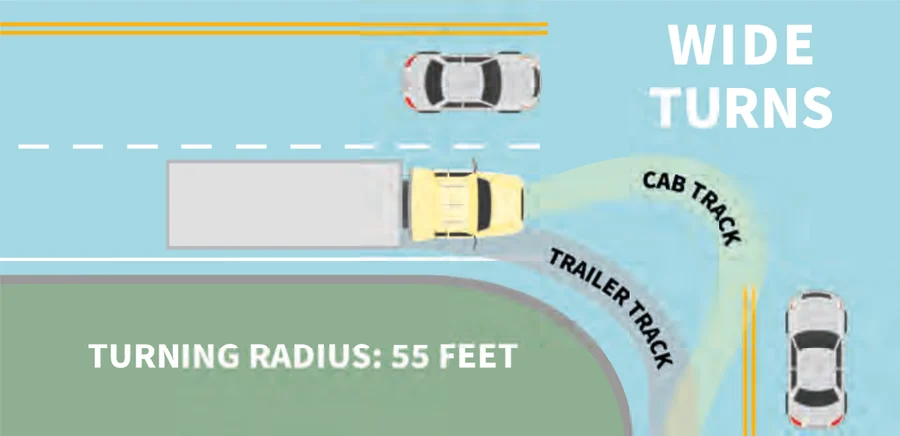
Trucks and buses may make a wide right turn from the left lane. Never squeeze between the large vehicle and the curb — let it finish turning.

Handbook p. 39 ↗
Truck wide turn radius
Wide turns: a truck's turning radius can be 55 feet

Know the rule

Always stop behind intersection stop lines; they leave room for large vehicles to turn.

Handbook p. 39 ↗

Know the rule

If you're unsure of an oncoming truck's or bus's speed, don't turn left in front of it. Don't cut off a large vehicle to reach an exit or turn, or to beat it into a single-lane construction zone.

Handbook p. 39 ↗

No-Zone

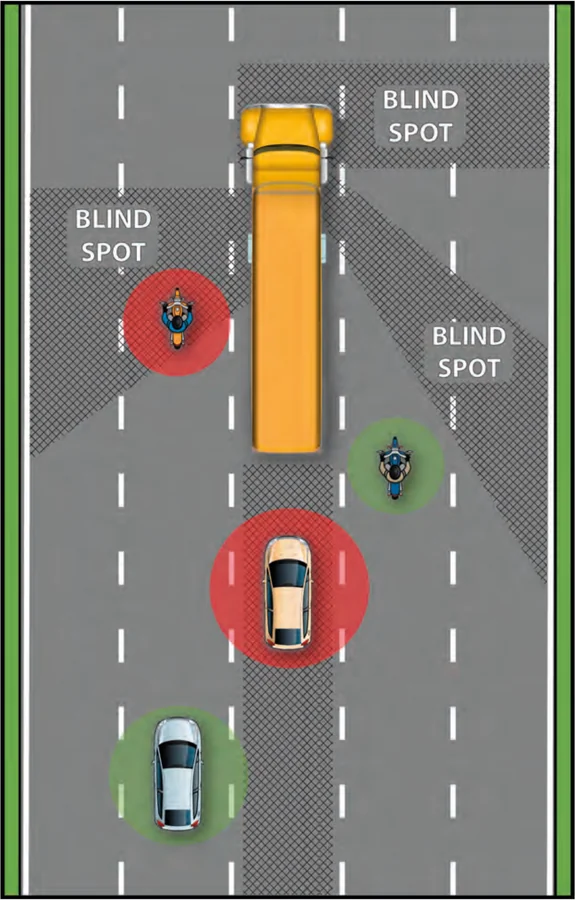
The areas around large trucks and buses — sides, front and rear — where vehicles disappear from the driver's view. The larger the truck, the larger the blind spot.

Handbook p. 40 ↗

Know the rule

Side No-Zones: if you can't see the driver's face in the side-view mirror, the driver can't see you. Don't drive alongside longer than necessary.

Handbook p. 40 ↗
335 feet

Minimum stopping distance for a loaded truck at 55 mph in ideal conditions — over 1½ times a car's

Handbook p. 40 ↗

Know the rule

When passing, wait until you see the truck's whole front in your rear-view mirror before pulling in front, and keep your speed.

Handbook p. 40 ↗
200 feet

How far a large vehicle's rear blind spot can extend

Handbook p. 40 ↗

Know the rule

Don't follow too closely: the driver can't see you and you can't see ahead. Position yourself where the driver can see you in the side mirrors.

Handbook p. 40 ↗

Know the rule

Avoid the right lane on steep hills behind large vehicles and near truck weigh stations, where trucks may be re-entering faster traffic.

Handbook p. 40 ↗
Truck blind spots (No-Zone)
The No-Zone: blind spots on the sides, front and rear of a truck

Put it into practice

You're about to pass a tractor-trailer and want to take the next exit. Complete the pass, wait until the truck's whole front shows in your rear-view mirror, then move over — and don't slow down in front of it.

Check your understanding

Read the question, decide on an answer, then open it to check the explanation. These are Roadwise study questions based on the source handbook.

How can you tell if a truck driver cannot see you in their side mirror?
  1. If the truck's turn signal is on
  2. If you're driving in the same lane
  3. If you can't see the driver's face in the mirror
  4. If you're within 500 feet of the truck

Answer: If you can't see the driver's face in the mirror

If you cannot see the driver's face in the side-view mirror, the driver cannot see you.
Handbook p. 40 ↗
About how much farther does a loaded truck need to stop from 55 mph compared to a passenger vehicle?
  1. About the same distance
  2. Half the distance
  3. Exactly double, no more
  4. More than 1.5 times the stopping distance

Answer: More than 1.5 times the stopping distance

A loaded truck at 55 mph needs a minimum of 335 feet to stop — more than 1.5 times a passenger vehicle's stopping distance.

Handbook p. 40 ↗
About how far can a large truck's rear No-Zone blind spot extend?
  1. Up to 200 feet
  2. Up to 50 feet
  3. Up to 500 feet
  4. Up to 100 feet

Answer: Up to 200 feet

Large vehicles have blind spots directly behind them that can extend up to 200 feet.

Handbook p. 40 ↗
What should you do if a large truck or bus is making a wide right turn?
  1. Squeeze between it and the curb to save time
  2. Let it finish turning before you move
  3. Pass it on the right immediately
  4. Honk to hurry it along

Answer: Let it finish turning before you move

Let the large vehicle finish its turn before driving up into the lane — never squeeze between it and the curb.

Handbook p. 39 ↗
You're driving up a steep hill behind a large truck near a weigh station. What lane position is safest?
  1. Stay directly behind the truck in the right lane
  2. Move as close as possible to pass on the right
  3. Avoid the right lane in that situation
  4. Lane position doesn't matter near weigh stations

Answer: Avoid the right lane in that situation

Avoid the right lanes near truck weigh stations or on steep hills behind large vehicles, where trucks may re-enter traffic.

Handbook p. 40 ↗
What should you look for in your rearview mirror before pulling back in front of a passed truck?
  1. Just the truck's headlights
  2. The truck's turn signal
  3. The truck's whole front
  4. The driver waving you in

Answer: The truck's whole front

When passing a large vehicle, look for the whole front of the vehicle in your rearview mirror before pulling in front of it.

Handbook p. 40 ↗
Take the lesson checkpoint in the app

More in Sharing the Road