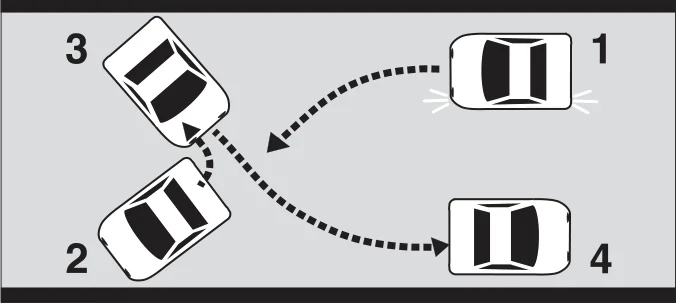
A 3-minute lesson from the New York course. Read the rules and examples, follow the handbook page references, and check your understanding before you move on.
Turning around is risky because you cross every lane of traffic. New York limits where you can make a U-turn, and you may be asked to do a three-point turn on your road test, so know both the rules and the steps.
U-turn
Any turn you make so you can proceed in the opposite direction.
Don't try a U-turn on a highway unless absolutely necessary. If you must turn around, use a parking lot, driveway or other area and, if possible, enter the road moving forward, not backing up.
Make a U-turn only from the left portion of the lane nearest the center line, never from the right lane. Unless signs say otherwise, you can U-turn on a green left-turn arrow if allowed, yielding to other traffic.
You missed your turn on a quiet two-way side street. With no sign prohibiting it and no hill or curve blocking views, you can use a three-point turn. On a limited access expressway you could never U-turn, even through a gap in the median.
Check your understanding
Read the question, decide on an answer, then open it to check the explanation. These are Roadwise study questions based on the source handbook.
From which part of the road can you legally start a U-turn?
Any lane on a multi-lane road
Only the right lane
The shoulder of the road
Only the left portion of the lane nearest the centerline
Answer: Only the left portion of the lane nearest the centerline
You can make a U-turn only from the left portion of the lane nearest to the centerline, never from the right lane.