roadwise.Open study app

New York driving lesson · Intersections and Turns

Signaling & preparing to turn

A 3-minute lesson from the New York course. Read the rules and examples, follow the handbook page references, and check your understanding before you move on.

Read time
3 minutes
Course unit
Intersections and Turns
Checkpoint questions
6
Source pages
36

Other road users can't read your mind. Signal before every turn or lane change, slow down, and look for the people who are easy to miss: motorcyclists, pedestrians, bicyclists and moped riders. Your lane position for a turn is set by law, not just good advice.

100 feet

Minimum distance before a turn or lane change to signal, with turn lights or hand signals

Handbook p. 36 ↗

Know the rule

A good safety tip: when possible, signal your intention to turn before you begin to brake or make the turn.

Handbook p. 36 ↗
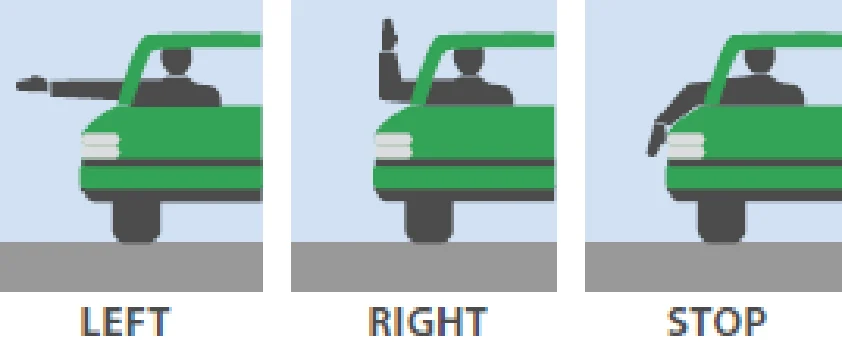
Hand signals (left, right, stop)
Hand signals: left turn, right turn, stop

Hand signals (as shown in the handbook):

  • Left turn: arm straight out
  • Right turn: arm bent upward
  • Stop or slow: arm bent downward
Handbook p. 36 ↗

As you prepare to turn:

  • Reduce your speed
  • Watch all sides, especially for motorcycles: most motorcycle crashes involve drivers who didn't see them
  • Keep your wheels straight until you actually begin the turn
  • Remember your rear wheels track inside the front wheels, nearer the curb or oncoming traffic
  • Watch for pedestrians, bicyclists and moped riders, especially on right turns
  • Look for wheelchair users, strollers and people pulling wheeled suitcases: low and easy to miss
Handbook p. 36 ↗

Know the rule

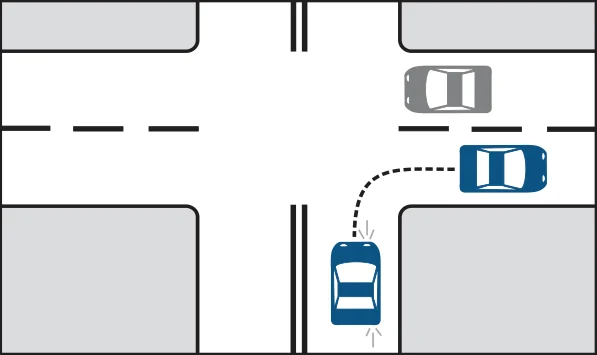
If your wheels are turned while you wait and you are hit from behind, your vehicle could be pushed into the oncoming lane.

Handbook p. 36 ↗
Left turn from a one-way road
Right turn: stay close to the right and turn into the right lane

Know the rule

Right turn: get as far to the right as possible, don't make wide, sweeping turns, and turn into the right lane of the road you enter unless signs tell you otherwise.

Handbook p. 36 ↗

Put it into practice

You're waiting to turn left across traffic. Keep your wheels pointed straight until the gap comes. If someone rear-ends you while your wheels are already turned, you'll be pushed into oncoming cars.

Check your understanding

Read the question, decide on an answer, then open it to check the explanation. These are Roadwise study questions based on the source handbook.

How far before a turn or lane change must you signal?
  1. At least 50 feet
  2. At least 500 feet
  3. At least 100 feet
  4. At least 25 feet

Answer: At least 100 feet

The law requires you to signal a turn or lane change at least 100 feet ahead.
Handbook p. 36 ↗
When preparing for a right turn, where should your vehicle be positioned?
  1. In the center of your lane
  2. As close to the centerline as possible
  3. Straddling the right lane and the shoulder
  4. As far to the right as possible

Answer: As far to the right as possible

As you prepare to turn right, get as far to the right as possible and avoid wide, sweeping turns.

Handbook p. 36 ↗
Why should you keep your wheels straight while waiting to turn left, before starting the turn?
  1. It keeps your turn signal from canceling
  2. A rear hit could push you into traffic
  3. It lets you start the turn faster
  4. It keeps you out of the crosswalk

Answer: A rear hit could push you into traffic

If your wheels are turned and you're hit from behind, your vehicle could be pushed into the oncoming lane.

Handbook p. 36 ↗
Why are drivers especially likely to miss seeing an approaching motorcycle before turning left?
  1. Motorcycles always ride near the curb
  2. Motorcycles never use headlights by day
  3. They're small; speed is hard to judge
  4. Motorcycles mostly travel at night

Answer: They're small; speed is hard to judge

Most crashes involving motorcycles happen because drivers fail to see them; their smaller size makes distance and speed hard to judge.

Handbook p. 36 ↗
Which highway users should you take special caution to check for before every turn?
  1. Motorcycles, pedestrians, and moped riders
  2. Only vehicles the same size as yours
  3. Only pedestrians, not cyclists
  4. Only oncoming traffic, never crossing traffic

Answer: Motorcycles, pedestrians, and moped riders

Be alert for traffic on all sides, with special caution for motorcycles, pedestrians, bicyclists, and moped riders.

Handbook p. 36 ↗
New York law requires you to signal a turn or lane change at least 100 feet ahead of time.
  1. True
  2. False

Answer: True

The law requires signaling a turn or lane change at least 100 feet before you make it.

Handbook p. 36 ↗
Take the lesson checkpoint in the app

More in Intersections and Turns