A 3-minute lesson from the New York course. Read the rules and examples, follow the handbook page references, and check your understanding before you move on.
Markings painted across and inside lanes tell you where to stop, which lane to use for a turn, and which lanes are reserved for buses, car-pools or bikes. Stopping in the wrong spot or using the wrong lane is a common road-test and written-test mistake.
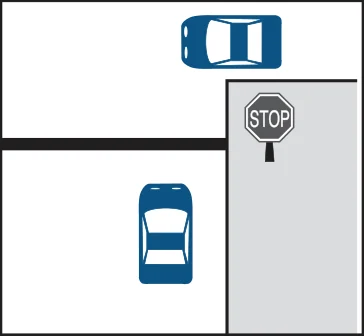
A stop line at an intersection with a STOP sign
Stop line
A white line painted across the lane at an intersection controlled by a STOP sign, YIELD sign or traffic light.
You need to stop at a stop line or crosswalk only if a light, sign or traffic officer requires it, or to yield to a pedestrian, in-line skater or scooter at a marked or unmarked crosswalk.
A single stop line may be set back from the intersection to give larger vehicles (tractor-trailers, buses, trucks) room to turn. Stop before you reach it.
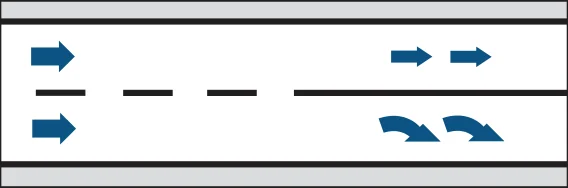
Lane arrows: the right lane turns right; go straight from the left lane
Know the rule
Arrows show which lanes you must use. In the example, you may turn right only from the right lane, and to go straight you must use the left lane. Get into the correct lane before you reach the solid line that separates the lanes.
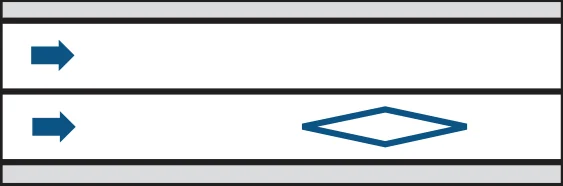
A diamond symbol marks a lane reserved for buses, HOVs (car-pools, van-pools), bicycles or other special vehicles. Don't use it unless your vehicle meets the occupancy or other requirements posted for the times they apply.
On city streets, parts of the solid white line beside a diamond lane may be replaced by broken white lines. There, a non-HOV may enter the lane to make a right turn at the next intersection.
You're in the right lane, which has a right-turn arrow, but you want to go straight. Move into the left lane before the solid lane line begins. Don't try to go straight from the right lane or change lanes inside the intersection.
Check your understanding
Read the question, decide on an answer, then open it to check the explanation. These are Roadwise study questions based on the source handbook.
What does a diamond symbol painted in a lane indicate?
A lane reserved for left turns only
A lane for buses, HOVs, or bikes
A merge point for two highways
A pedestrian crossing zone
Answer: A lane for buses, HOVs, or bikes
A diamond symbol marks a lane reserved for buses, HOV vehicles, bicycles or other special vehicles under posted conditions.