roadwise.Open study app

New York driving lesson · Traffic Control

Edge lines & lane lines

A 3-minute lesson from the New York course. Read the rules and examples, follow the handbook page references, and check your understanding before you move on.

Read time
3 minutes
Course unit
Traffic Control
Checkpoint questions
6
Source pages
31, 32

Lines on the road divide lanes and tell you where you may pass or change lanes. The color tells you which way traffic moves; whether a line is solid or broken tells you if you may cross it. The arrows in these diagrams show the direction of traffic.

Know the rule

Solid lines along the side of the road mark its edge, where the travel lane ends and the shoulder begins. It is illegal to cross the edge line except when a police officer or other authorized official tells you to, or an official sign allows it.

Handbook p. 31 ↗
Lane lines and direction of travel
An edge line angling toward the center: the road narrows ahead

Know the rule

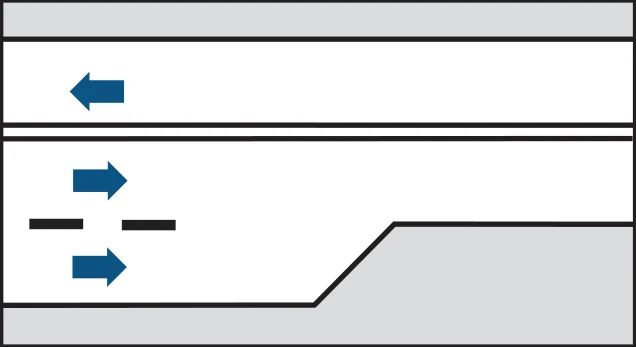
An edge line that angles toward the center of the road shows that the road is narrower ahead.

Handbook p. 31 ↗

Know the rule

White lines separate lanes of traffic moving in the same direction. Yellow lines separate traffic moving in opposite directions. There may be two lines between lanes, and lines can be solid or broken.

Handbook p. 32 ↗
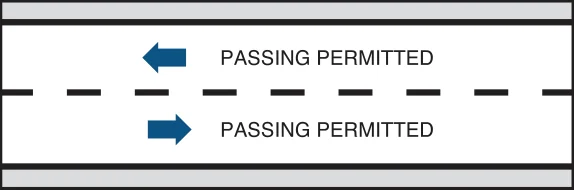
Broken line: passing permitted
One broken line: passing permitted

Know the rule

One broken line: you can pass or change lanes if you can do so safely without interfering with traffic.

Handbook p. 32 ↗
Solid and broken lines: passing permitted one direction
Solid line with broken line

Know the rule

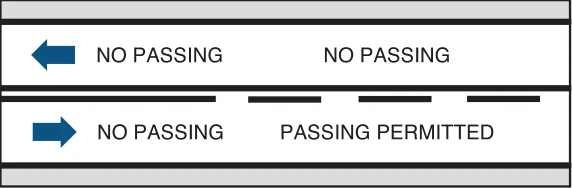
Solid line with a broken line: on the solid-line side you may not pass or cross except to turn left into a driveway. On the broken-line side you may pass if it's safe and you won't interfere with traffic.

Handbook p. 32 ↗
Solid line: must stay in lane
Double solid lines: stay in your lane

Know the rule

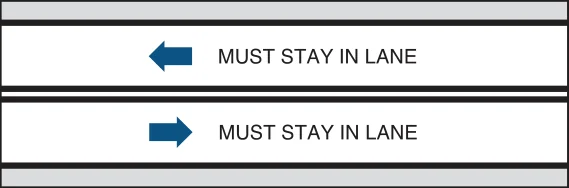
Double solid lines: you cannot pass or change lanes. You may cross only to turn left to enter or leave the highway, such as to or from a driveway or to make a U-turn.

Handbook p. 32 ↗
Lane line (direction of travel)
One solid line

Know the rule

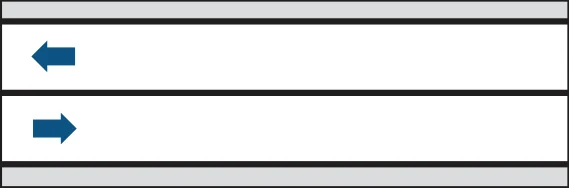
One solid line: you can pass or change lanes only when obstructions in the road or traffic conditions make it necessary.

Handbook p. 32 ↗

Put it into practice

You're on a two-lane road behind a slow truck. On your side of the center there's a solid yellow line with a broken line on the far side. You may not pass here. You may cross it only to turn left into a driveway.

Check your understanding

Read the question, decide on an answer, then open it to check the explanation. These are Roadwise study questions based on the source handbook.

What do double solid yellow lines mean?
  1. You may pass only during daylight
  2. No passing; cross only to turn left
  3. You must always stop before crossing them
  4. They mark a reversible lane

Answer: No passing; cross only to turn left

Double solid lines mean you cannot pass or change lanes, and cannot cross except to turn left or make a legal U-turn.
Handbook p. 32 ↗
What does a single broken line between lanes moving the same direction mean?
  1. You may never change lanes there
  2. Only trucks may use that lane
  3. Pass or change lanes when safe
  4. It marks a bicycle lane

Answer: Pass or change lanes when safe

One broken line lets you pass other vehicles or change lanes if you can do so safely.

Handbook p. 32 ↗
You are on the solid-line side of a solid-and-broken line pair. Can you pass?
  1. Yes, whenever it's safe
  2. Yes, if no oncoming traffic is near
  3. No, never under any circumstance
  4. No; cross it only to turn left

Answer: No; cross it only to turn left

On the solid-line side you cannot pass or cross the line except to make a left turn into a driveway.

Handbook p. 32 ↗
What color are lines that separate lanes of traffic moving in opposite directions?
  1. Yellow
  2. White
  3. Red
  4. Blue

Answer: Yellow

Lines separating opposite-direction traffic are yellow; same-direction lane lines are white.

Handbook p. 32 ↗
An edge line along the roadside gradually angles in toward the center of the road. What does this indicate?
  1. The speed limit is increasing ahead
  2. A passing zone is starting
  3. The road is becoming narrower ahead
  4. The shoulder is widening ahead

Answer: The road is becoming narrower ahead

An edge line that angles toward the center of the road shows that the road is narrower ahead.

Handbook p. 31 ↗
Compare a single solid line to double solid lines for passing. What's the key difference?
  1. Single: never pass; double: pass if needed
  2. Both allow passing when it's safe
  3. Single: pass only if needed; double: never
  4. Both forbid passing in all cases

Answer: Single: pass only if needed; double: never

A single solid line permits passing only when necessary due to obstructions or conditions; double solid lines never allow passing or lane changes.

Handbook p. 32 ↗
Take the lesson checkpoint in the app

More in Traffic Control