roadwise.Open study app

New Jersey driving lesson · Signs, Signals, and Road Markings

Traffic signals

A 3-minute lesson from the New Jersey course. Read the rules and examples, follow the handbook page references, and check your understanding before you move on.

Read time
3 minutes
Course unit
Signs, Signals, and Road Markings
Checkpoint questions
6
Source pages
213, 214, 215

Signals control the flow of traffic at intersections for drivers, cyclists and pedestrians. Each color and arrow has an exact meaning, and a police officer directing traffic outranks them all.

Know the rule

During heavy traffic or emergencies a police officer may direct traffic and can overrule signals; always obey the officer. Stealing or damaging traffic, airport or railroad-crossing signs brings court penalties.

Handbook p. 213 ↗

Know the rule

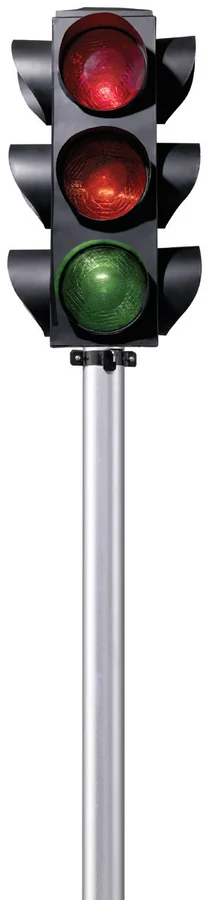
Vertical signals: red is always on top, yellow in the center, green third, and a green arrow, if any, on the bottom. Horizontal signals: red is always on the left.

Handbook p. 214 ↗
Traffic signal head
Vertical signal: red on top, yellow, then green

What each signal means

What each signal means
SignalWhat to do
Steady redStop before the intersection or crosswalk; wait for green
Steady yellowStop before entering, unless too close to stop safely
Yellow arrowGreen-to-red change coming; chance to stop safely
Steady greenGo; yield to pedestrians and vehicles in the intersection
Green arrowGo only as the arrow shows; yield to pedestrians
Flashing yellowSlow down and proceed with care
Flashing redStop, yield to traffic and pedestrians, go when safe
Handbook p. 214 ↗

Know the rule

On a steady green, yield to pedestrians and to vehicles still in the intersection when turning, and yield to approaching vehicles before turning left.

Handbook p. 214 ↗

Know the rule

Flashing red lights at a railroad crossing mean a train is approaching. Yield to it and go only when the lights stop flashing and all other active warning devices shut off.

Handbook p. 214 ↗

Know the rule

If a signal has no working bulbs and no one is directing traffic, treat it as a four-way stop: look left and right, yield to traffic from either side, and go when safe.

Handbook p. 215 ↗

Know the rule

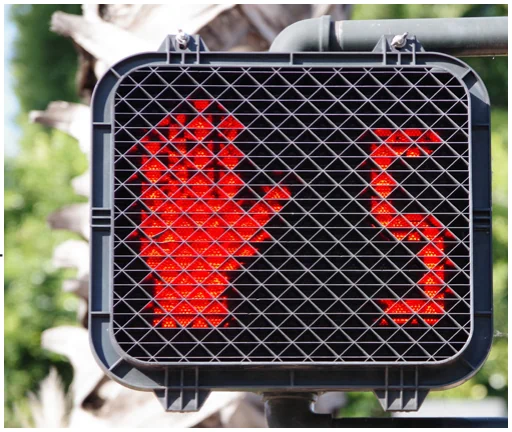
Raised palm (don't walk): pedestrians must not leave the curb or enter the roadway; those already crossing should go quickly to a safe spot. Pedestrians already in the crosswalk will have time to finish.

Handbook p. 215 ↗
Pedestrian don't walk signal
Raised palm with countdown: don't start crossing

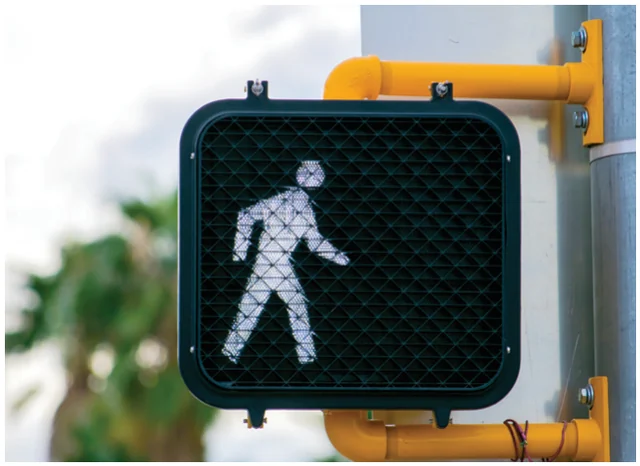
Know the rule

Walking person or countdown: pedestrians facing it may cross. New Jersey law requires turning drivers to yield to pedestrians crossing on this signal and to pedestrians in the crosswalk.

Handbook p. 215 ↗
Pedestrian walk signal
Walking person: pedestrians may cross

Know the rule

Pushing a pedestrian button at some signals changes the flow, giving the side street a longer green shortly afterward.

Handbook p. 215 ↗

Put it into practice

Your light turns green, but a pedestrian is still in the crosswalk finishing her walk and a car that entered on yellow is clearing the intersection. Wait for both; green means go only after yielding to those already in the intersection.

Check your understanding

Read the question, decide on an answer, then open it to check the explanation. These are Roadwise study questions based on the source handbook.

When traffic signals are hung vertically, which light is always on top?
  1. Yellow
  2. Green
  3. A green arrow
  4. Red

Answer: Red

When traffic signals are hung vertically, red is always on top, yellow in the center, and green third in line.

Handbook p. 214 ↗
A traffic signal shows a steady yellow light. What should a motorist do?
  1. Speed up to clear the intersection
  2. Stop, unless too close to stop safely
  3. Treat it the same as a green light
  4. Come to a complete stop regardless of position

Answer: Stop, unless too close to stop safely

A motorist should stop before entering the intersection on yellow, unless already too close to stop safely.

Handbook p. 214 ↗
What does a flashing red light at an intersection mean?
  1. Proceed with caution without stopping
  2. Slow down only, no need to stop
  3. Stop, then yield and go when safe
  4. Treat it like a yield sign

Answer: Stop, then yield and go when safe

A flashing red light means stop, yield to traffic and pedestrians, and go only when safe.

Handbook p. 214 ↗
Red lights are flashing at a railroad crossing. When may you go?
  1. After stopping, if no train is visible
  2. Once the gates begin to rise
  3. When the lights stop and all devices deactivate
  4. After waiting at least 30 seconds

Answer: When the lights stop and all devices deactivate

Flashing red lights at a railroad crossing mean a train is approaching; go only when the red lights stop flashing and all other active warning devices deactivate.
Handbook p. 215 ↗
The white walking-person or countdown signal is lit for pedestrians. What must a turning motorist do?
  1. Yield to pedestrians crossing and in the crosswalk
  2. Go first; turning cars have priority
  3. Yield only once the countdown reaches zero
  4. Yield only if a pedestrian is in your lane

Answer: Yield to pedestrians crossing and in the crosswalk

New Jersey law requires turning motorists to yield to pedestrians crossing on a countdown signal and to those already in the crosswalk.

Handbook p. 215 ↗
A green arrow signal, when shown alone or with a red light, means a motorist may proceed only as shown by the arrow.
  1. True
  2. False

Answer: True

A green arrow permits movement only in the direction of the arrow, while remaining cautious of pedestrians.

Handbook p. 214 ↗
Take the lesson checkpoint in the app

More in Signs, Signals, and Road Markings