roadwise.Open study app

New Jersey driving lesson · Signs, Signals, and Road Markings

Roundabouts, rumble strips, and slow-moving vehicles

A 3-minute lesson from the New Jersey course. Read the rules and examples, follow the handbook page references, and check your understanding before you move on.

Read time
3 minutes
Course unit
Signs, Signals, and Road Markings
Checkpoint questions
6
Source pages
70, 219, 220

Some road features are designed to slow you down or to make intersections safer. Know what a roundabout, rumble strip, speed bump or slow-moving vehicle sign is telling you.

Know the rule

A fluorescent, reflective orange triangle marks slow-moving vehicles, such as farm and construction equipment, on public roads. Their operators must obey all traffic rules and display the sign on the back.

Handbook p. 219 ↗

Rumble strips

Small indentations or raised strips across or along the road or shoulder that warn of a decision point ahead, such as a four-way intersection after miles of open road.

Handbook p. 220 ↗

Know the rule

Rumble strips vibrate the steering wheel and make noise to wake a dozing driver or warn of danger. They won't damage your vehicle, are meant to slow you down, and are almost always used with a cautionary sign.

Handbook p. 220 ↗

Speed bump

A low ridge across a street designed to slow cars down.

Handbook p. 220 ↗

Speed hump

A longer, flatter version of a speed bump, which is more raised.

Handbook p. 220 ↗

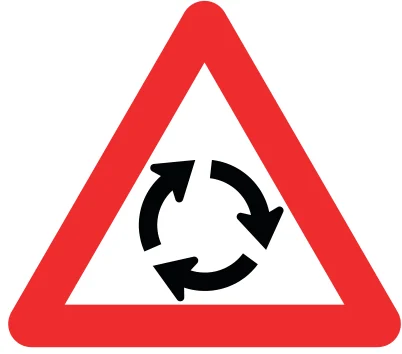
Roundabout

A one-way, circular intersection where traffic flows around a center island, designed for drivers, pedestrians (including those with disabilities) and bicyclists.

Handbook p. 220 ↗

Know the rule

Roundabouts eliminate conflicting movements such as left turns; traffic enters and exits only by right turns, which substantially reduces severe crashes.

Handbook p. 220 ↗
Roundabout ahead
Roundabout sign

Know the rule

In an older traffic circle with no signs, the established traffic pattern usually decides right-of-way. If in doubt, the vehicle on the left yields to the vehicle approaching from the right.

Handbook p. 70 ↗

Put it into practice

Your tires hit a band of rumble strips on a rural highway, followed by a sign for a four-way stop ahead. That's their job: slow down and prepare to stop.

Check your understanding

Read the question, decide on an answer, then open it to check the explanation. These are Roadwise study questions based on the source handbook.

In a roundabout, how does traffic typically flow?
  1. Two-way, with vehicles passing in both directions
  2. Only clockwise, regardless of side of road
  3. There is no consistent pattern
  4. One-way, circulating around a center island

Answer: One-way, circulating around a center island

A roundabout is a one-way, circular intersection where traffic flows around a center island.
Handbook p. 220 ↗
Why do roundabouts substantially reduce the occurrence of severe crashes compared to traditional intersections?
  1. Right turns only, so no conflicting left turns
  2. They have higher speed limits than intersections
  3. They eliminate the need for turn signals
  4. They require no yielding at all

Answer: Right turns only, so no conflicting left turns

Because roundabout traffic enters or exits only through right turns, conflicting movements like left turns are eliminated, reducing severe crashes.

Handbook p. 220 ↗
What is the purpose of rumble strips on a highway or shoulder?
  1. To damage vehicles that speed
  2. To alert drivers to a hazard ahead
  3. To mark the center of the road
  4. To indicate a toll booth ahead

Answer: To alert drivers to a hazard ahead

Rumble strips vibrate the steering wheel and make noise to alert a motorist to an upcoming decision point or hazard.

Handbook p. 220 ↗
What is a key difference between a speed bump and a speed hump?
  1. A speed hump is shorter and sharper
  2. A speed hump is longer and flatter
  3. They are two names for the same device
  4. A speed hump is painted, not raised

Answer: A speed hump is longer and flatter

The manual describes a speed hump as a longer, flatter version of a speed bump.

Handbook p. 220 ↗
Driving over rumble strips can damage a vehicle's tires.
  1. True
  2. False

Answer: False

Rumble strips alert the motorist and are meant to slow them down; they will not damage a vehicle.

Handbook p. 220 ↗
A fluorescent, reflective orange triangle on the back of a vehicle identifies what?
  1. A vehicle carrying hazardous materials
  2. An oversize load
  3. A student driver
  4. A slow-moving vehicle

Answer: A slow-moving vehicle

The orange triangular sign marks slow-moving vehicles such as farm and construction equipment on public highways.

Handbook p. 219 ↗
Take the lesson checkpoint in the app

More in Signs, Signals, and Road Markings