roadwise.Open study app

New Jersey driving lesson · Defensive Driving

Following distance and lane changes

A 3-minute lesson from the New Jersey course. Read the rules and examples, follow the handbook page references, and check your understanding before you move on.

Read time
3 minutes
Course unit
Defensive Driving
Checkpoint questions
6
Source pages
96, 97, 98, 99

Space is your time to react. Tailgating is a common cause of crashes and can set off a chain of rear-end collisions. Keep a cushion in front, add more in bad conditions, and change lanes only when you truly need to.

Know the rule

Keep plenty of space on all sides, stay in the middle of the lane, and leave enough room ahead to stop or pass safely.

Handbook p. 96 ↗
1 car length per 10 mph

Rule-of-thumb following distance: about 20 feet for each 10 mph; increase it at high speed or in bad weather

Handbook p. 96 ↗
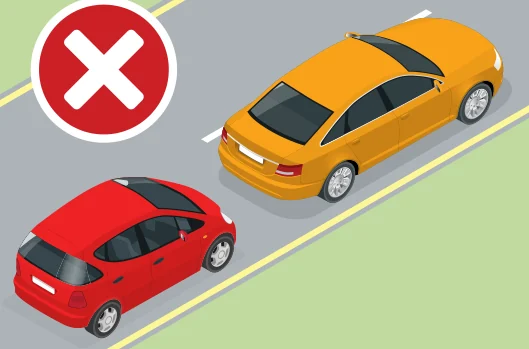
Tailgating (following too closely)
Too close: don't tailgate

The three-seconds-plus rule

  • Pick a fixed object ahead, such as a sign or tree
  • When the vehicle ahead passes it, count: one thousand-one, one thousand-two, one thousand-three
  • If you pass the object after at least three seconds, you have enough distance for a sudden stop
  • In bad weather, increase it to four or more seconds
Handbook p. 97 ↗

Stopping distance

Perception distance + reaction distance + braking distance.

Handbook p. 97 ↗

Know the rule

Keeping a foot near the brake reduces reaction distance. Heavier vehicles may take longer to stop, and the rules assume the best driving conditions.

Handbook p. 97 ↗

Minimum safe following distance (car lengths)

Minimum safe following distance (car lengths)
Road condition20 / 30 mph40 / 50 mph
Ideal2 / 34 / 5
Wet pavement4 / 68 / 10
Gravel4 / 68 / 10
Packed snow6 / 912 / (not listed)
Ice12 / 18(not listed)
Handbook p. 98 ↗

Before passing or changing lanes

  • Only when necessary, and only if you can finish without speeding
  • Keep a safe following distance; check traffic ahead and behind
  • Only where signs and pavement markings allow
  • Signal every lane change, including your return to the right lane
  • Return when well ahead: the passed vehicle should be visible in your rearview mirror
  • Cancel the turn signal
Handbook p. 98 ↗

Know the rule

Don't straddle lanes. Before a lane change, check the rearview mirror and glance back at your blind spot.

Handbook p. 98 ↗

Know the rule

When another vehicle passes you, stay in your lane and slow down to make the pass easier; return to normal speed once it's well ahead.

Handbook p. 99 ↗

Put it into practice

At 40 mph on a wet road, the chart calls for 8 car lengths, twice the ideal distance. With the three-second rule, you would stretch your count to four seconds or more.

Check your understanding

Read the question, decide on an answer, then open it to check the explanation. These are Roadwise study questions based on the source handbook.

What is the general rule of thumb for following distance based on speed?
  1. One car length (20 ft) per 10 mph
  2. One car length regardless of speed
  3. Two car lengths for every 50 mph
  4. A fixed 100 feet at any speed

Answer: One car length (20 ft) per 10 mph

The rule of thumb is to keep about one car length (roughly 20 feet) back for each 10 mph of speed.

Handbook p. 96 ↗
Using the three-seconds-plus rule, how many seconds should pass between a vehicle ahead passing a fixed object and your vehicle passing that same object?
  1. At least one second
  2. At least three seconds
  3. At least ten seconds
  4. Exactly five seconds

Answer: At least three seconds

The three-seconds-plus rule requires at least three seconds between your vehicle and a fixed point the vehicle ahead has just passed.
Handbook p. 97 ↗
During bad weather, how much should the three-seconds-plus rule interval be increased?
  1. It should stay the same
  2. To exactly five seconds
  3. To four or more seconds
  4. To ten or more seconds

Answer: To four or more seconds

During bad weather, the time interval of the three-seconds-plus rule should be increased to four or more seconds.

Handbook p. 97 ↗
Which formula correctly represents total stopping distance?
  1. Perception + reaction + braking distance
  2. Speed multiplied by reaction time only
  3. Braking distance minus perception distance
  4. Reaction distance divided by speed

Answer: Perception + reaction + braking distance

Stopping distance equals perception distance plus reaction distance plus braking distance.

Handbook p. 97 ↗
Keeping a foot near the brake pedal while driving can help reduce what?
  1. Reaction distance
  2. Fuel consumption
  3. Tire wear
  4. Braking distance

Answer: Reaction distance

By keeping a foot near the brake, a motorist can reduce reaction distance in an emergency.

Handbook p. 97 ↗
Tailgating is a common cause of rear-end crashes when many vehicles are following too closely together.
  1. True
  2. False

Answer: True

Tailgating can cause a series of rear-end crashes when vehicles are packed too closely together.

Handbook p. 96 ↗
Take the lesson checkpoint in the app

More in Defensive Driving