Roadwise States New Hampshire Driving lessons Reversing direction New Hampshire driving lesson · Turning, Intersections, and Parking
Reversing direction A 3-minute lesson from the New Hampshire course. Read the rules and examples, follow the handbook page references, and check your understanding before you move on.
Read time 3 minutes
Course unit Turning, Intersections, and Parking
Checkpoint questions 6
Source pages 32, 33 Sometimes you need to turn around. The safest way depends on the road: on a divided highway you go to the next exit; on ordinary streets you may use a U-turn, a two-point turn or a three-point turn.
Know the rule
If you miss an exit on a divided highway, drive to the next exit to reverse direction. Never stop, back up or try to turn around.
Handbook p. 32 ↗ Know the rule
U-turns can be extremely dangerous and aren't legal everywhere. First check for signs prohibiting them.
Handbook p. 32 ↗ Making a U-turn: Signal and pull onto the right shoulder Wait for the road to be clear of vehicles Signal that you're pulling back out Turn into the nearest lane going the opposite direction Handbook p. 33 ↗ Two-point turn Using a street, alley or driveway to reverse direction when driving around the block isn't practical or possible. It can be done in reverse or forward.
Handbook p. 33 ↗ Reverse two-point turn: Signal right, stop, check traffic to the sides and rear Back until your rear bumper reaches the near edge of the driveway Backing slowly, steer rapidly all the way right; straighten and stop as you center Shift to drive, check both ways, signal and turn left into the proper lane Handbook p. 33 ↗ Forward two-point turn: Check mirrors and signal left; move close to the center of the road Turn into the driveway or alley as near the right side as possible Stop when your rear clears the curb or driveway edge; check all directions Signal right, shift to reverse, back slowly turning the wheel quickly all the way right As you center in the nearest lane: straighten, stop, shift to drive, cancel signal, go Handbook p. 33 ↗ Know the rule
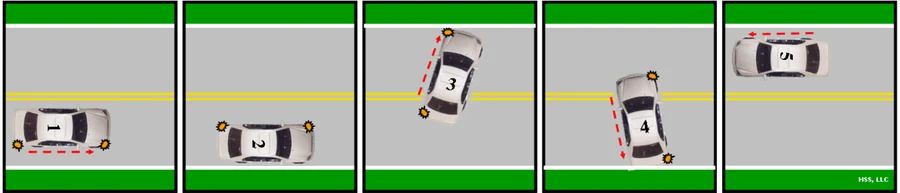
Use a three-point turn only when the street is too narrow for a U-turn, and only on a two-lane roadway.
Handbook p. 33 ↗ Three-point turn: Check mirrors, signal right, and pull to the right side of the road Signal left, check traffic and blind spots, turn hard left across; stop at the other side Shift to reverse, check traffic and both blind spots, turn hard right; stop Shift to drive, signal left, check, turn hard left into the right lane of the new direction Make sure the turn signal has cancelled and continue straight Handbook p. 33 ↗ Three-point turn, step by step Put it into practice
You pass your exit on I-93. Keep going to the next exit and turn around there. Backing up on the shoulder or crossing the median is never the answer.
Check your understanding Read the question, decide on an answer, then open it to check the explanation. These are Roadwise study questions based on the source handbook.
If a driver misses their exit on a divided highway, what should they do? Drive to the next exit to reverse direction Stop and carefully back up to the exit Make a quick U-turn across the median Pull onto the shoulder and wait for help Answer: Drive to the next exit to reverse direction
Drivers should never stop or back up; instead, drive to the next exit.
Handbook p. 32 ↗ Before making a U-turn, what should a driver check first? Whether signs prohibit U-turns there Whether other vehicles are also turning Whether the road has painted lane lines Whether the speed limit is above 35 mph Answer: Whether signs prohibit U-turns there
Drivers should first check for signs indicating U-turns are prohibited at that location.
Handbook p. 32 ↗ A three-point turn should only be used in which situation? On a two-lane roadway too narrow for a U-turn Only when directed by a police officer Whenever a driveway is unavailable On any four-lane divided highway Answer: On a two-lane roadway too narrow for a U-turn
A three-point turn should be used only on a two-lane road too narrow for a U-turn.
Handbook p. 33 ↗ In a two-point turn, what is used to reverse direction instead of driving around a block? A shoulder pull-off area only A street, alley, or driveway The breakdown lane on a highway A designated turnaround lane Answer: A street, alley, or driveway
A two-point turn uses a street, alley, or driveway to reverse direction.
Handbook p. 33 ↗ In a reverse two-point turn, which direction does a driver first signal before backing into a driveway? Left No signal is needed Hazard flashers Right Answer: Right
In a reverse two-point turn, the driver first signals a right turn before backing in.
Handbook p. 33 ↗ In a forward two-point turn, which direction does the driver first signal before pulling into the driveway or alley? Left No signal, since it's a driveway Hazard flashers Right Answer: Left
A forward two-point turn begins by signaling a left turn and moving toward the driveway.
Handbook p. 33 ↗ Previous lesson Toll roads and turning Next lesson Intersections and roundabouts More in Turning, Intersections, and Parking About the source Roadwise’s New Hampshire course uses the driver handbook edition supplied with this study pack. This lesson cites source pages 32, 33. The linked PDF is a third-party mirror of the handbook, rather than a government-hosted page.
Open the handbook source PDF · View the source edition
For current application requirements, fees, appointments, and the format that applies to your age or license type, check New Hampshire’s DMV. Roadwise provides study material and does not issue permits or licenses.