roadwise.Open study app

Nevada driving lesson · Towing

Combination vehicles & trailer skids

A 3-minute lesson from the Nevada course. Read the rules and examples, follow the handbook page references, and check your understanding before you move on.

Read time
3 minutes
Course unit
Towing
Checkpoint questions
5
Source pages
73, 74

The more trailers you pull, the more a quick steering move is magnified at the back. Smooth steering, early braking and knowing how to stop a trailer skid keep your rig upright and in line.

Know the rule

Combinations need more skill than single vehicles. When towing a combination, the heaviest vehicle must always be first behind the towing vehicle, with the lighter one at the rear.

Handbook p. 73 ↗

Rearward amplification

What causes the "crack-the-whip" effect: a quick lane change is amplified toward the rear trailer, which can overturn even when the towing vehicle doesn't.

Handbook p. 73 ↗
2.0

Rearward amplification meaning the rear trailer is twice as likely to turn over as the truck

Handbook p. 73 ↗
3.5

Rearward amplification of triples — the last trailer can roll 3.5 times as easily

Handbook p. 73 ↗

Know the rule

Steer gently and smoothly when pulling trailers — they flip over from quick steering moves more easily than many vehicles.

Handbook p. 73 ↗

Know the rule

Empty large combinations take longer to stop than fully loaded ones: stiff springs and strong brakes give poor traction, so wheels lock easily and the trailer can swing out or jackknife.

Handbook p. 74 ↗

Know the rule

In any combination rig, allow a lot of following distance and look far enough ahead to brake early — don't get caught making a panic stop.

Handbook p. 74 ↗

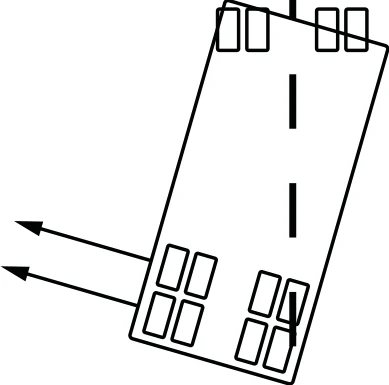
Trailer jackknife

When the trailer's wheels lock up and the trailer swings around. More likely when the trailer is empty or lightly loaded.

Handbook p. 74 ↗
Trailer wheels locked and sliding

Know the rule

See a skid early in your mirrors — check them any time you brake hard. Once the trailer swings out of your lane, a jackknife is very hard to prevent.

Handbook p. 74 ↗

Know the rule

To stop a trailer skid, release the brakes to regain traction. Don't use the trailer hand brake to straighten out — the trailer brakes caused the skid. Once the wheels grip, the trailer follows and straightens out.

Handbook p. 74 ↗

Put it into practice

Braking hard on a downgrade, you see your trailer sliding sideways in the mirror. Release the brakes instead of pressing harder, and don't touch the trailer hand brake — let the tires grip so the trailer lines up behind you again.

Check your understanding

Read the question, decide on an answer, then open it to check the explanation. These are Roadwise study questions based on the source handbook.

When towing a combination of vehicles, the heaviest vehicle should be positioned:
  1. In the last position, farthest back
  2. In the middle of the combination
  3. It does not matter
  4. First behind the towing vehicle

Answer: First behind the towing vehicle

The heaviest vehicle must always be in the first position behind the towing vehicle.
Handbook p. 73 ↗
'Rearward amplification' describes:
  1. The trailer 'crack-the-whip' effect
  2. The engine's power loss while towing
  3. The delay in trailer brake response
  4. The extra fuel used while towing

Answer: The trailer 'crack-the-whip' effect

Rearward amplification causes the crack-the-whip effect that can overturn a trailer.

Handbook p. 73 ↗
According to the chart, triple trailers have a rearward amplification of about:
  1. 1.0
  2. 3.5
  3. 2.0
  4. 5.0

Answer: 3.5

Triples have a rearward amplification of 3.5, meaning the last trailer can roll 3.5 times as easily.

Handbook p. 73 ↗
Empty or lightly loaded large combination vehicles take:
  1. Less time to stop than when fully loaded
  2. The same time to stop, regardless of load
  3. Longer to stop than when fully loaded
  4. Longer only on wet roads

Answer: Longer to stop than when fully loaded

Empty combination vehicles take longer to stop than fully loaded ones due to reduced traction.

Handbook p. 74 ↗
If a trailer begins to skid and jackknife, the correct response is to:
  1. Apply the trailer hand brake to straighten it
  2. Accelerate to pull the trailer straight
  3. Turn the steering wheel sharply into the skid
  4. Release the brakes to regain traction

Answer: Release the brakes to regain traction

Release the brakes to regain traction; the trailer will then start to follow and straighten out.

Handbook p. 74 ↗
Take the lesson checkpoint in the app

More in Towing