With a trailer you're longer, heavier and slower. You need more space everywhere — ahead, beside, above and below — and backing and turning follow different rules than in a car alone.
Towing safely:
- Be aware of your surroundings — lack of awareness is a major cause of crashes
- Use your mirrors often, and more in special situations, to watch traffic and your rig
- Signal your intentions — it's the law
- Communicate your presence; others may not notice you even in plain sight
Know the rule
Heavier vehicles make brakes work harder and absorb more heat, but heavy-vehicle brakes, tires and springs work best fully loaded. Empty trucks need greater stopping distances: less traction, and wheels that bounce and lock up.
Handbook p. 70 ↗Know the rule
Backing with a trailer: turn the steering wheel in the opposite direction from a single vehicle. Once the trailer starts to turn, turn the wheel the other way to follow it.
Handbook p. 71 ↗Backing rules:
- Avoid backing when you can — park so you can pull forward to leave; back in a straight line
- Look at your path: get out, walk around, check side and overhead clearance
- Back as slowly as possible
- Use mirrors; correct drift at once by turning the top of the wheel toward the drift
- Back toward the driver's side, even if you must go around the block
- Pull forward to reposition as needed
- Use a helper you can see; agree on hand signals, especially "STOP"
Know the rule
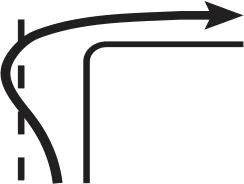
Right turns: turn slowly. If you must swing wide, do it as you complete the turn, keeping the trailer's rear close to the curb. Swinging left at the start invites drivers to pass on your right.
Handbook p. 71 ↗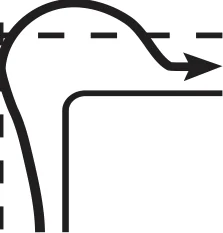
Know the rule
If you must cross into oncoming lanes to turn, give oncoming vehicles room to go by or stop — but don't back up for them; you might hit someone behind you.
Handbook p. 71 ↗Know the rule
Left turns: reach the center of the intersection before you start turning. With two left-turn lanes, always use the right-hand one — drivers on your right are hard to see.
Handbook p. 72 ↗Off-tracking
When a vehicle or trailer drifts into another lane unintentionally during a turn. Turn too soon and the left side of your rig may hit another vehicle.
Handbook p. 72 ↗Space overhead and underneath:
- Don't trust posted clearances — repaving or packed snow may have reduced them
- An empty trailer is higher than a loaded one
- Not sure you'll clear? Go slowly, or take another route
- Before backing in, check for trees, branches and electric wires
- Railroad tracks and drainage channels can snag a low, heavily loaded rig
Know the rule
Entering or crossing traffic, you need a much larger gap than in a car — more when heavily loaded. Make sure you can get all the way across before traffic reaches you.
Handbook p. 72 ↗Put it into practice
You need to back your camper into a campsite on the right. Instead, drive around the loop so you can back toward the driver's side, get out to check for low branches, then back slowly with a helper in view.