roadwise.Open study app

Nebraska driving lesson · Passing, Turning & Parking

Parking and emergency stops

A 3-minute lesson from the Nebraska course. Read the rules and examples, follow the handbook page references, and check your understanding before you move on.

Read time
3 minutes
Course unit
Passing, Turning & Parking
Checkpoint questions
6
Source pages
64, 65

Where and how you park matters for safety and the law. The distances in this lesson show up on almost every test.

Emergency roadside stop:

  • Signal and move onto the shoulder, as far off the road as possible
  • Park within 12 inches of and parallel to the curb or road's edge
  • Park on the right side of the road unless it's a one-way street
  • Make sure the vehicle can't move: shift to park gear and set the parking brake
  • Turn on your 4-way flashers
  • Turn off the engine and remove the keys
  • Check traffic before getting out
Handbook p. 64 ↗

Never park or stop within:

Never park or stop within:
DistanceOf
15 feetA fire hydrant
20 feetA crosswalk at an intersection
30 feetA flashing signal, stop sign, yield sign or roadside control
50 feetRailroad tracks
Handbook p. 65 ↗

Never park or stop:

  • On the roadway beside a stopped or parked vehicle
  • On a sidewalk, within an intersection or on a crosswalk
  • On a bridge or within a highway tunnel
  • In front of a public or private driveway
  • Anywhere official signs prohibit standing, stopping or parking
Handbook p. 65 ↗

Know the rule

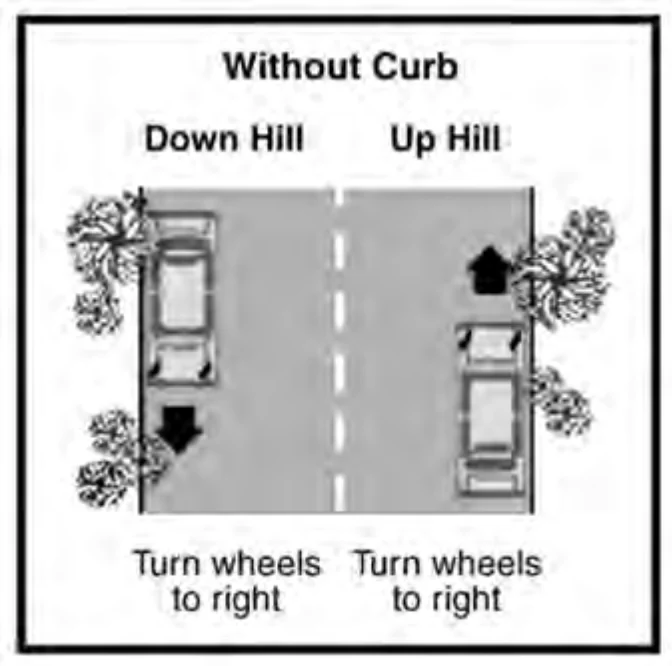
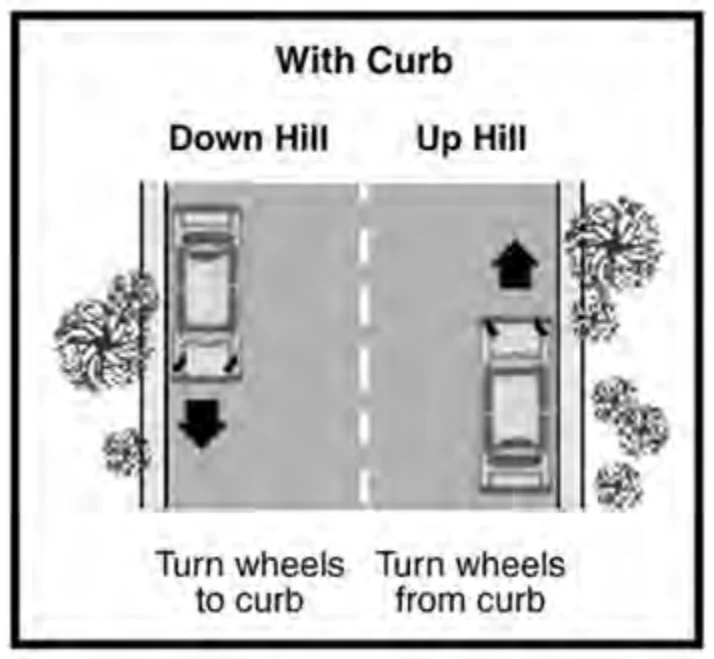
Parking on a hill: facing uphill where there's a curb, set the parking brake and turn the wheels away from the curb. In any other situation, turn the wheels toward the curb or edge of the road.

Handbook p. 65 ↗
Parking on a hill with a curb
Hill parking with a curb
Parking on a hill without a curb
Hill parking without a curb

Put it into practice

You parallel park facing uphill on a street with a curb. Set the parking brake and turn your front wheels away from the curb. Facing downhill on the same street, you'd turn them toward the curb.

Check your understanding

Read the question, decide on an answer, then open it to check the explanation. These are Roadwise study questions based on the source handbook.

When making an emergency roadside stop, you should park your vehicle:
  1. At least 3 feet from the curb
  2. Perpendicular to the curb
  3. Within 12 inches of the curb or road's edge
  4. Angled toward the shoulder

Answer: Within 12 inches of the curb or road's edge

Park within 12 inches of the curb or edge, parallel to it.
Handbook p. 64 ↗
You may not park within how many feet of a fire hydrant?
  1. 10 feet
  2. 20 feet
  3. 30 feet
  4. 15 feet

Answer: 15 feet

Parking within 15 feet of a fire hydrant is prohibited.

Handbook p. 65 ↗
You may not park within how many feet of a crosswalk at an intersection?
  1. 20 feet
  2. 10 feet
  3. 15 feet
  4. 30 feet

Answer: 20 feet

Parking within 20 feet of a crosswalk at an intersection is prohibited.

Handbook p. 65 ↗
You may not park within how many feet of a flashing signal, stop sign, or yield sign?
  1. 15 feet
  2. 30 feet
  3. 20 feet
  4. 50 feet

Answer: 30 feet

Parking within 30 feet of a flashing signal or stop/yield sign is prohibited.

Handbook p. 65 ↗
You may not park within how many feet of railroad tracks?
  1. 15 feet
  2. 30 feet
  3. 50 feet
  4. 100 feet

Answer: 50 feet

Parking within 50 feet of railroad tracks is prohibited.

Handbook p. 65 ↗
If you park facing uphill on a street with a curb, you should:
  1. Turn the wheels toward the curb
  2. Leave the wheels straight and set the parking brake
  3. Turn the wheels toward the curb without setting the brake
  4. Set the parking brake and turn the wheels away from the curb

Answer: Set the parking brake and turn the wheels away from the curb

Facing uphill with a curb, turn wheels away from the curb.

Handbook p. 65 ↗
Take the lesson checkpoint in the app

More in Passing, Turning & Parking