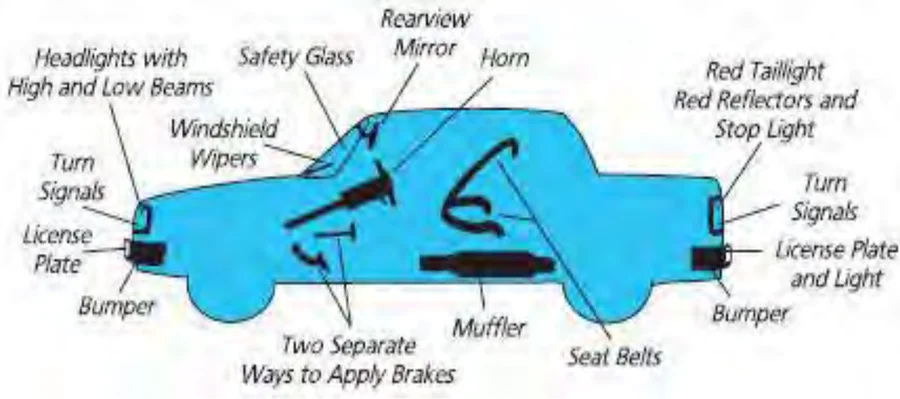
Montana law sets minimum performance for equipment every vehicle must have — how far each light must be seen, how loud the horn must be. These exact distances are favorite test questions.
Know the rule
Headlights are required from a half hour after sunset to a half hour before sunrise, and any time weather or blowing dust cuts visibility to less than 500 feet.
Handbook p. 24 ↗Vehicle light distances
| Distance | What it's for |
|---|---|
| 1,000 ft | Dim high beams when meeting other cars |
| 500 ft | Dim high beams when behind other vehicles |
| 500 ft | Turn on headlights if you can't see this far |
| 500 ft | Taillights must be visible |
| 350 ft | High beams must light up people and vehicles |
| 300 ft | Brake lights and turn signals seen in sunlight |
| 100 ft | Low beams must light up people and vehicles |
| 50 ft | License plate light |
Know the rule
Vehicles made after January 1, 1956 must show white or amber light to the front and red or amber to the rear, visible for 500 feet. Headlights and taillights may not be tinted or covered unless it's compliant original or optional equipment.
Handbook p. 24 ↗Know the rule
Flashing, blinking, rotating or pulsating lights (other than turn signals) are prohibited except on emergency or authorized vehicles, as is undercarriage lighting that flashes or shows police or emergency colors.
Handbook p. 25 ↗Know the rule
Turn signals are required when the steering post is more than 24 inches from the vehicle's left outside limit, or more than 14 feet from the rear of the vehicle or its load.
Handbook p. 25 ↗Other required equipment
- Red rear reflectors: visible at night in high beams from 50 to 300 feet
- Muffler: must prevent excessive or unusual noise
- Mirror: 200 feet of visibility to the rear
- Horn: warning audible for 200 feet
- Brakes and parking brake: stop and hold the vehicle under any load, on any grade
- Parking lights (parked on a roadway during headlight hours): white/amber front, red rear, seen 500 ft
Know the rule
License plate lighting that isn't original manufacturer's equipment is prohibited.
Handbook p. 25 ↗Know the rule
A safety-glass windshield (vehicles made after January 1, 1956) must be in good condition, nothing that blocks your view may be attached to any window, and working wipers are required.
Handbook p. 25 ↗Know the rule
Montana applies strict standards to window tinting and sun screening — check with an examiner, County Treasurer or law enforcement officer.
Handbook p. 26 ↗Know the rule
A vehicle may have no more than two spot and/or auxiliary (fog) lamps. Turn spot lamps off when approaching another moving vehicle from either direction; fog lamps may be used with low beams if no brighter than the low beam.
Handbook p. 26 ↗Put it into practice
At dusk on a two-lane highway you have your high beams on. An oncoming pickup appears in the distance: dim to low beams by the time it's 1,000 feet away. If you later close in behind a car, dim when you're 500 feet behind it.