A 3-minute lesson from the Montana course. Read the rules and examples, follow the handbook page references, and check your understanding before you move on.
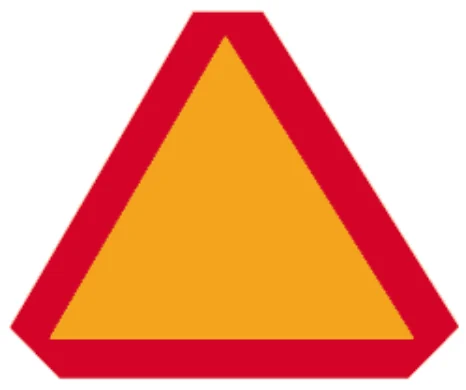
When a big vehicle breaks down after dark, warning devices set at exact distances give approaching drivers time to react. Slow farm and road equipment carries an orange triangle so you can spot it early.
Know the rule
When a truck, bus, tractor, trailer, semi-trailer or pole trailer is disabled on the highway or shoulder while lighted lamps are required, first place a warning device immediately at the traffic side of the vehicle.
A disabled vehicle carrying explosives, flammable liquid or compressed gas uses red electric lanterns or reflectors — one at the traffic side, one 100 feet ahead, one 100 feet behind. Never flares or flame.
The emblem is required on slow vehicles, animal-drawn vehicles and road machinery — except road machinery doing actual work and guarded by a flagger or warning signs.
On a two-lane highway, a slow-moving vehicle that doesn't leave a clear lane for passing must pull over at the first safe opportunity with room for a turnout.
At night your box truck breaks down 300 feet past a blind curve on a two-lane road. Set one device at the traffic side, one 100 feet ahead in your lane, and the one toward the curve at least 500 feet back.
Check your understanding
Read the question, decide on an answer, then open it to check the explanation. These are Roadwise study questions based on the source handbook.
A disabled truck sits within 500 feet of a curve that blocks the view of approaching traffic. Where must the warning device be placed in that direction?
Exactly 100 feet from the vehicle
At the crest of the curve only
10 feet from the vehicle
At least 500 feet away
Answer: At least 500 feet away
If a curve, hill, or obstruction is within 500 feet, the warning device must be placed at least 500 feet away to give adequate warning.