roadwise.Open study app

Michigan driving lesson · Sharing the Road

Slow-moving vehicles, pedestrians and children

A 3-minute lesson from the Michigan course. Read the rules and examples, follow the handbook page references, and check your understanding before you move on.

Read time
3 minutes
Course unit
Sharing the Road
Checkpoint questions
6
Source pages
68, 69

Farm equipment, horse-drawn buggies and people on foot share Michigan roads. They are slower and more vulnerable than you, so the law puts the burden of care on the driver.

Slow-moving vehicle

A vehicle that can't go faster than 25 mph — Amish buggies, farm machinery like combines and tractors pulling wagons, industrial and construction equipment. Four-wheelers and golf carts don't count.

Handbook p. 68 ↗
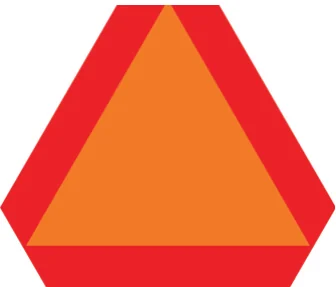
Slow-moving vehicle emblem
Slow-moving vehicle emblem: an orange triangle

Know the rule

Slow-moving vehicles carry an orange triangle on the back. Don't get impatient — the driver will usually pull over when possible to let traffic by.

Handbook p. 68 ↗

Following a horse and rider or buggy

Following a horse and rider or buggy
RuleAmount
Reduce your speed to15–20 mph
Keep a following distance of at least20 feet
Handbook p. 68 ↗

Know the rule

Pass horses with caution when it's safe. Never honk the horn or rev the engine — loud noises can startle horses.

Handbook p. 68 ↗

Know the rule

Always yield to pedestrians — people walking, jogging, hiking, skateboarding, pushing strollers — even when you have a green light. Watch at driveways, alleys, stop signs, signals, roundabouts, crosswalks and mid-block.

Handbook p. 68 ↗

Know the rule

Never pass a vehicle that has stopped for a pedestrian. Be extra careful when a large truck or bus is stopped, since it can hide a pedestrian.

Handbook p. 68 ↗

Know the rule

Where there's no sidewalk, pedestrians should walk facing oncoming traffic. Watch both sides of the road and give extra time to the elderly, the young and people with disabilities.

Handbook p. 69 ↗

Know the rule

You are required by law to stop or yield for a pedestrian with a white cane or guide dog. Don't honk or rev your engine — it covers audible cues people with visual impairments rely on.

Handbook p. 69 ↗

Know the rule

Stop at the marked crosswalk limit line, or before the intersection if there's no limit line. Never block a crosswalk.

Handbook p. 69 ↗

Know the rule

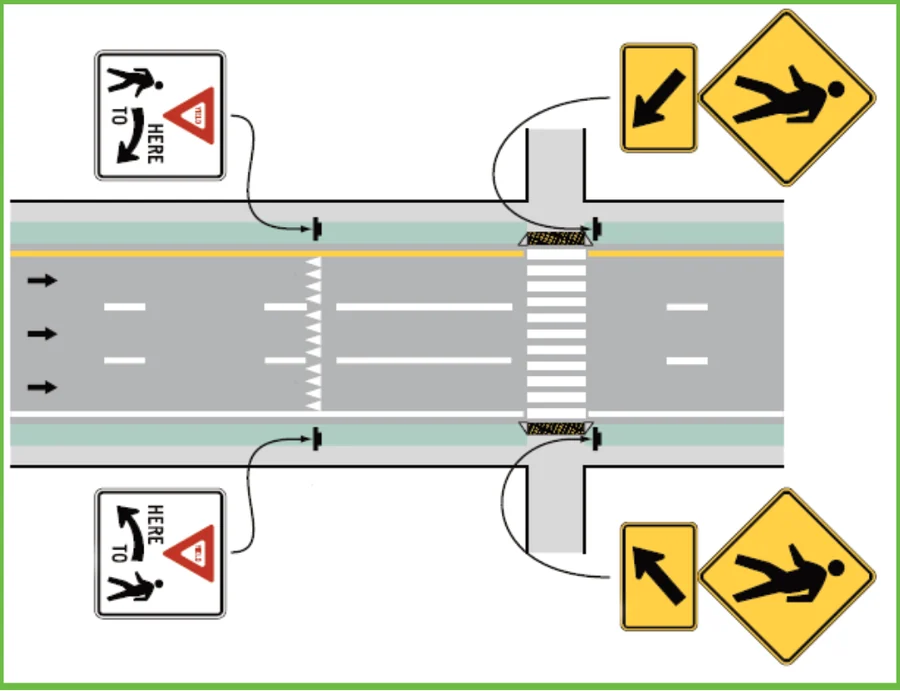
Mid-block crosswalks let pedestrians cross away from intersections. A yield line sometimes shows where drivers should stop.

Handbook p. 69 ↗
Bicyclist merge/turn caution diagram
Figure 6.1: Mid-block crosswalk with yield lines

Know the rule

Pay close attention around parked cars, school zones, playgrounds and parks — children are unpredictable and can dart into the street.

Handbook p. 69 ↗

Put it into practice

You come up behind an Amish buggy on a two-lane road. Slow to 15–20 mph, stay at least 20 feet back, and pass carefully only when it's safe — no honking.

Check your understanding

Read the question, decide on an answer, then open it to check the explanation. These are Roadwise study questions based on the source handbook.

What is the top-speed threshold that defines a "slow-moving vehicle" requiring the orange emblem?
  1. 30 mph
  2. 25 mph
  3. 20 mph
  4. 15 mph

Answer: 25 mph

Slow-moving vehicles are those that cannot travel faster than 25 mph, like farm equipment and buggies.
Handbook p. 68 ↗
When following a horse-drawn buggy, what speed should you reduce to?
  1. 35-40 mph
  2. 25-30 mph
  3. 15-20 mph
  4. 5-10 mph

Answer: 15-20 mph

Reduce your speed to 15-20 mph when following a horse and rider or horse-drawn buggy.

Handbook p. 68 ↗
How much distance should you keep from a horse-drawn buggy you're following?
  1. At least 10 feet
  2. At least 20 feet
  3. At least 5 feet
  4. At least 40 feet

Answer: At least 20 feet

Maintain a safe distance of at least 20 feet between your vehicle and the rider or buggy.

Handbook p. 68 ↗
May you pass a vehicle that has stopped for a pedestrian in a crosswalk?
  1. No, this is never allowed
  2. Yes, if the pedestrian has nearly finished crossing
  3. Yes, carefully
  4. Yes, on the shoulder

Answer: No, this is never allowed

Never attempt to pass another vehicle that has stopped for a pedestrian.

Handbook p. 68 ↗
What must a driver do when a pedestrian uses a white cane or guide dog?
  1. Slow down but continue without stopping
  2. Honk once to let them know you're nearby
  3. Stop or yield the right of way, and avoid honking
  4. Wave them across and keep going

Answer: Stop or yield the right of way, and avoid honking

Drivers must stop or yield for a pedestrian with a white cane or guide dog and should avoid honking, which can be distracting.

Handbook p. 69 ↗
Golf carts are legally classified as slow-moving vehicles requiring the orange emblem.
  1. True
  2. False

Answer: False

Golf carts and four-wheelers are specifically excluded from the slow-moving-vehicle definition.

Handbook p. 68 ↗
Take the lesson checkpoint in the app

More in Sharing the Road