roadwise.Open study app

Michigan driving lesson · Right-of-Way, Passing, and Turning

Passing safely and when you can't pass

A 4-minute lesson from the Michigan course. Read the rules and examples, follow the handbook page references, and check your understanding before you move on.

Read time
4 minutes
Course unit
Right-of-Way, Passing, and Turning
Checkpoint questions
6
Source pages
45, 46

Passing on a two-lane road puts you face to face with oncoming traffic, so Michigan sets hard limits: how far to stay from oncoming cars, when you may pass on the right, and a list of places passing is forbidden.

Passing on the left:

  • Have a clear view of the left lane, with oncoming traffic far enough away
  • Don't cut back in until you see the entire vehicle you passed in your rearview mirror
  • Allow extra room when pulling a trailer
  • Pass only one vehicle at a time
  • Don't follow too closely when another vehicle is passing slower traffic
Handbook p. 45 ↗
200 ft

You must be back in your lane before you get within this distance of any oncoming vehicle

Handbook p. 46 ↗

Know the rule

Use extreme caution when passing in the center lane of a three-lane road — an oncoming driver may be doing the same. Passing or merging in that lane is prohibited if it's marked for left turns only.

Handbook p. 46 ↗

Know the rule

Passing on the right is allowed only in certain situations, and never by driving on the shoulder or off the road.

Handbook p. 46 ↗

You may pass on the right:

  • On a two-lane road with enough room, when the vehicle ahead is turning left
  • On a one-way street with more than one lane
  • On a road with two or more lanes in each direction
  • At an intersection or spot specially widened for passing
Handbook p. 46 ↗

Don't pass — markings and places:

  • A solid yellow line is on your side of the center line
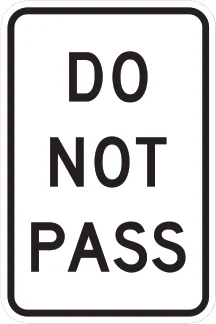
  • "Do Not Pass" or "No Passing Zone" signs are posted
  • A hill or curve blocks your view of oncoming traffic
  • Within 100 feet of an intersection or railroad crossing
  • Your view is blocked within 100 feet of a bridge, viaduct or tunnel
  • The center lane of a three-lane road is marked for left turns only
  • In a construction zone posted with no-passing signs
Handbook p. 46 ↗

Don't pass — traffic situations:

  • Oncoming traffic is close enough that passing could cause a crash
  • You can't see clearly ahead
  • A vehicle has stopped at a crosswalk or intersection to let a pedestrian cross
  • A school bus has stopped to load or unload with its red lights flashing
Handbook p. 46 ↗
100 ft

No passing within this distance of an intersection or railroad crossing

Handbook p. 46 ↗
Do not pass
Do Not Pass sign

Put it into practice

On a two-lane road, the car ahead stops at a crosswalk. You can't see why, but there's room to go around. Don't — a vehicle stopped at a crosswalk may be letting a pedestrian cross, and passing it is prohibited.

Check your understanding

Read the question, decide on an answer, then open it to check the explanation. These are Roadwise study questions based on the source handbook.

Before pulling back into your lane after passing, what should you see?
  1. Just the front bumper of the vehicle you passed
  2. The whole vehicle in your rearview mirror
  3. Just the taillights, no need for the full vehicle
  4. Your side mirror only, not the rearview

Answer: The whole vehicle in your rearview mirror

Don't cut back into the right lane until you can see the entire vehicle you're passing in your rearview mirror.
Handbook p. 46 ↗
How close to an oncoming vehicle can you be before you must have completed your pass and returned to your lane?
  1. 200 feet
  2. 50 feet
  3. 100 feet
  4. 300 feet

Answer: 200 feet

You must return to your lane before you get within 200 feet of any oncoming vehicles.

Handbook p. 46 ↗
How many vehicles may you legally pass at one time on a two-lane road?
  1. Up to three
  2. Only one
  3. Up to two
  4. Up to four

Answer: Only one

Don't pass more than one vehicle at a time.

Handbook p. 46 ↗
On a two-lane road, when may you legally pass on the right?
  1. Only if the vehicle ahead is turning right
  2. Never, it's always illegal
  3. Only if there are two lanes in your direction
  4. If the car ahead turns left and there's room

Answer: If the car ahead turns left and there's room

Passing on the right is allowed when there's enough room and the vehicle ahead is turning left.

Handbook p. 46 ↗
How close to an intersection or railroad crossing must you be to be barred from passing?
  1. Within 200 feet
  2. Within 100 feet
  3. Within 300 feet
  4. Within 50 feet

Answer: Within 100 feet

You may not pass within 100 feet of an intersection or railroad crossing.

Handbook p. 46 ↗
A vehicle has stopped at a crosswalk to let a pedestrian cross. May you pass it?
  1. Yes, if you check for the pedestrian first
  2. No, that's prohibited
  3. Yes, on the shoulder only
  4. Yes, if the pedestrian has already crossed halfway

Answer: No, that's prohibited

You may not pass a vehicle that has stopped at a crosswalk or intersection to let a pedestrian cross.

Handbook p. 46 ↗
Take the lesson checkpoint in the app

More in Right-of-Way, Passing, and Turning