roadwise.Open study app

Louisiana driving lesson · Distraction, Fatigue & Emergencies

Skids & rollovers

A 3-minute lesson from the Louisiana course. Read the rules and examples, follow the handbook page references, and check your understanding before you move on.

Read time
3 minutes
Course unit
Distraction, Fatigue & Emergencies
Checkpoint questions
6
Source pages
121, 122, 123

Skids usually start when you turn or stop suddenly on slippery pavement. Rollovers start when a sliding vehicle gets 'tripped.' Both are mostly prevented by controlling your speed and steering smoothly.

Know the rule

Only about 1 of every 40 vehicles in police-reported crashes rolls over, yet 1 of every 3 passenger-vehicle occupant deaths happens in rollovers.

Handbook p. 122 ↗

Know the rule

A sliding vehicle can be tripped into a rollover by a curb, guardrail, tree stump or soft, uneven ground. SUVs, vans, pickups and small trucks roll more easily because of their higher center of gravity; extra cargo and passengers add risk.

Handbook p. 122 ↗

Reduce your rollover risk:

  • Obey speed limits and use extra caution in bad weather
  • Don't overcorrect your steering in surprises
  • If you leave the pavement, slow down gradually; don't jerk the wheel back
  • Wear your seat belt; being thrown from a rolling vehicle is often fatal
  • Side airbags with rollover sensors help protect you
Handbook p. 122 ↗

Know the rule

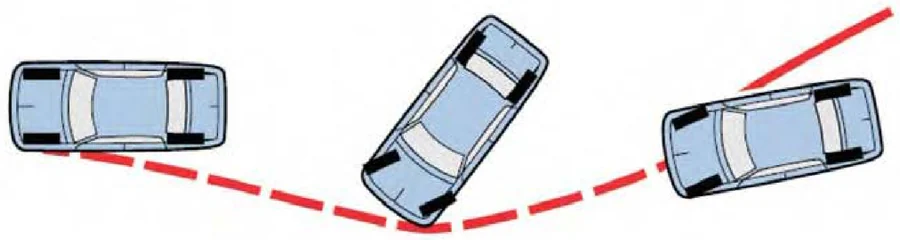
If the rear of your car starts to slide, don't use your brakes. Steer in the direction the rear end is skidding.

Handbook p. 122 ↗

Steering out of a skid:

  • Take your foot off the gas
  • Turn the front wheels just enough to keep going straight: rear skids right, steer right
  • Don't over-steer; if the car skids the other way, turn in that direction
  • When the car is back under control, straighten the wheels
Handbook p. 123 ↗
Vehicle skid recovery (illustration)
Skid and recovery path

Know the rule

In a skid, look and steer where you want to go and be ready to counter-steer. Without ABS, avoid braking (pump lightly if necessary). With ABS, brake firmly as you steer.

Handbook p. 123 ↗

Know the rule

Prevent skids by steering and braking with a light touch. When slowing, keep mild pressure on the brake rather than braking hard or locking the wheels.

Handbook p. 123 ↗

Know the rule

If you hydroplane, don't brake or turn suddenly; ease off the gas until you feel the road. Brake gently with light pumps, or normally with ABS. Drive in the tire tracks of cars ahead and stay away from puddles.

Handbook p. 123 ↗

ESP (Electronic Stability Program)

Works with ABS: compares where you steer with where the car goes and brakes individual wheels to reduce skidding. Steer toward where you're looking; avoid abrupt steering.

Handbook p. 123 ↗

Put it into practice

On a wet curve, your car's rear end slides to the right. Ease off the gas, steer right just enough to keep the front heading down the road, and straighten out as it recovers. Don't brake hard.

Check your understanding

Read the question, decide on an answer, then open it to check the explanation. These are Roadwise study questions based on the source handbook.

If the rear of your car starts to skid, what should you do with the steering wheel?
  1. Steer in the direction the rear of the car is skidding
  2. Steer opposite the direction of the skid
  3. Keep the wheel perfectly straight
  4. Turn the wheel as sharply as possible

Answer: Steer in the direction the rear of the car is skidding

Steering into the direction of the skid helps realign the rear of the vehicle with the front.
Handbook p. 122 ↗
In a car without ABS, what should you do with the brakes during a skid?
  1. Brake as hard as possible
  2. Avoid using the brakes
  3. Brake firmly as you steer
  4. Apply the parking brake instead

Answer: Avoid using the brakes

Braking during a skid in a non-ABS vehicle can make the skid worse; easing off the gas and steering is correct.

Handbook p. 123 ↗
About what share of passenger vehicle occupant deaths occur in rollover crashes?
  1. About 1 in 40
  2. About 1 in 10
  3. About 1 in 100
  4. About 1 in 3

Answer: About 1 in 3

Only about 1 in 40 crash-involved vehicles rolls over, yet about 1 in 3 passenger vehicle occupant deaths occur in rollovers.

Handbook p. 121 ↗
Which of these is a major contributing factor to rollover crashes?
  1. Excessive speed and overcorrecting the steering wheel
  2. Braking gently on dry pavement
  3. Driving below the speed limit
  4. Using cruise control on highways

Answer: Excessive speed and overcorrecting the steering wheel

Speed and steering overcorrection are two of the primary contributors to rollover crashes.

Handbook p. 122 ↗
If your vehicle has ABS and begins to skid, what is the correct braking technique?
  1. Avoid the brakes, as in a non-ABS car
  2. Brake firmly while steering where you want to go
  3. Pump the brakes by hand
  4. Use only the parking brake

Answer: Brake firmly while steering where you want to go

With ABS, you can brake firmly and let the system prevent wheel lockup while you steer.

Handbook p. 123 ↗
Vehicles like SUVs, vans, and pickups are more prone to rollovers mainly because of:
  1. Their wider tires having less grip
  2. Their engines being mounted in the rear
  3. Their lighter overall weight
  4. Their higher center of gravity

Answer: Their higher center of gravity

A higher center of gravity makes these vehicle types more likely to tip over than typical passenger cars.

Handbook p. 122 ↗
Take the lesson checkpoint in the app

More in Distraction, Fatigue & Emergencies