roadwise.Open study app

Louisiana driving lesson · Vehicle Safety

Child passenger restraints

A 3-minute lesson from the Louisiana course. Read the rules and examples, follow the handbook page references, and check your understanding before you move on.

Read time
3 minutes
Course unit
Vehicle Safety
Checkpoint questions
6
Source pages
45, 46

Louisiana law requires every child to ride in an age- or size-appropriate restraint that meets federal safety standards. The right seat depends on age AND weight, and when a child fits two categories you choose the more protective one.

Louisiana child restraint law

Louisiana child restraint law
Age / weightRequired restraint
Birth, or under 20 lbs at any ageRear-facing car seat
1 to 4 years, 20 to under 40 lbsForward-facing car seat
4 to 6 years, 40 to under 60 lbsBooster seat with restraints
6 years and over 60 lbsBooster seat with restraints, or seat belt
Handbook p. 45 ↗

Know the rule

A child 6 or younger, or under 60 lbs, may not ride in the front seat of a vehicle with an active airbag.

Handbook p. 45 ↗

Know the rule

Booster seats are an appropriate option for a child of any age.

Handbook p. 45 ↗

Know the rule

A child who falls into more than one age or weight category must use the more protective category.

Handbook p. 46 ↗
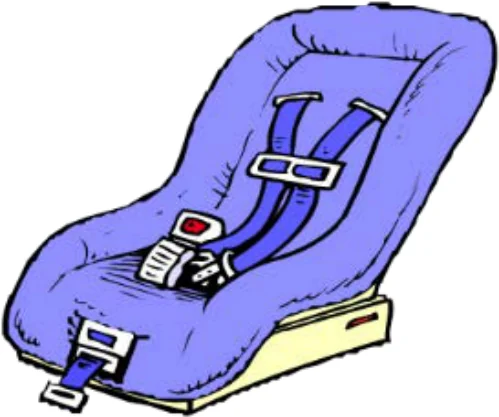
Child safety seat (illustration)
Child safety seat

Know the rule

Have all children under 13 sit in the back seat. The middle of the back seat is safer than the front seat.

Handbook p. 46 ↗

Know the rule

Motor vehicle injuries are the leading cause of death among children in the United States; the right car seat prevents many of these deaths.

Handbook p. 46 ↗

Know the rule

Buckle your own belt on every trip, however short, to set a good example.

Handbook p. 46 ↗

Put it into practice

Your 5-year-old weighs 38 lbs. Her age puts her in the booster group, but her weight fits the forward-facing car seat group. Use the more protective choice, the forward-facing car seat, in the back seat.

Check your understanding

Read the question, decide on an answer, then open it to check the explanation. These are Roadwise study questions based on the source handbook.

A child weighing under 20 pounds must ride in a:
  1. Rear-facing car seat
  2. Forward-facing car seat
  3. Booster seat
  4. Regular seat belt only

Answer: Rear-facing car seat

Infants under 20 pounds must be in a rear-facing car seat regardless of age.

Handbook p. 45 ↗
A child between 20 and 40 pounds, ages 1 to 4, must ride in a:
  1. Rear-facing car seat only
  2. Forward-facing car seat
  3. Adult seat belt only
  4. Booster seat with no restraints

Answer: Forward-facing car seat

This weight and age range requires a forward-facing car seat.

Handbook p. 45 ↗
A child between 40 and 60 pounds, ages 4 to 6, must ride in a:
  1. Forward-facing car seat only
  2. Adult seat belt with no booster
  3. Booster seat with restraints
  4. Rear-facing car seat

Answer: Booster seat with restraints

This range calls for a booster seat equipped with restraints.

Handbook p. 45 ↗
A child that falls into more than one age or weight category should be restrained using:
  1. The more protective category
  2. Whichever the parent prefers
  3. The less restrictive category, for comfort
  4. The category matching the child's age

Answer: The more protective category

When a child qualifies for more than one category, the more protective option must be used.

Handbook p. 46 ↗
Under Louisiana law, when is a front seat with an active airbag off-limits to a child?
  1. Only if the child is under 1 year old
  2. If 6 or younger, or under 60 pounds
  3. Only if the child weighs under 20 pounds
  4. Front seats are never restricted for children

Answer: If 6 or younger, or under 60 pounds

Children 6 or younger, or under 60 pounds, must not ride in a front seat with an active airbag.

Handbook p. 45 ↗
A 3-year-old weighs 42 pounds: by age (1–4) the child fits the forward-facing seat category, but by weight (40–60 lbs) the booster category. What should be used?
  1. The booster seat, since weight decides
  2. Whichever seat is easier to install
  3. A seat belt, since the rules conflict
  4. The forward-facing car seat

Answer: The forward-facing car seat

A child who falls into more than one category must use the more protective category, here the forward-facing car seat.
Handbook p. 46 ↗
Take the lesson checkpoint in the app

More in Vehicle Safety