Roadwise States Louisiana Driving lessons Air bags & other safety features Louisiana driving lesson · Vehicle Safety
Air bags & other safety features A 3-minute lesson from the Louisiana course. Read the rules and examples, follow the handbook page references, and check your understanding before you move on.
Read time 3 minutes
Course unit Vehicle Safety
Checkpoint questions 6
Source pages 46, 47, 48 Air bags supplement your seat belt; they don't replace it. They burst out at 150 to 200 mph, so how far you sit from the wheel and where your hands are really matter. Modern cars also add many active and passive safety systems.
Know the rule
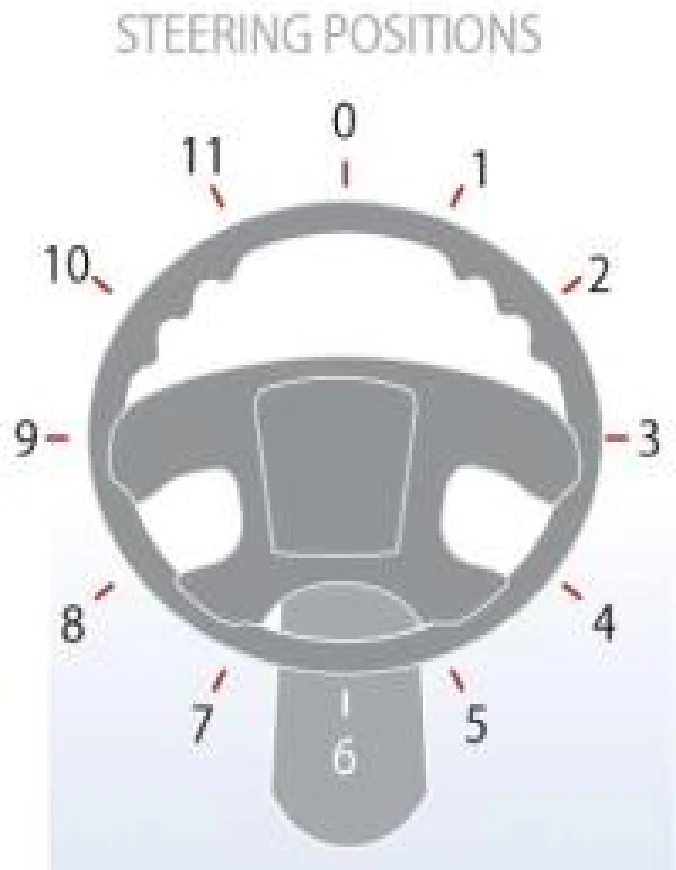
Hold the wheel at 9 and 3 or 8 and 4, not 10 and 2. At 10 and 2 a deploying air bag can throw your hands into your head or break a wrist or forearm; thumbs have been severed.
Handbook p. 46 ↗ In a car with air bags: Sit at least 10 inches from the steering wheel Use the 9-and-3 or 8-and-4 hand position Tilt the wheel toward your chest, away from your head Seat older, frail people and children 12 and under in the back seat Handbook p. 46 ↗ Steering wheel clock positions Know the rule
A passenger air bag on-off switch (common in pickups and sports cars) lets you disable the front passenger bag to carry a child 12 or under in the right front seat.
Handbook p. 46 ↗ Know the rule
Air bags don't deploy when you're rear-ended. They're a Supplementary Restraint System; your seat belt is your primary restraint.
Handbook p. 47 ↗ Know the rule
Adjust your headrest before driving; it protects you from whiplash.
Handbook p. 47 ↗ Active safety Technology that helps prevent a crash, such as crash-avoidance and driver-assistance systems.
Handbook p. 47 ↗ Passive safety Parts of the vehicle that protect you during a crash, mainly airbags, seat belts and the vehicle's physical structure.
Handbook p. 47 ↗ Driver-assistance systems include: Automatic braking Adaptive cruise control that keeps a safe distance from the car ahead Lane departure warning Reverse backup sensors and backup camera Tire pressure monitoring Traction control, Electronic Stability Control and anti-lock brakes Handbook p. 47 ↗ Crashworthy features: Seat belts limit forward motion and prevent ejection Laminated windshields stay in one piece; tempered side glass breaks into granules Crumple zones absorb crash force and divert it from the passenger area Side impact beams and collapsible steering columns Padded instrument panel; cargo barriers in SUVs, wagons and vans Handbook p. 48 ↗ Know the rule
School buses and semi-trailer trucks must have retro-reflective strips outlining their sides and rear for night visibility.
Handbook p. 48 ↗ Know the rule
Some studies suggest lighter-colored cars are in fewer crashes than darker ones.
Handbook p. 48 ↗ Put it into practice
You're short and sit close to reach the pedals. Adjust so your chest is at least 10 inches from the air bag, tilt the wheel toward your chest, and keep your hands at 9 and 3.
Check your understanding Read the question, decide on an answer, then open it to check the explanation. These are Roadwise study questions based on the source handbook.
About how fast does an air bag deploy? 150 to 200 mph 10 to 20 mph 50 to 75 mph 300 to 400 mph Answer: 150 to 200 mph
Air bags deploy extremely fast, at 150 to 200 miles per hour.
Handbook p. 46 ↗ Why is the traditional 10-and-2 steering hand position no longer recommended? It provides too little steering control A deploying air bag can throw your hands into your face It is illegal in Louisiana It tires your arms on long trips Answer: A deploying air bag can throw your hands into your face
Hands at 10-and-2 sit directly where an air bag deploys, risking injury to hands, wrists, or the face.
Handbook p. 46 ↗ What are the recommended hand positions on the steering wheel for vehicles with air bags? 10 and 2 o'clock 12 o'clock only 9 and 3, or 8 and 4 10 and 2, or 11 and 1 Answer: 9 and 3, or 8 and 4
These lower hand positions reduce injury risk from a deploying air bag.
Handbook p. 46 ↗ How far away from a steering wheel equipped with an air bag should a driver sit? At least 2 inches At least 20 inches At least 6 inches At least 10 inches Answer: At least 10 inches
Sitting at least 10 inches away reduces the risk of injury when the air bag deploys.
Handbook p. 46 ↗ Where should children age 12 and under sit in a vehicle? In the back seat In the front seat, if buckled Anywhere, as long as they are buckled In the front seat only if over 4 feet tall Answer: In the back seat
Children 12 and under should always ride in the back seat for safety.
Handbook p. 46 ↗ Air bags are best described as: A complete replacement for seat belts A supplement to your seat belt Only useful in side-impact crashes Required only for drivers, not passengers Answer: A supplement to your seat belt
Air bags supplement, but do not replace, the protection of a properly worn seat belt.
Handbook p. 47 ↗ Previous lesson Child passenger restraints Next lesson Pre-trip vehicle checks About the source Roadwise’s Louisiana course uses the driver handbook edition supplied with this study pack. This lesson cites source pages 46, 47, 48. The linked PDF is a third-party mirror of the handbook, rather than a government-hosted page.
Open the handbook source PDF · View the source edition
For current application requirements, fees, appointments, and the format that applies to your age or license type, check Louisiana’s OMV. Roadwise provides study material and does not issue permits or licenses.