roadwise.Open study app

Iowa driving lesson · Seat Belts, Distractions & Impaired Driving

Blind spots

A 2-minute lesson from the Iowa course. Read the rules and examples, follow the handbook page references, and check your understanding before you move on.

Read time
2 minutes
Course unit
Seat Belts, Distractions & Impaired Driving
Checkpoint questions
5
Source pages
34

Every vehicle has areas its driver can't see in the mirrors. Some come from the car itself—mirrors and door posts—and some from the world around you: trees, the sun, hedges, hills, and walls. Staying out of other drivers' blind spots is as important as checking your own.

Blind spot

An area outside your vehicle that cannot be seen using your mirrors.

Handbook p. 34 ↗

Other drivers' blind spots:

  • Don't drive in another driver's blind spot—speed up or slow down so they can see you
  • When passing, get through the other driver's blind spot as quickly as you can
  • Never stay alongside a large vehicle like a truck or bus—they have large blind spots
Handbook p. 34 ↗

Your blind spots:

  • Know the natural blind spots of your own vehicle
  • Be cautious of blind spots when changing lanes and/or pulling into cross traffic
  • Weather conditions and daylight can increase blind spots
Handbook p. 34 ↗

Know the rule

The sun can create blind spots with reflections off any window. The front windshield is the most common place for glare; sunglasses or visors help shield your eyes.

Handbook p. 34 ↗
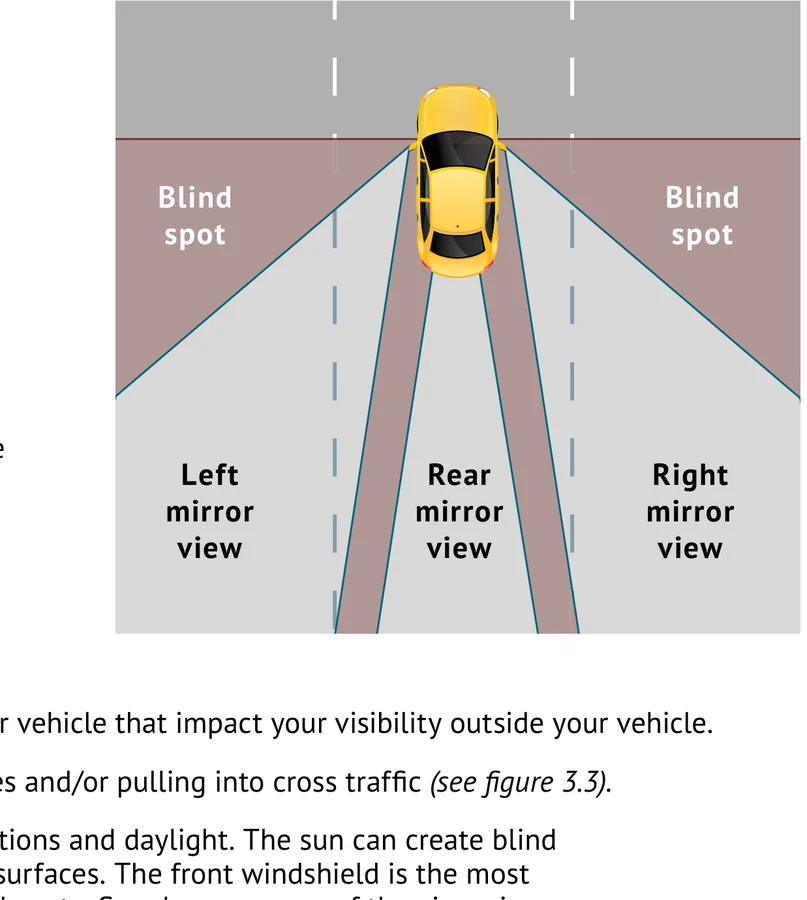
Blind spot zones diagram
Blind spots on either side, outside the mirror views

Put it into practice

On the interstate you realize you've been cruising beside a semi's trailer for a mile. Either pass promptly or drop back—never linger alongside a truck.

Check your understanding

Read the question, decide on an answer, then open it to check the explanation. These are Roadwise study questions based on the source handbook.

Why shouldn't you drive alongside a large truck or bus for an extended time?
  1. It's illegal to drive beside them
  2. Trucks have the right-of-way on highways
  3. It uses more fuel to stay beside them
  4. Their blind spots are larger than a car's

Answer: Their blind spots are larger than a car's

Large vehicles have large blind spots, and it's hard for their drivers to see vehicles alongside them.
Handbook p. 34 ↗
According to the manual, where is the most common place for glaring sun reflections that create blind spots?
  1. The rear window
  2. The front windshield
  3. The driver's side window
  4. The side mirrors

Answer: The front windshield

The sun can create blind spots with reflections off any window, and the front windshield is the most common place for them.

Handbook p. 34 ↗
What can cause blind spots besides the vehicle's own structure?
  1. Only faulty mirrors
  2. Only nighttime driving
  3. Trees, sun, or hills
  4. Only driving in reverse

Answer: Trees, sun, or hills

Blind spots can be caused by obstructions in vision from vehicle equipment and the driving environment, like trees, sun, hedges, hills, and walls.

Handbook p. 34 ↗
What should you do when passing another vehicle regarding their blind spot?
  1. Slow down and stay in their blind spot briefly
  2. Match their exact speed while passing
  3. Stay beside them until they notice you
  4. Get through their blind spot quickly

Answer: Get through their blind spot quickly

When passing, get through the other driver's blind spot as quickly as you can so they can see you.

Handbook p. 34 ↗
If you're driving in another driver's blind spot, you should speed up or slow down so they can see your vehicle.
  1. True
  2. False

Answer: True

The manual advises speeding up or slowing down so the other driver can see you when you're in their blind spot.

Handbook p. 34 ↗
Take the lesson checkpoint in the app

More in Seat Belts, Distractions & Impaired Driving