Freeways, interstates, expressways, and toll roads are usually safer than other roads: one-way traffic, few entrances, and special safety features. But high speeds make a single error disastrous, and monotony can cause boredom and fatigue.
Interstate speeds (where designated, weather permitting)
| Road | Up to |
|---|---|
| Rural interstates | 80 mph unless otherwise posted |
| Urban interstates | 65 mph unless otherwise posted |
Know the rule
Before a long trip, plan food, rest, and fuel stops. On short trips know the route and the entrance and exit numbers. Tell someone your route, how long you'll be gone, and when to expect you.
Handbook p. 83 ↗Freeway entrance
Three parts: an entrance ramp (observe traffic), an acceleration lane (reach freeway speed), and a merging area (blend into the outside lane).
Handbook p. 83 ↗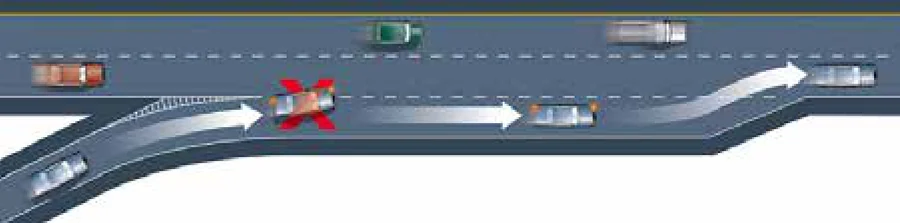
Entering a freeway:
- Make sure it's the ramp you want; never back up or U-turn through the median
- Check traffic, signal, and look over your left shoulder for a gap
- Accelerate to freeway speed as the ramp straightens
- Yield to traffic already on the highway
- At traffic speed, merge and turn off your signal
Know the rule
Median crossovers are for highway maintenance and emergency vehicles only; it is illegal for anyone else to use them. Wait for the next exit to get off or change direction.
Handbook p. 84 ↗Know the rule
Short ramps or heavy traffic: you may have to slow before the end of the acceleration lane, or even stop. Leave room ahead to speed up, wait for a big enough gap, signal, and accelerate as rapidly as you can.
Handbook p. 84 ↗Know the rule
Keep a steady speed with the flow of traffic. A minimum speed may be posted; if you can't or won't drive the posted speed, use another kind of road.
Handbook p. 85 ↗Know the rule
Usually drive in the far right or center lane; the left lane is for higher-speed traffic and passing. In rush hour, avoid the right lane so entering drivers have room.
Handbook p. 85 ↗Minimum signal time before changing lanes or exiting a freeway
Handbook p. 85 ↗Know the rule
Driving across a median barrier or unpaved strip is illegal except at an authorized opening, and never allowed on interstates; crossovers there are for emergency vehicles only.
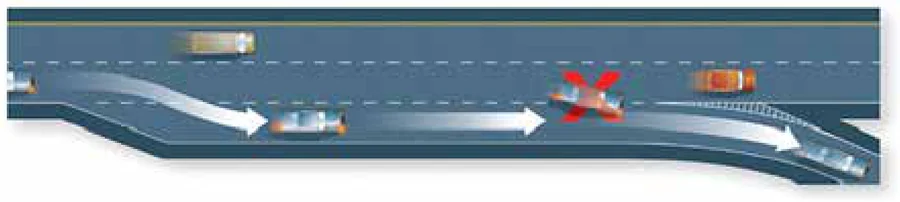
Handbook p. 85 ↗Leaving the freeway:
- About a half mile before the exit, signal and move into the lane nearest it
- Signal and move into the deceleration lane to slow without blocking traffic
- Adjust to any posted exit speed on the ramp
- Be alert for more complicated traffic and slower speeds after the ramp
Put it into practice
You realize you took the wrong on-ramp. Don't stop, back up, or cut across the median. Merge normally, drive to the next exit, and get turned around there.