roadwise.Open study app

Idaho driving lesson · Right-of-Way, Passing & Parking

Following distance and slow vehicles

A 3-minute lesson from the Idaho course. Read the rules and examples, follow the handbook page references, and check your understanding before you move on.

Read time
3 minutes
Course unit
Right-of-Way, Passing & Parking
Checkpoint questions
6
Source pages
79, 80

Tailgating, driving too close to the car ahead, is a common cause of crashes. Leave enough space to stop in any situation, and know how quickly your brakes stop you. Test them often, especially when the road is wet, icy, or snowy.

Three-second rule

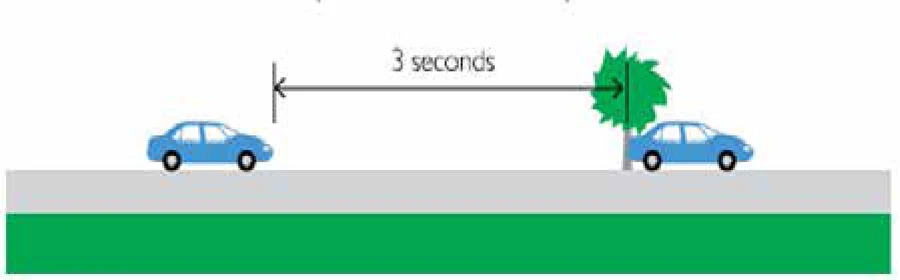
The minimum recommended following distance: at least three seconds between the moment the car ahead passes a fixed object and the moment you pass it.

Handbook p. 79 ↗

Using the three-second rule:

  • Pick a fixed object ahead, such as a sign or tree
  • When the car ahead passes it, count 'one-thousand-one, one-thousand-two, one-thousand-three'
  • If you reach the object after at least three seconds, you have room for a sudden stop
Handbook p. 79 ↗
3-second following distance rule
Three-second following distance

Know the rule

At high speeds or in bad weather, increase your following distance. In bad weather, increase the three seconds several times over.

Handbook p. 79 ↗

Space cushion

Plenty of space on all sides of your car so you have time to react to danger. Stay in the middle of your lane with room ahead to stop or pass safely.

Handbook p. 80 ↗

Know the rule

If a car follows you too closely, slow down and let it pass.

Handbook p. 80 ↗

Know the rule

A vehicle moving slower than traffic that delays three or more vehicles in a rural area or on a two-lane highway must turn off wherever safe to let them pass.

Handbook p. 79 ↗

Know the rule

Slow-moving vehicles built to go no faster than 25 mph may use public highways only in daylight: 30 minutes before sunrise to 30 minutes after sunset.

Handbook p. 79 ↗

Know the rule

Exception: snow removal and farm equipment on non-interstate highways with flashing lights visible for 500 feet. All slow-moving vehicles need a foot brake, turn signals, and the approved slow-moving vehicle emblem.

Handbook p. 79 ↗

Put it into practice

The car ahead passes a mileage sign. You count 'one-thousand-one, one-thousand-two' and you're already at the sign. You're following too closely: ease off until you reach three seconds, and stretch that further if it's raining.

Check your understanding

Read the question, decide on an answer, then open it to check the explanation. These are Roadwise study questions based on the source handbook.

The three-second rule is the minimum recommended following distance, measured:
  1. only at speeds above 55 mph
  2. from when the car ahead passes a fixed object
  3. as a fixed distance of three car lengths
  4. from when you see brake lights ahead

Answer: from when the car ahead passes a fixed object

Count three seconds from when the lead car passes a fixed point.
Handbook p. 79 ↗
In bad weather, your following distance should:
  1. be doubled only at night
  2. decrease to react faster
  3. increase several times beyond three seconds
  4. stay at three seconds regardless

Answer: increase several times beyond three seconds

Bad weather calls for several times the standard three-second gap.

Handbook p. 80 ↗
'Tailgating' is best described as:
  1. driving too far behind traffic
  2. following a large vehicle at a safe distance
  3. passing on the right
  4. driving too close to the vehicle ahead

Answer: driving too close to the vehicle ahead

Tailgating means following another vehicle too closely.

Handbook p. 79 ↗
To keep a proper space cushion, you should stay:
  1. in the middle of your lane with room to stop or pass
  2. toward the left side of your lane
  3. close to the center line for visibility
  4. close to the right edge of your lane

Answer: in the middle of your lane with room to stop or pass

Staying centered in your lane keeps a margin on all sides.

Handbook p. 80 ↗
If a car follows you too closely, you should:
  1. brake suddenly to warn them
  2. slow down and let it pass
  3. swerve to the shoulder
  4. speed up to create distance

Answer: slow down and let it pass

Slowing down lets a tailgater pass safely.

Handbook p. 80 ↗
At high speeds you should increase your following distance beyond the standard three seconds.
  1. True
  2. False

Answer: True

Higher speeds call for a longer following distance.

Handbook p. 79 ↗
Take the lesson checkpoint in the app

More in Right-of-Way, Passing & Parking