roadwise.Open study app

Idaho driving lesson · Right-of-Way, Passing & Parking

Parking and backing

A 3-minute lesson from the Idaho course. Read the rules and examples, follow the handbook page references, and check your understanding before you move on.

Read time
3 minutes
Course unit
Right-of-Way, Passing & Parking
Checkpoint questions
6
Source pages
80, 81, 82

Parking rules keep your car from blocking traffic, hiding hazards, or rolling away. Idaho's no-parking distances are classic test questions, so memorize the numbers.

18 inches

Park parallel to and within this distance of the curb or road edge, facing the same direction as traffic

Handbook p. 80 ↗

Know the rule

When you park, set the parking brake (if the car is left running), shift an automatic into park or leave a manual in gear, remove the keys, and secure your car.

Handbook p. 80 ↗

Parking on a hill

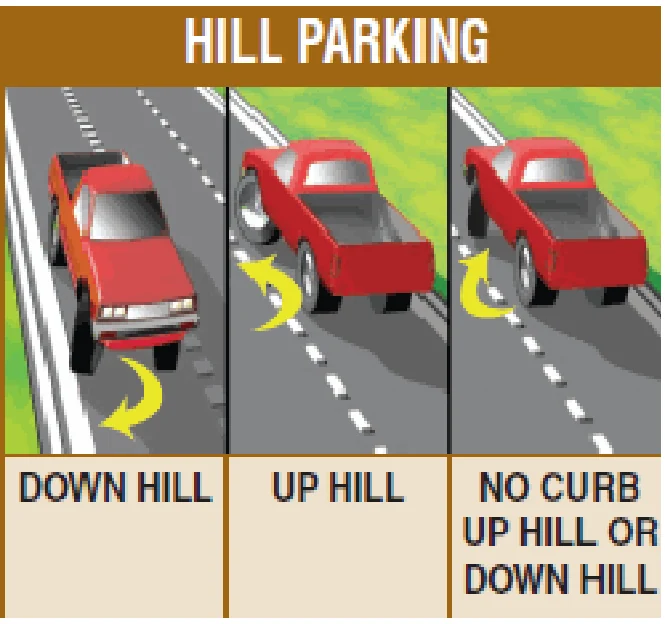
Parking on a hill
FacingTurn front wheels
DownhillSharply toward and against the curb or road edge
Uphill, with a curbSharply away from and against the curb
Uphill, no curbSharply toward the edge of the road
Handbook p. 81 ↗
Parking on a hill (wheel positioning)
Hill parking: downhill, uphill, and no curb

No parking within...

No parking within...
DistanceOf
15 feetA fire hydrant
20 feetA crosswalk
20 feetA fire station driveway
30 feetA stop sign, yield sign, or traffic signal
50 feetRailroad tracks
Handbook p. 81 ↗

Never park:

  • In bike lanes or on sidewalks
  • On the street side of a parked vehicle (double parking)
  • In intersections, or on bridges or overpasses
  • In front of a driveway
  • On any controlled-access highway (freeway)
  • Where signs or a red-painted curb prohibit it
Handbook p. 81 ↗

Know the rule

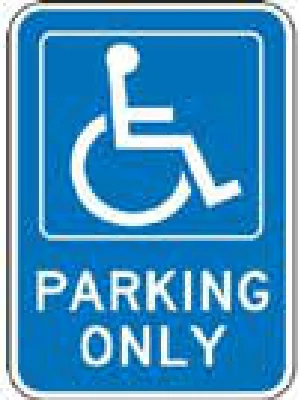
Only vehicles displaying the handicapped symbol on a plate or special card may park in handicapped spaces. Others may be fined. A handicapped person may park in reserved spaces without paying and for unlimited time.

Handbook p. 82 ↗
Reserved parking (accessible)
Handicapped parking sign

When backing:

  • Check behind the vehicle before you get in; children and small objects are hard to see
  • Put your right arm on the passenger seat back and look through the rear window; don't rely on mirrors
  • Back slowly and keep looking back until you've stopped completely
  • Avoid backing in traffic whenever possible
Handbook p. 82 ↗

Know the rule

Backing is always prohibited on freeways, expressways, and other controlled-access highways, including the shoulder. If you pass your exit, go on to the next one.

Handbook p. 82 ↗

Put it into practice

You parallel park facing uphill on a street with a curb. Pull within 18 inches of the curb, turn your front wheels sharply away from the curb so they'll catch it if the car rolls back, set the brake, and remove the keys.

Check your understanding

Read the question, decide on an answer, then open it to check the explanation. These are Roadwise study questions based on the source handbook.

When parking on a public road, you must park within how many inches of the curb?
  1. 18 inches
  2. 12 inches
  3. 24 inches
  4. 6 inches

Answer: 18 inches

Parallel parking must be within 18 inches of the curb.
Handbook p. 80 ↗
Parking is not allowed within how many feet of a fire hydrant?
  1. 25 feet
  2. 15 feet
  3. 10 feet
  4. 20 feet

Answer: 15 feet

No parking within 15 feet of a fire hydrant.

Handbook p. 81 ↗
Parking is not allowed within how many feet of a crosswalk?
  1. 15 feet
  2. 10 feet
  3. 20 feet
  4. 30 feet

Answer: 20 feet

No parking within 20 feet of a crosswalk.

Handbook p. 81 ↗
Parking is not allowed within how many feet of a stop sign, yield sign, or traffic signal?
  1. 50 feet
  2. 20 feet
  3. 15 feet
  4. 30 feet

Answer: 30 feet

No parking within 30 feet of these traffic controls.

Handbook p. 81 ↗
Parking is not allowed within how many feet of railroad tracks?
  1. 50 feet
  2. 30 feet
  3. 100 feet
  4. 15 feet

Answer: 50 feet

No parking within 50 feet of railroad tracks.

Handbook p. 81 ↗
When you park facing uphill, how should you turn your front wheels?
  1. Toward the curb; away from the edge if no curb
  2. Straight ahead, with or without a curb
  3. Toward the curb, with or without a curb
  4. Away from the curb; toward the edge if no curb

Answer: Away from the curb; toward the edge if no curb

Facing uphill, turn your wheels sharply away from the curb; if there is no curb, turn them sharply toward the edge of the road.

Handbook p. 81 ↗
Take the lesson checkpoint in the app

More in Right-of-Way, Passing & Parking