Most cars can go far faster than the driver, road or vehicle can handle. Excessive speed for conditions is most often listed as a crash cause, and every extra mile per hour adds stopping distance.
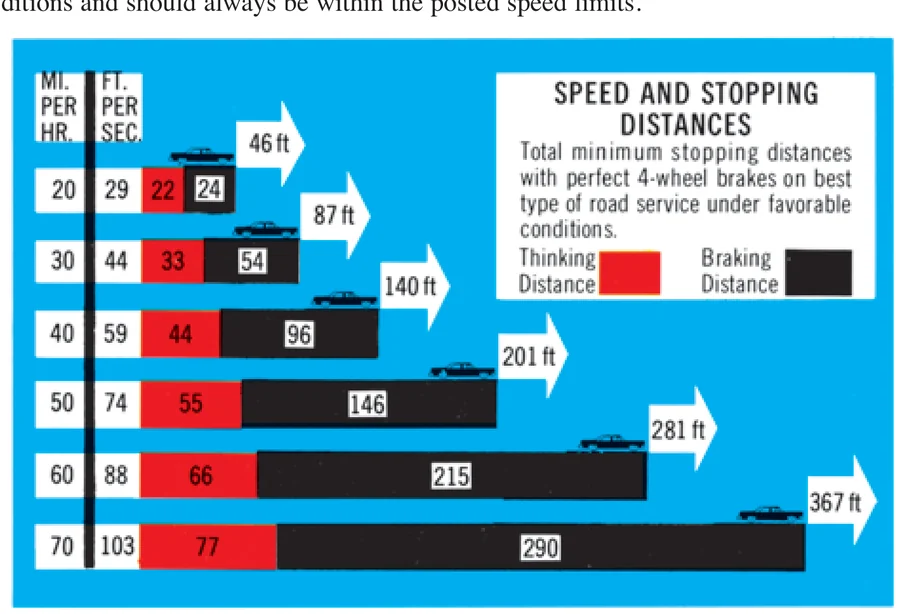
Total minimum stopping distance (ideal conditions)
| Speed | Thinking | Braking | Total |
|---|---|---|---|
| 20 mph | 22 ft | 24 ft | 46 ft |
| 30 mph | 33 ft | 54 ft | 87 ft |
| 40 mph | 44 ft | 96 ft | 140 ft |
| 50 mph | 55 ft | 146 ft | 201 ft |
| 60 mph | 66 ft | 215 ft | 281 ft |
| 70 mph | 77 ft | 290 ft | 367 ft |
Keeping a safe speed:
- Keep pace with traffic; if you can't, move as far right as possible
- Keep a safe following interval
- Maintain a steady speed – bursts of speed and hard braking are wasteful and dangerous
- Slow down for poor road or weather conditions
- Never let emotions set your speed
Know the rule
Two-second rule: when the vehicle ahead passes a fixed marker, count 'one thousand one, one thousand two.' If you reach 'two' before you get to the marker, you have at least two seconds. Never have less.
Handbook p. 67 ↗Turns and curves:
- Get into the proper lane well ahead; if you miss it, turn elsewhere
- Make precise turns – don't swing wide or cut short
- Slow before the curve or turn, then hold a steady speed
- Avoid left and U-turns when possible – they're more hazardous
- Watch for hidden pedestrians, bicyclists and motorcyclists
- Don't drive in a bike lane when turning right
- Waiting to turn left, keep wheels straight until it's clear
Safe passing on two- or three-lane roads:
- Pass only if the vehicle ahead is below the safe speed – not just because it's there
- In a line of cars, let those ahead pass the lead vehicle first
- Pass on the left; pass left-turners carefully on the right, never on the shoulder
- Check ahead, SIGNAL, check behind, sound your horn
- Speed up in your lane, then move left and pass
Know the rule
If a conflict appears mid-pass, brake sharply and return behind the vehicle. Don't try to speed up: brakes cut speed faster than power adds it.
Handbook p. 68 ↗Know the rule
Return to your lane when you can see the passed vehicle in your interior rear-view mirror.
Handbook p. 68 ↗Know the rule
On roads with two or more lanes your way, never use an opposing lane to pass. You may pass on either side, but be careful on the right, in the driver's blind spot.
Handbook p. 68 ↗Know the rule
Never try to pass when approaching or moving through an intersection or crosswalk.
Handbook p. 68 ↗Clues a parked car may pull out:
- Movement in or near the vehicle
- Lit stop, back-up or signal lamps
- Smoke or vapor from the exhaust
- Front wheels turning
Know the rule
When a vehicle has just parked, assume the driver will open the door as you approach.
Handbook p. 69 ↗Know the rule
Stopping unnecessarily in a lane is illegal. Load, unload or chat only in a parking space, loading zone or other place out of traffic, never in an intersection or crosswalk.
Handbook p. 69 ↗Put it into practice
You're doing 60 mph and a hazard appears. Under ideal conditions you'll travel 66 feet before braking even starts and 281 feet total. On wet roads or with a slower reaction, it's farther.