roadwise.Open study app

Hawaii driving lesson · Safe Driving Techniques

Backing, entering traffic, roundabouts and lane changes

A 4-minute lesson from the Hawaii course. Read the rules and examples, follow the handbook page references, and check your understanding before you move on.

Read time
4 minutes
Course unit
Safe Driving Techniques
Checkpoint questions
6
Source pages
64, 65, 66

Backing, pulling into traffic and changing lanes all mean moving into space someone else may be using. The driver making the move carries the responsibility, so each has a set procedure.

Backing safely:

  • Check the area behind the vehicle before you get in
  • Turn around and look – don't rely on mirrors
  • If you can't see, have someone outside guide you
  • Tap the brakes gently when you start, to check them
  • Always back slowly; watch the front for clearance when turning
  • Avoid backing into traffic or across a roadway; park so you leave going forward
Handbook p. 64 ↗

Know the rule

The driver leaving a parking space has the chief responsibility for avoiding a collision. Be extra careful backing in residential areas, where children play behind and between cars.

Handbook p. 64 ↗

Entering traffic from a driveway:

  • Always stop before entering the roadway, before crossing the sidewalk (failing to stop is unlawful)
  • Move forward slowly, watching for pedestrians and oncoming vehicles
  • Make sure the lane is clear
  • Enter the nearest lane with a right turn whenever possible, then speed up to traffic speed
Handbook p. 64 ↗

Know the rule

From a parallel-parked spot, move forward into the nearest lane when there's enough space. From a diagonal spot, you must back out first, which is more dangerous and takes longer.

Handbook p. 65 ↗

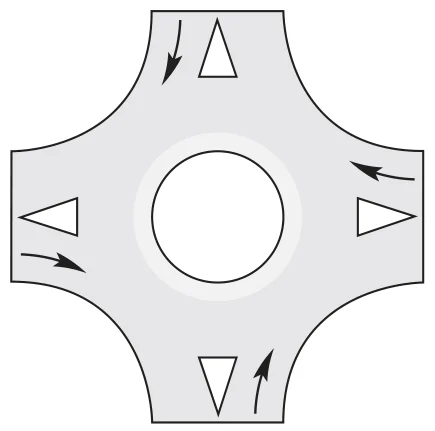
Roundabout

A one-way circular intersection in which entering traffic must yield the right-of-way to circulating traffic. Each approach has a yield sign and may have yield lines.

Handbook p. 65 ↗
Roundabout diagram (schematic)
Roundabout: yield on entry and travel counterclockwise

Driving a roundabout:

  • Slow down as you approach
  • Yield to pedestrians and bicyclists entering and exiting
  • Look left and yield to traffic already in the roundabout
  • Drive right of the central island, counterclockwise, at low speed
  • Use your right turn signal to exit
  • Missed your exit? Go around again
Handbook p. 65 ↗

Choosing a lane

Choosing a lane
Lanes your wayWhich to use
OneThat lane – use great care in congestion
TwoRight lane in free flow; left to pass or for merges
Three or moreCenter lanes; right lane if slower
Handbook p. 65 ↗
100 feet

Required signal distance before a lane change

Handbook p. 65 ↗

Changing lanes:

  • Check ahead, sides and rear; use mirrors and turn your head for blind spots
  • Signal well in advance
  • Move gradually; abrupt moves can make you lose control
  • Better to slow and slip in behind a car than speed up and cut in
  • Always yield to vehicles in the other lane; if it's congested, enter at the end of the line
Handbook p. 65 ↗

Know the rule

Never change lanes when approaching or moving through intersections and crosswalks.

Handbook p. 66 ↗

Put it into practice

You're entering a roundabout and a car is already circling toward you from the left. Yield and let it pass, then enter, go counterclockwise and signal right as you approach your exit.

Check your understanding

Read the question, decide on an answer, then open it to check the explanation. These are Roadwise study questions based on the source handbook.

Before backing your vehicle, you should:
  1. rely on your rear-view mirrors only
  2. turn around and look to the rear
  3. use your side mirrors only
  4. sound the horn and back quickly

Answer: turn around and look to the rear

Turn around and look to the rear; the view in rear-view mirrors is too small for backing safely.
Handbook p. 64 ↗
When backing, you should generally:
  1. back quickly to limit time in traffic
  2. back into the lane farthest from the edge
  3. back slowly and test the brakes gently at the start
  4. brake firmly only at the end

Answer: back slowly and test the brakes gently at the start

Back slowly, applying the brakes gently as you start the movement.

Handbook p. 64 ↗
When entering traffic from a driveway, you must:
  1. stop only if a pedestrian is in view
  2. yield without stopping if it looks clear
  3. sound the horn, then proceed slowly
  4. always stop first

Answer: always stop first

You must stop before entering the roadway, then proceed slowly and watchfully.

Handbook p. 64 ↗
In a roundabout, entering traffic must:
  1. stop completely regardless of traffic
  2. yield to traffic already circulating
  3. always exit at the first opportunity
  4. have the right-of-way over circulating traffic

Answer: yield to traffic already circulating

Entering traffic must yield to vehicles already circulating in the roundabout.

Handbook p. 65 ↗
On a road with three or more lanes in your direction, the safest lane for through traffic with fewer conflicts is generally:
  1. the center lane(s)
  2. the far left lane
  3. the far right lane
  4. any lane, it makes no difference

Answer: the center lane(s)

Center lanes generally have fewer traffic conflicts on roads with three or more lanes.

Handbook p. 65 ↗
You should never change lanes when:
  1. traffic is light
  2. driving on a freeway
  3. driving below the speed limit
  4. approaching or moving through an intersection or crosswalk

Answer: approaching or moving through an intersection or crosswalk

Lane changes should never be made through an intersection or crosswalk.

Handbook p. 66 ↗
Take the lesson checkpoint in the app

More in Safe Driving Techniques