roadwise.Open study app

Colorado driving lesson · Speed, Turning & Parking

Speed limits & stopping distance

A 3-minute lesson from the Colorado course. Read the rules and examples, follow the handbook page references, and check your understanding before you move on.

Read time
3 minutes
Course unit
Speed, Turning & Parking
Checkpoint questions
6
Source pages
15

Speed is the greatest factor in how severe a crash is, and many fatal Colorado crashes involve driving too fast. Posted limits are for ideal conditions. Colorado also sets default limits that apply whenever no other limit is posted.

Know the rule

Speed limit signs show the maximum speed in ideal conditions. Slow down for poor weather, and near railroad tracks, pedestrians, bicyclists, animals and school buses.

Handbook p. 15 ↗

Know the rule

Some roads, such as freeways, have minimum limits. Driving slower than the minimum is a violation unless road or weather conditions require it.

Handbook p. 15 ↗

Know the rule

Driving much slower than the posted speed in normal conditions can disrupt traffic flow and create unsafe situations.

Handbook p. 15 ↗

Colorado limits unless otherwise posted

Colorado limits unless otherwise posted
WhereLimit
Narrow, winding mountain highways; blind curves20 mph
Any business district25 mph
Any residence district30 mph
Open mountain highways40 mph
Vehicles in the business of hauling trash45 mph
Urban interstates and highways55 mph
Designated rural interstates and highways65-75 mph
Handbook p. 15 ↗

Know the rule

Cities or towns may adopt lower speed limits by ordinance.

Handbook p. 15 ↗

Stopping distance

The distance your vehicle travels from when you realize you must stop until it actually stops.

Handbook p. 15 ↗

Stopping distance depends on:

  • Your speed
  • The time it takes to recognize you need to stop
  • How quickly you react
  • The time your brakes take to slow and stop the vehicle
Handbook p. 15 ↗
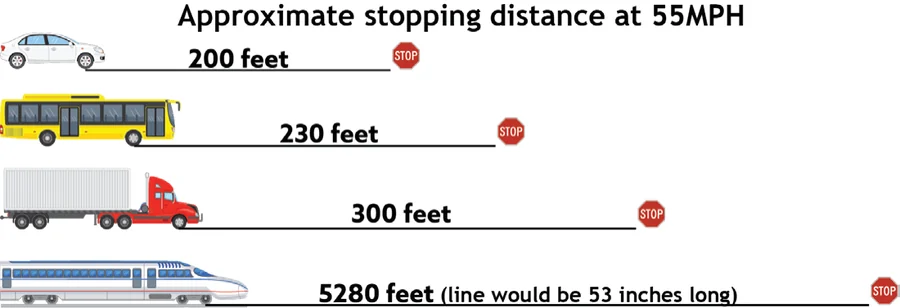
Stopping distance comparison by vehicle type (55 mph)
Approximate stopping distances at 55 mph

Approximate stopping distance at 55 mph (ideal conditions)

Approximate stopping distance at 55 mph (ideal conditions)
VehicleDistance
Lightweight passenger carAbout 200 feet
Bus230 feet
Truck300 feet
Train5,280 feet
Handbook p. 15 ↗

Know the rule

Sudden stops are dangerous and often come from inattention or following too closely. Braking too hard can cause a skid and make it hard for drivers behind you to stop.

Handbook p. 15 ↗

Put it into practice

Driving through a neighborhood with no posted signs, you're in a residence district, so the limit is 30 mph. Downtown among shops with no signs? That's a business district: 25 mph.

Check your understanding

Read the question, decide on an answer, then open it to check the explanation. These are Roadwise study questions based on the source handbook.

Unless otherwise posted, what is the speed limit in a residence district in Colorado?
  1. 25 mph
  2. 35 mph
  3. 20 mph
  4. 30 mph

Answer: 30 mph

Unless posted otherwise, the Colorado speed limit in a residence district is 30 mph.
Handbook p. 15 ↗
Unless otherwise posted, what is the speed limit in a business district in Colorado?
  1. 35 mph
  2. 25 mph
  3. 30 mph
  4. 20 mph

Answer: 25 mph

Unless posted otherwise, the speed limit in a business district is 25 mph.

Handbook p. 15 ↗
Unless otherwise posted, what is the speed limit on narrow, winding mountain highways and blind curves?
  1. 15 mph
  2. 30 mph
  3. 20 mph
  4. 25 mph

Answer: 20 mph

The default speed limit on narrow, winding mountain highways and blind curves is 20 mph.

Handbook p. 15 ↗
Unless otherwise posted, what is the speed limit on open mountain highways?
  1. 30 mph
  2. 45 mph
  3. 40 mph
  4. 50 mph

Answer: 40 mph

Unless posted otherwise, the speed limit on open mountain highways is 40 mph.

Handbook p. 15 ↗
Unless otherwise posted, what is the default speed limit on urban interstates and highways?
  1. 55 mph
  2. 65 mph
  3. 45 mph
  4. 50 mph

Answer: 55 mph

Unless posted otherwise, the default speed limit on urban interstate and highways is 55 mph.

Handbook p. 15 ↗
According to the National Safety Council figure in the handbook, about how far does a lightweight passenger car traveling 55 mph need to stop?
  1. About 50 feet
  2. About 100 feet
  3. About 500 feet
  4. About 200 feet

Answer: About 200 feet

The handbook cites that a lightweight passenger car at 55 mph can stop in about 200 feet under ideal conditions.

Handbook p. 15 ↗
Take the lesson checkpoint in the app

More in Speed, Turning & Parking