A 3-minute lesson from the Colorado course. Read the rules and examples, follow the handbook page references, and check your understanding before you move on.
A good turn has four parts: signal early enough, search for anyone crossing your path, start and finish in the correct lane, and follow the correct path. Failing to signal is a traffic violation.
Know the rule
Signal before any turn: onto another road, into a parking lot, into another lane, or when pulling out from a parked position.
Turning right: start in the rightmost lane and turn from the right-most part of it, as close to the curb as possible. Turning left: be in the left side of your lane.
Waiting to turn left, stay at the stop line or crosswalk until there's a big enough gap. Pulling into the intersection blocks emergency vehicles and limits oncoming drivers' view.
You're waiting to turn left across a busy road. Keep your wheels pointed straight, stay behind the stop line, and watch for oncoming bikes and motorcycles. Turn only when the gap is large enough to finish safely.
Check your understanding
Read the question, decide on an answer, then open it to check the explanation. These are Roadwise study questions based on the source handbook.
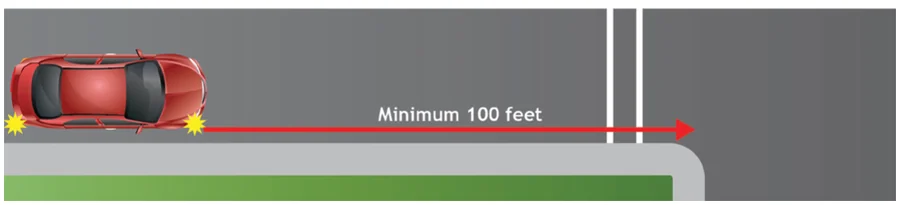
In urban areas, how far before a turn or lane change must you signal continuously?
200 feet
100 feet
300 feet
50 feet
Answer: 100 feet
In urban areas, you must signal continuously for 100 feet before making a turn or lane change.