roadwise.Open study app

Colorado driving lesson · Speed, Turning & Parking

Parking rules

A 3-minute lesson from the Colorado course. Read the rules and examples, follow the handbook page references, and check your understanding before you move on.

Read time
3 minutes
Course unit
Speed, Turning & Parking
Checkpoint questions
6
Source pages
16, 17

Parking isn't just finding a space. Secure the vehicle, avoid prohibited spots, and on hills turn your wheels so a rolling car ends up against the curb or off the road instead of in traffic.

Know the rule

Leave an automatic in park. With a standard transmission, leave it in low gear facing uphill and reverse gear facing downhill.

Handbook p. 16 ↗

Know the rule

Set the emergency brake and remove the ignition key when leaving the vehicle.

Handbook p. 16 ↗

Never park:

  • On a crosswalk, sidewalk, bridge, elevated structure, railroad tracks or any controlled access highway
  • Within 30 feet of a traffic signal, stop sign or railroad crossing
  • Within 15 feet of a fire hydrant
  • Within an intersection, tunnel, runaway truck ramp or on/off ramp
  • Blocking a driveway
  • In a bike lane
Handbook p. 16 ↗
12 inches

Maximum distance from the curb when parallel parking

Handbook p. 17 ↗

Know the rule

Where parallel parking is allowed, park within 12 inches of the curb, or as close as possible to the outside edge of the shoulder, so traffic isn't blocked or slowed.

Handbook p. 17 ↗

Parallel parking steps:

  • Stop even with the vehicle ahead
  • Turn the wheel sharply right; back slowly toward the car behind
  • Once clear of the car ahead, turn sharply left and keep backing slowly
  • Turn sharply right and pull toward the curb, centered in the space
  • To leave: signal, check mirrors and blind spots, pull out when safe
Handbook p. 16 ↗
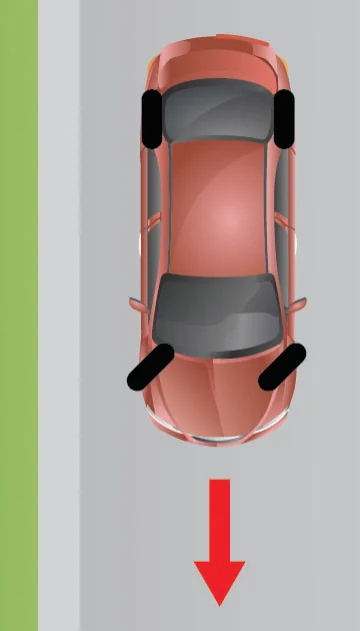
Vehicle lane position on roadway (opposite direction)
Downhill parking: wheels toward the curb

Which way to turn your wheels

Which way to turn your wheels
SituationFront wheels
Downhill, with curbToward the curb; roll until the tire rests on it
Uphill, with curbAway from curb; roll back until it touches
Uphill, no curbTo the right
Downhill, no curbTo the right
Handbook p. 17 ↗

Know the rule

With no curb, turn the wheels right so that if the vehicle moves, it rolls off the highway, not into the roadway.

Handbook p. 17 ↗

Put it into practice

You park facing uphill on a street with a curb. Turn the front wheels away from the curb (left) and let the car roll back gently until the back of the front tire rests against the curb.

Check your understanding

Read the question, decide on an answer, then open it to check the explanation. These are Roadwise study questions based on the source handbook.

How close to the curb must your vehicle be when parallel parking, where permitted?
  1. Within 12 inches of it
  2. Within 3 feet of the curb
  3. Within 18 inches of the curb
  4. Within 6 inches of the curb

Answer: Within 12 inches of it

Where parallel parking is permitted, your vehicle must be within 12 inches of the curb, or as close as possible to the shoulder edge.
Handbook p. 17 ↗
How close to a fire hydrant is parking prohibited?
  1. Within 20 feet
  2. Within 15 feet
  3. Within 10 feet
  4. Within 30 feet

Answer: Within 15 feet

You may not park within 15 feet of a fire hydrant.

Handbook p. 16 ↗
How close to a traffic signal, stop sign, or railroad crossing is parking prohibited?
  1. Within 30 feet
  2. Within 15 feet
  3. Within 50 feet
  4. Within 10 feet

Answer: Within 30 feet

Parking is prohibited within 30 feet of a traffic signal, stop sign, or railroad crossing.

Handbook p. 16 ↗
When parking downhill facing a curb, which direction should you turn your front wheels?
  1. It does not matter
  2. Straight ahead
  3. Away from the curb
  4. Toward the curb

Answer: Toward the curb

When parked facing downhill with a curb present, turn your front wheels toward the curb so the tire rests against it.

Handbook p. 17 ↗
When parking uphill with no curb present, which direction should you turn your front wheels?
  1. To the left
  2. Straight ahead
  3. Either way, if the brake is set
  4. To the right

Answer: To the right

With no curb, turn your wheels to the right whether parking uphill or downhill, so a rolling vehicle moves off the road, not into it.

Handbook p. 17 ↗
If your vehicle has a standard (manual) transmission, what gear should you leave it in when parked facing uphill?
  1. Low gear
  2. Any gear is acceptable
  3. Reverse gear
  4. Neutral

Answer: Low gear

With a manual transmission, leave the vehicle in low gear when headed uphill, and in reverse gear when headed downhill.

Handbook p. 16 ↗
Take the lesson checkpoint in the app

More in Speed, Turning & Parking