roadwise.Open study app

Colorado driving lesson · Freeway Driving, Lane Changes & Passing

Entering, driving & leaving the freeway

A 3-minute lesson from the Colorado course. Read the rules and examples, follow the handbook page references, and check your understanding before you move on.

Read time
3 minutes
Course unit
Freeway Driving, Lane Changes & Passing
Checkpoint questions
6
Source pages
17, 18

Freeways move more traffic at higher speeds than other roads, so you need to stay aware of everything around you. Ramps are built to let you speed up before merging and slow down after exiting.

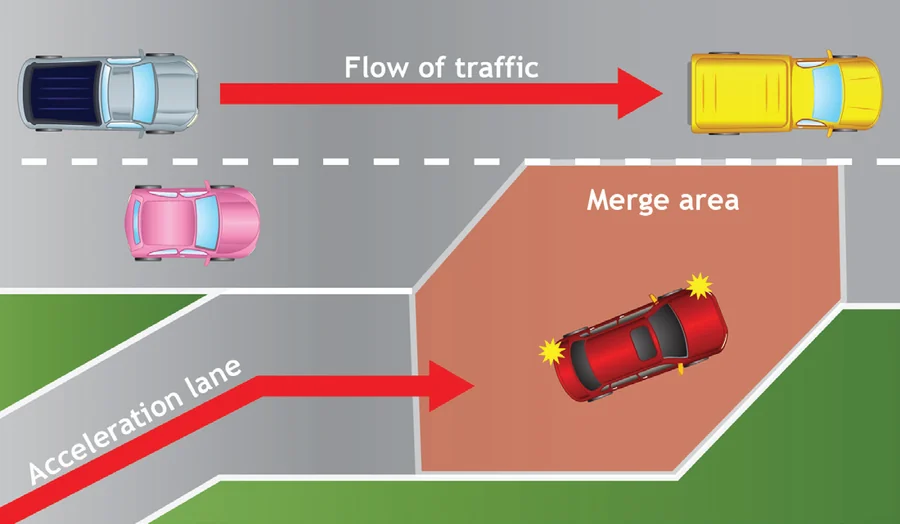
Freeway on-ramp acceleration lane merge
Acceleration lane and merge area

Know the rule

Entering: signal, look for an opening, accelerate to the speed of traffic on the ramp, and merge when safe. You must yield the right-of-way to freeway traffic.

Handbook p. 17 ↗

Know the rule

Don't merge until the solid white line has ended, and don't stop in the acceleration lane unless absolutely necessary.

Handbook p. 17 ↗

Know the rule

On metered ramps, stop and wait for a green light before entering the freeway.

Handbook p. 17 ↗

On the freeway:

  • Drive in the rightmost lane when you're slower than normal speed
  • Leftmost (passing) lane: for passing, left turns, or when traffic is too heavy to merge right
  • If safe, move over near merge areas to make room for entering vehicles
  • Watch ahead, around and behind you, including your blind spots
  • Plan ahead using directional and guidance signs
  • Never drive across, over or within a median or island
Handbook p. 17 ↗
200 feet

Minimum signaling distance before changing lanes on the freeway

Handbook p. 17 ↗

Know the rule

Avoid frequent lane changes.

Handbook p. 17 ↗
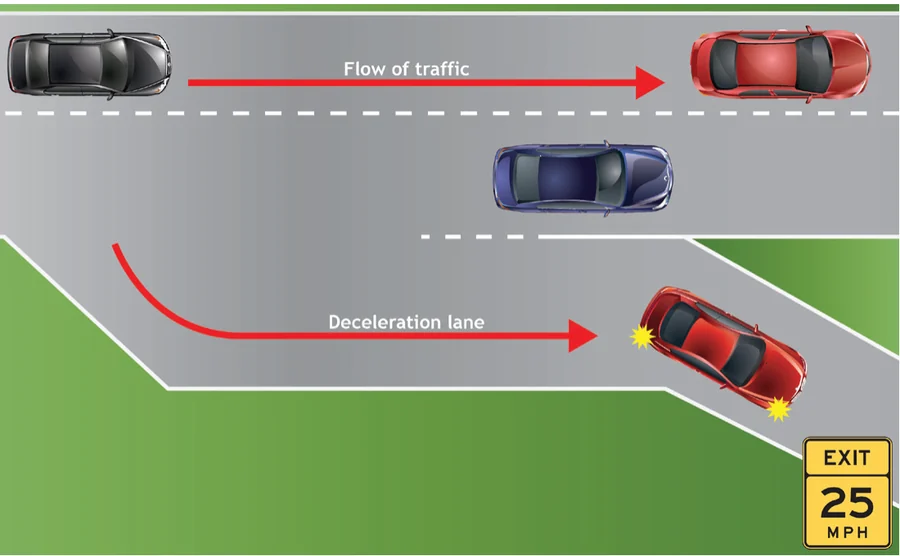
Freeway exit deceleration lane
Exiting through the deceleration lane

Know the rule

Exiting: signal 200 feet before the deceleration lane begins. Keep your speed until you're in the deceleration lane, then slow to the ramp's advised speed.

Handbook p. 18 ↗

Exit tips:

  • Keep your speed consistent with traffic while on the freeway
  • Don't exit at the last second
  • Slow down after turning into the deceleration lane; don't exceed the ramp's posted limit
Handbook p. 18 ↗

Put it into practice

Your exit is 1 mile ahead and you're in the left lane. Work your way right early, signaling 200 feet before each lane change. At the deceleration lane, signal, move in at freeway speed, then slow to the ramp speed.

Check your understanding

Read the question, decide on an answer, then open it to check the explanation. These are Roadwise study questions based on the source handbook.

On a metered freeway entrance ramp, what must you do?
  1. Merge immediately without stopping
  2. Stop only if traffic is heavy
  3. Stop and wait for the green light
  4. Stop, then merge when you see a gap

Answer: Stop and wait for the green light

On metered ramps, you must stop and wait to be released on a green light before entering the freeway.
Handbook p. 17 ↗
When entering a freeway, you should not merge into traffic until what happens?
  1. You reach the end of the ramp
  2. You reach 55 mph
  3. The acceleration lane begins
  4. The solid white line has ended

Answer: The solid white line has ended

Do not merge into traffic until the solid white line has ended.

Handbook p. 17 ↗
Which freeway lane is reserved for passing and left turns?
  1. The HOV lane
  2. The rightmost lane
  3. Any center lane
  4. The leftmost lane

Answer: The leftmost lane

The passing lane, the leftmost lane, is reserved for passing vehicles, left turns, and situations where merging isn't possible.

Handbook p. 17 ↗
How far before the deceleration lane should you activate your turn signal when exiting a freeway?
  1. 50 feet
  2. 100 feet
  3. 200 feet
  4. 500 feet

Answer: 200 feet

Activate your turn signal 200 feet before the beginning of the deceleration lane when leaving a freeway.

Handbook p. 18 ↗
When should you drive in the rightmost freeway lane?
  1. Only during rush hour
  2. Only when exiting within the next mile
  3. When slower than traffic
  4. At all times, regardless of speed

Answer: When slower than traffic

You should drive in the rightmost lane when driving slower than the normal speed of surrounding traffic.

Handbook p. 17 ↗
What speed should you maintain as you approach a freeway exit, before entering the deceleration lane?
  1. It does not matter as long as you signal
  2. Match the posted exit-ramp speed immediately
  3. Begin slowing a mile before the exit
  4. Your normal speed, then slow in the deceleration lane

Answer: Your normal speed, then slow in the deceleration lane

Maintain your speed until you enter the deceleration lane, then slow down to the speed advised for the exit ramp.

Handbook p. 18 ↗
Take the lesson checkpoint in the app

More in Freeway Driving, Lane Changes & Passing