roadwise.Open study app

Colorado driving lesson · Freeway Driving, Lane Changes & Passing

Changing lanes safely

A 2-minute lesson from the Colorado course. Read the rules and examples, follow the handbook page references, and check your understanding before you move on.

Read time
2 minutes
Course unit
Freeway Driving, Lane Changes & Passing
Checkpoint questions
5
Source pages
18

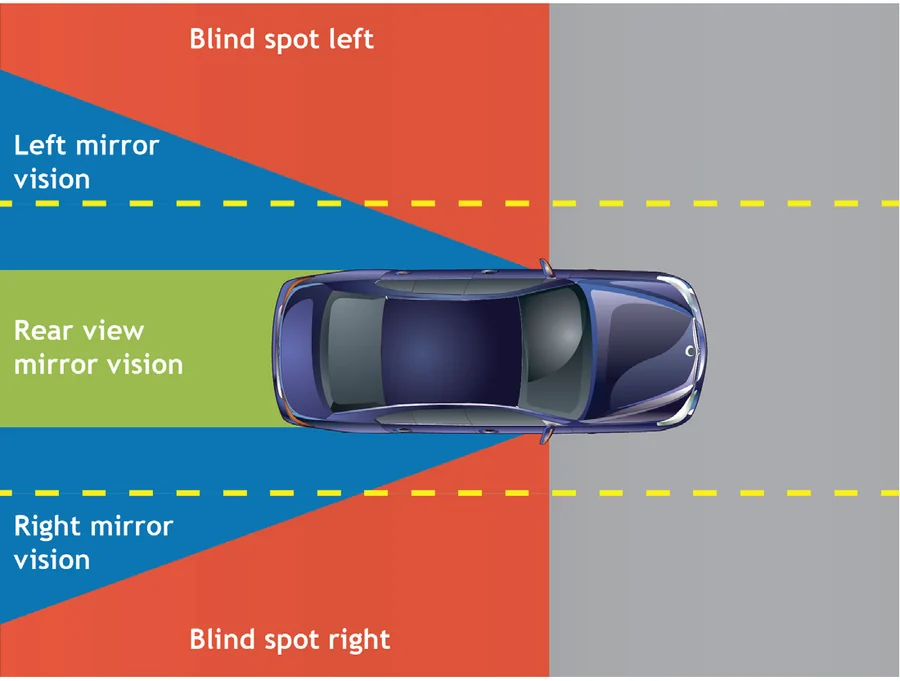
Changing lanes includes moving from one lane to another, passing, merging from an entrance ramp and pulling out from the curb or shoulder. Every time, check ahead, beside and behind, including your blind spots.

Blind spot

An area slightly to the side and rear of your vehicle that you can't see in your rearview or side mirrors.

Handbook p. 18 ↗
Blind spots and mirror vision zones
Mirror views and blind spots

To change lanes:

  • Turn on your signal: at least 3 seconds or 200 feet before leaving your lane
  • Check traffic ahead
  • Use your mirrors to check traffic behind
  • Look over your shoulder to check your blind spot
  • When safe, move into the new lane
  • Once centered, check the mirror for traffic behind you
Handbook p. 18 ↗
3 seconds

Turn off your signal within this time after completing the lane change

Handbook p. 18 ↗

Know the rule

You must yield to vehicles already in the lane you want to enter. Don't change lanes if another vehicle must slow down for you.

Handbook p. 14 ↗

Know the rule

Before changing lanes, backing up or turning, check your path and blind spots for bicyclists.

Handbook p. 26 ↗

Put it into practice

Your mirrors look clear for a move to the left lane. Before steering, glance over your left shoulder: a small car may be sitting in your blind spot. Only move over once that check is clear too.

Check your understanding

Read the question, decide on an answer, then open it to check the explanation. These are Roadwise study questions based on the source handbook.

When changing lanes, how long or how far must you keep your turn signal active before leaving your lane?
  1. A minimum of 1 second
  2. A minimum of 10 seconds
  3. There is no minimum
  4. A minimum of 3 seconds or 200 feet

Answer: A minimum of 3 seconds or 200 feet

Leave your turn signal active for a minimum of 3 seconds or 200 feet before leaving your lane.
Handbook p. 18 ↗
What is a blind spot?
  1. The area directly in front of your headlights
  2. Any area behind a large truck
  3. An area to the side and rear of your vehicle you cannot see in your mirrors
  4. The windshield's lower edge

Answer: An area to the side and rear of your vehicle you cannot see in your mirrors

A blind spot is an area slightly to the side and rear of your vehicle that you cannot see using your mirrors.

Handbook p. 18 ↗
Within how many seconds should you deactivate your turn signal after completing a lane change?
  1. 10 seconds
  2. There is no time limit
  3. 3 seconds
  4. 1 second

Answer: 3 seconds

You should deactivate your turn signal within 3 seconds of completing the lane change.

Handbook p. 18 ↗
After you are centered in your new lane during a lane change, what should you check?
  1. The lane you just left
  2. Your mirror for traffic behind you
  3. Your blind spot on the other side
  4. The traffic signal ahead

Answer: Your mirror for traffic behind you

After you are centered in the new lane, check the mirror for traffic behind you.

Handbook p. 18 ↗
You must check your blind spot by looking over your shoulder before changing lanes.
  1. True
  2. False

Answer: True

Mirrors alone don't show your blind spot, so a shoulder check is required before changing lanes.

Handbook p. 18 ↗
Take the lesson checkpoint in the app

More in Freeway Driving, Lane Changes & Passing