A 4-minute lesson from the Colorado course. Read the rules and examples, follow the handbook page references, and check your understanding before you move on.
Bicycles are vehicles, and people riding them have most of the same rights and duties as drivers. They're also smaller and far more vulnerable, and some are children. Actively look for them and judge their speed carefully.
Know the rule
Bicyclists ride as far right as they judge safe, but may use the center of the lane for visibility, on narrow roads, or to avoid car doors, broken glass or drainage grates.
When passing bicyclists, even in a bike lane, give at least three feet from the outermost part of your vehicle. You may cross a double yellow line with no oncoming traffic to do so; if you can't, slow and stay behind.
Bike riders have the right-of-way in bike lanes, which continue through intersections. Don't stop, park or drive in a bike lane or path; you may cross one to turn or enter a road, driveway or alley.
Since 2022, when the intersection is clear and they already have the right-of-way, bicyclists 15 and older may treat stop signs as yield signs and stop lights as stop signs.
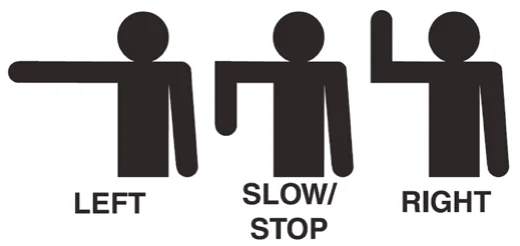
A bicyclist may not be able to signal if they need both hands on the handlebars. Watch for other clues, like turning their head or looking over their shoulder.
You're parked on a busy street and about to get out. Check to the side and rear for bicyclists, then reach across with your right hand, the one closest to the center of the car, to open the driver's door. That's the Dutch Reach.
Check your understanding
Read the question, decide on an answer, then open it to check the explanation. These are Roadwise study questions based on the source handbook.
When passing a bicyclist, the 3-foot minimum is measured from what part of your vehicle?
The center of your lane
Your front bumper
The outermost part, including mirrors
Your driver's side door
Answer: The outermost part, including mirrors
Passing motorists must give at least three feet from the outermost part of the vehicle or any attachments, such as mirrors or trailers.
What is the 'Dutch Reach' technique for opening a vehicle door?
Opening the door only an inch at first
Using your elbow to push the door open
Opening the door only when the engine is off
Opening it with the hand farthest from the door
Answer: Opening it with the hand farthest from the door
The Dutch Reach means using the hand closest to the vehicle's center (farthest from the door) to open it, which naturally makes you look back for bicyclists.
Under the 2022 Colorado law, can a 16-year-old bicyclist always treat a stop sign as a yield sign, regardless of traffic conditions?
No, only when the intersection is clear and they already have the right-of-way
No, this law only applies to stop lights, not stop signs
Yes, always, once they turn 15
Yes, but only at night
Answer: No, only when the intersection is clear and they already have the right-of-way
The 2022 law allows bicyclists 15 and older to treat stop signs as yield signs only when the intersection is clear and they already have the right-of-way.