roadwise.Open study app

Colorado driving lesson · Sharing the Road

Light rail

A 3-minute lesson from the Colorado course. Read the rules and examples, follow the handbook page references, and check your understanding before you move on.

Read time
3 minutes
Course unit
Sharing the Road
Checkpoint questions
6
Source pages
24, 25

RTD runs Light Rail Vehicles (LRVs) in the Denver metro area. On some streets they run the same direction as traffic, on others the opposite direction. They obey signals and signs like any motorist, but they're huge and can't stop quickly.

Know the rule

LRVs are governed by all traffic signals and signs and have the same rights and responsibilities as other motorists on the streets.

Handbook p. 24 ↗
40 tons

Weight a single light rail car can reach, which is why it can't stop quickly

Handbook p. 24 ↗
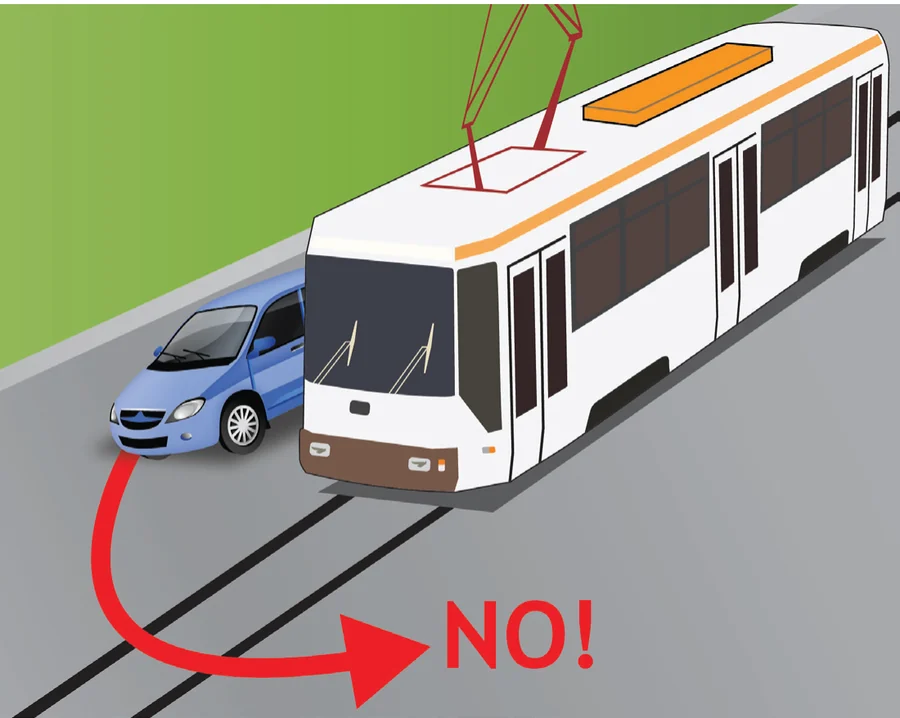
Do not cut in front of a light rail vehicle
Never turn in front of a light rail vehicle

Light rail safety:

  • Never turn in front of an approaching LRV
  • Never turn across light rail tracks without checking all directions
  • Watch for people getting on and off a stopped LRV
  • Stay alert: buildings and foliage can hide LRVs
Handbook p. 24 ↗

Know the rule

Light rail crossings may use regular traffic lights, warning lights or gates with railroad-type arms. All mean the same thing: stop and do not cross the tracks.

Handbook p. 25 ↗

Know the rule

Never drive around traffic gates, even if an LRV just passed; another may be coming the other way.

Handbook p. 25 ↗
18 ft 6 in

Standard height of overhead light rail wires above the center of the tracks

Handbook p. 25 ↗

Know the rule

Know your vehicle's height. Assume any wire hanging from overhead catenary is electrified; never touch it or anything it touches.

Handbook p. 25 ↗

Know the rule

If you find a hanging wire or think safety devices are malfunctioning, call 911 or RTD at 303-299-6000.

Handbook p. 25 ↗

Put it into practice

A light rail train has just cleared the crossing, but the gates are still down. Stay put: a second train could be coming from the other direction. Wait until the gates rise.

Check your understanding

Read the question, decide on an answer, then open it to check the explanation. These are Roadwise study questions based on the source handbook.

About how much can a light rail vehicle (LRV) in the Denver area weigh?
  1. Up to 10 tons
  2. Up to 4 tons
  3. Up to 400 tons
  4. Up to 40 tons

Answer: Up to 40 tons

Each light rail car weighs up to 40 tons and cannot stop quickly.
Handbook p. 24 ↗
What is the standard height of overhead light rail wires above the center of the tracks?
  1. 10 feet
  2. 18 feet, 6 inches
  3. 25 feet
  4. 14 feet

Answer: 18 feet, 6 inches

Overhead catenary wires are a standard height of 18 feet, 6 inches above the center of the tracks.

Handbook p. 25 ↗
If you see a hanging wire near light rail tracks, what should you assume?
  1. It is only dangerous if it's raining
  2. It is electrified; never touch it
  3. It is safe unless a train is approaching
  4. It has already been de-energized

Answer: It is electrified; never touch it

Always assume a hanging catenary wire is electrified — never touch it or anything it's touching.

Handbook p. 25 ↗
How are light rail vehicles (LRVs) governed with respect to traffic signals and signs?
  1. Like any other motorist
  2. They are exempt from all traffic signals
  3. They follow a separate signal system entirely
  4. They only stop at marked LRV-only signals

Answer: Like any other motorist

LRVs are governed by all traffic signals and signs and have the same rights and responsibilities as other motorists.

Handbook p. 24 ↗
Why should you never drive around a lowered traffic gate at a light rail crossing, even if a train just passed?
  1. Trains at that crossing always run single-direction
  2. It is only a suggestion, not a rule
  3. The gate will not lower again for an hour
  4. A second train may be coming

Answer: A second train may be coming

Never drive around traffic gates, even if an LRV has just passed, because another train could be coming from the opposite direction.

Handbook p. 25 ↗
Light rail cars can stop just as quickly as a passenger car due to their weight.
  1. True
  2. False

Answer: False

Light rail cars weigh up to 40 tons and cannot stop quickly, unlike a passenger car.

Handbook p. 24 ↗
Take the lesson checkpoint in the app

More in Sharing the Road