roadwise.Open study app

Colorado driving lesson · Sharing the Road

Railroad crossings

A 3-minute lesson from the Colorado course. Read the rules and examples, follow the handbook page references, and check your understanding before you move on.

Read time
3 minutes
Course unit
Sharing the Road
Checkpoint questions
6
Source pages
11, 24

A train can come at any time, day or night, and it can't stop for you. The average freight train at 55 mph needs about a mile to stop. Trains also look slower than they are, so judge their speed and distance carefully.

Know the rule

Obey all warning devices, lights, gates and signs. At a crossing without flashing lights or gates, stop before it if necessary to check for trains.

Handbook p. 24 ↗

Know the rule

Never stop on the tracks; it's illegal and very dangerous. Don't drive on until the tracks are clear and there's room to clear a train on the other side, especially with multiple tracks.

Handbook p. 24 ↗

Know the rule

If your vehicle stalls on a crossing, get everyone out and move far away, even if no train is visible. Call the number on the blue ENS sign or local law enforcement.

Handbook p. 24 ↗
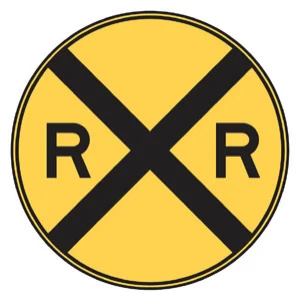
Railroad crossing ahead
Railroad advance warning sign

Know the rule

The advance warning sign is placed far enough ahead to let you stop before the crossing. It is the only round traffic sign.

Handbook p. 24 ↗

Know the rule

Pavement markings may include "R X R" and a stop line. Stay behind the line; if there's none, stay at least 10 feet from the tracks. Trains overhang the tracks by 3 feet.

Handbook p. 24 ↗
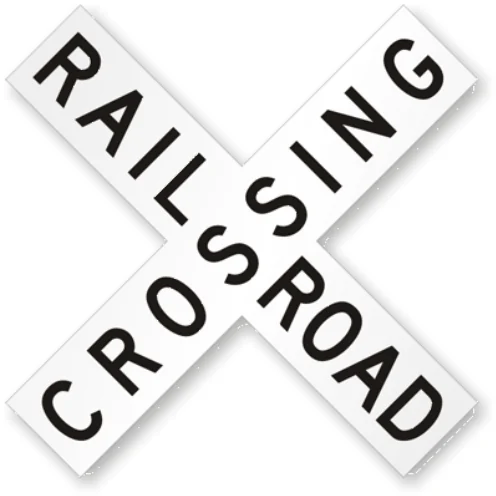
Railroad crossbuck
Crossbuck sign

Know the rule

Treat a crossbuck like a yield sign. A sign below it shows the number of tracks if there's more than one. Crossbucks become regulatory when a train approaches.

Handbook p. 24 ↗

Know the rule

Quiet Zone crossings post a "No Train Horn" sign below the advance warning sign. Horns don't sound, but flashing lights and gates still warn you.

Handbook p. 24 ↗

Know the rule

Always stop when crossing lights flash, and wait until they stop. With gates, don't cross until they're raised and the lights stop; while down, the road is closed.

Handbook p. 24 ↗

Know the rule

Commercial buses and trucks carrying hazardous materials must stop at most crossings, so be ready to stop behind them.

Handbook p. 24 ↗

Know the rule

Blue ENS signs give a 24/7/365 number and the DOT (X-ING) crossing number, so the dispatcher can stop trains headed there.

Handbook p. 24 ↗

Put it into practice

You're waiting at a crossing with no painted stop line while a train passes. Stay at least 10 feet from the nearest rail; the train overhangs the tracks by 3 feet. Once it passes, check for a second train before crossing.

Check your understanding

Read the question, decide on an answer, then open it to check the explanation. These are Roadwise study questions based on the source handbook.

If there is no stop line at a railroad crossing, how far back must you stay from the tracks?
  1. At least 10 feet
  2. At least 50 feet
  3. At least 3 feet
  4. At least 25 feet

Answer: At least 10 feet

If no stop line is visible, you must stay at least 10 feet from the tracks while waiting.
Handbook p. 24 ↗
By about how many feet do trains typically overhang the tracks?
  1. 3 feet
  2. 10 feet
  3. 1 foot
  4. 6 feet

Answer: 3 feet

Trains overhang the tracks by about 3 feet, which is why you must stay well clear while waiting.

Handbook p. 24 ↗
About how far does a freight train traveling 55 mph need to come to a stop?
  1. About one mile
  2. About 200 feet
  3. About a quarter mile
  4. About 100 yards

Answer: About one mile

The average freight train traveling at 55 mph requires about one mile to stop.

Handbook p. 24 ↗
What does a 'No Train Horn' sign at a designated quiet zone indicate?
  1. The crossing has no gates
  2. The crossing is permanently closed
  3. Horns won't sound there
  4. Trains no longer use that crossing

Answer: Horns won't sound there

Quiet Zone crossings post a 'No Train Horn' sign below the advance warning sign, meaning horns won't sound there.

Handbook p. 24 ↗
A Crossbuck sign at a railroad crossing should be treated the same as what other sign?
  1. A stop sign
  2. A do not enter sign
  3. A one-way sign
  4. A yield sign

Answer: A yield sign

Crossbuck signs should be treated the same as a yield sign, though they become regulatory when a train approaches.

Handbook p. 24 ↗
Which types of vehicles must stop at most railroad crossings?
  1. Vehicles with trailers under 500 lbs
  2. Buses and hazmat trucks
  3. Pickup trucks towing trailers
  4. Motorcycles only

Answer: Buses and hazmat trucks

Commercial buses and trucks carrying hazardous materials must stop at most railroad crossings; be ready to stop if following one.

Handbook p. 24 ↗
Take the lesson checkpoint in the app

More in Sharing the Road