Roadwise States Colorado Driving lessons Regulatory signs Colorado driving lesson · Traffic Signals, Signs & Markings
Regulatory signs A 3-minute lesson from the Colorado course. Read the rules and examples, follow the handbook page references, and check your understanding before you move on.
Read time 3 minutes
Course unit Traffic Signals, Signs & Markings
Checkpoint questions 6
Source pages 10, 11 Sign shape and color tell you the kind of message before you can read it. Regulatory signs state the law at that spot, and disobeying one is a traffic violation.
Know the rule
Regulatory signs are black or red on a white background.
Handbook p. 10 ↗ Know the rule
Speed limit signs show the maximum or minimum speed allowed. Maximums are for ideal conditions; slow down when conditions require it.
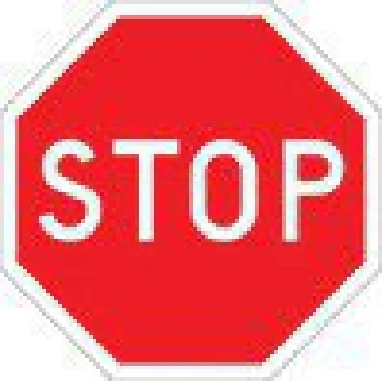
Handbook p. 10 ↗ Stop sign Know the rule
At a stop sign, come to a complete stop at the marked stop line. If there's no line, stop before the crosswalk on the near side; if none, where you can see approaching traffic, nearest the crossing road.
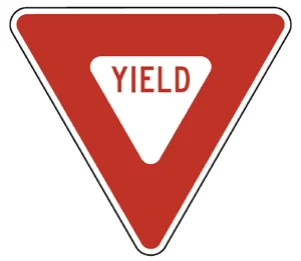
Handbook p. 10 ↗ Yield sign Know the rule
Yield signs mean you must slow or stop to yield to all pedestrians and any vehicle with the right-of-way.
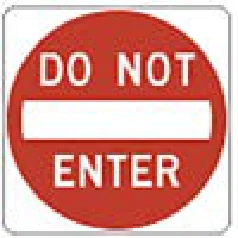
Handbook p. 10 ↗ Do Not Enter sign Know the rule
Do Not Enter and Wrong Way signs redirect drivers heading the wrong way on streets or freeway ramps. Do not proceed past one.
Handbook p. 11 ↗ Know the rule
One Way signs mean you may travel only in the direction of the sign's arrow.
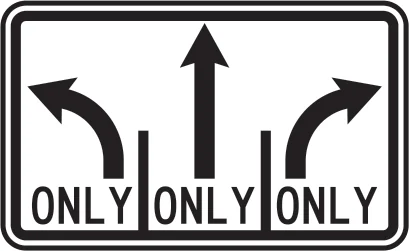
Handbook p. 11 ↗ Lane control sign Know the rule
Lane control signs show where you can turn, often with arrows. They're beside or above the road, and arrows may also be painted on the pavement.
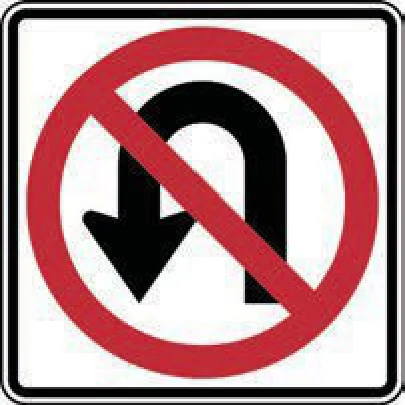
Handbook p. 11 ↗ No U-turn (prohibited) sign Know the rule
Prohibited signs show something you cannot do, such as no U-turn or no left turn.
Handbook p. 11 ↗ Put it into practice
You approach a stop sign with no painted stop line and no crosswalk. Stop at the point nearest the crossing road where you can see approaching traffic.
A useful reminder Stop location order: stop line first, then before the near crosswalk, then the point where you can see cross traffic.
Check your understanding Read the question, decide on an answer, then open it to check the explanation. These are Roadwise study questions based on the source handbook.
What colors are regulatory traffic signs typically displayed in? Blue or brown Yellow with black symbols Orange with black letters Black or red on white Answer: Black or red on white
Regulatory signs, which tell you of laws that apply at a location, are black or red on a white background.
Handbook p. 10 ↗ If there is no marked stop line and no crosswalk at a stop sign, where must you stop? Anywhere before entering the intersection Exactly at the stop sign post At the point nearest the intersecting roadway where you have a view of approaching traffic At least 50 feet before the intersection Answer: At the point nearest the intersecting roadway where you have a view of approaching traffic
Without a marked stop line or crosswalk, you must stop where you have a clear view of approaching traffic.
Handbook p. 10 ↗ What must you do at a sign posted with a yield symbol? Stop only if other vehicles are visible Come to a full stop every time Speed up to merge quickly Slow or stop and yield to those with the right-of-way Answer: Slow or stop and yield to those with the right-of-way
A yield sign requires you to slow or stop to yield to pedestrians and any vehicle that has the right-of-way.
Handbook p. 10 ↗ Besides traffic signals and signs, who else can provide traffic control that you must obey? Police, highway workers or crossing guards Only officers in marked patrol cars Only flaggers in work zones Only uniformed police officers Answer: Police, highway workers or crossing guards
Traffic control can also be provided by law enforcement, highway personnel, or school crossing guards, and you must obey their directions.
Handbook p. 10 ↗ What does a prohibited sign, such as one showing 'no U-turn,' indicate? That maneuver isn't allowed there That the maneuver is only allowed at night That the maneuver requires a signal first That the maneuver is allowed only for buses Answer: That maneuver isn't allowed there
Prohibited signs indicate you cannot do something, such as making a U-turn or a left turn, at that location.
Handbook p. 11 ↗ Regulatory signs in Colorado are colored black or red on a white background. True False Answer: True
Regulatory signs use black or red lettering on a white background to indicate laws and regulations.
Handbook p. 10 ↗ Previous lesson Traffic signals & arrows Next lesson Warning, guide & service signs More in Traffic Signals, Signs & Markings About the source Roadwise’s Colorado course uses the driver handbook edition supplied with this study pack. This lesson cites source pages 10, 11. The linked PDF is a third-party mirror of the handbook, rather than a government-hosted page.
Open the handbook source PDF · View the source edition
For current application requirements, fees, appointments, and the format that applies to your age or license type, check Colorado’s DMV. Roadwise provides study material and does not issue permits or licenses.