roadwise.Open study app

Colorado driving lesson · Traffic Signals, Signs & Markings

Bicycle, slow-moving & disabled parking signs

A 3-minute lesson from the Colorado course. Read the rules and examples, follow the handbook page references, and check your understanding before you move on.

Read time
3 minutes
Course unit
Traffic Signals, Signs & Markings
Checkpoint questions
6
Source pages
12

Some signs protect people who are easy to overlook: bicyclists, pedestrians, slow farm vehicles and drivers with disabilities. Several come with specific distances and steep fines.

Know the rule

Bicycle and pedestrian crossing signs are yellow with black symbols. They mark places where both might cross, such as where a shared use path meets the road.

Handbook p. 12 ↗
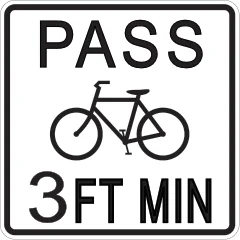
Pass 3 feet minimum (bicycle)
PASS 3 FT MIN sign

Know the rule

Pass 3 ft min signs (white with black letters): when passing or overtaking bicyclists, give 3 feet of clearance on all roadways, even where no sign is posted.

Handbook p. 12 ↗
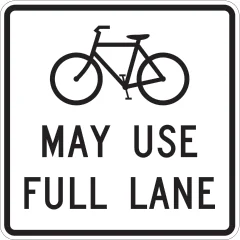
Bicycles may use full lane
Bicycle May Use Full Lane sign

Know the rule

Bicycle May Use Full Lane signs (white with black) remind you that bicyclists may ride in the center of the lane if hazards or poor visibility make the right side unsafe.

Handbook p. 12 ↗
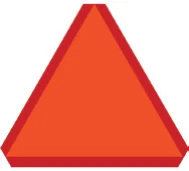
Slow-moving vehicle emblem
Slow moving vehicle emblem

Slow moving vehicle marker

A reflective orange triangle on the rear of a vehicle designed to travel slower than 25 mph.

Handbook p. 12 ↗

Know the rule

Disabled parking signs and pavement symbols mark spaces only for vehicles displaying a disabled parking permit. The placard owner must be entering or exiting the vehicle.

Handbook p. 12 ↗

Know the rule

Crosshatched sections next to disabled spaces are for van access only; parking there is never allowed.

Handbook p. 12 ↗
$350-$5,000

Fine range for parking in a disabled space without a placard or plate (misdemeanor)

Handbook p. 12 ↗

Know the rule

Parking illegally in a disabled space can also bring possible jail, loss of driving privileges and/or impoundment.

Handbook p. 12 ↗

Know the rule

Using someone else's placard or plate brings jail time, loss of driving privileges, towing, and fines double the no-placard range.

Handbook p. 12 ↗

Put it into practice

Your grandmother's placard is in your car, but you're running into the store alone. You may not park in the disabled space: the placard owner must be the one entering or leaving the vehicle.

Check your understanding

Read the question, decide on an answer, then open it to check the explanation. These are Roadwise study questions based on the source handbook.

A reflective orange triangle mounted on the rear of a vehicle indicates what?
  1. The vehicle is disabled and being towed
  2. The vehicle is a funeral procession vehicle
  3. The vehicle is carrying hazardous materials
  4. A vehicle slower than 25 mph

Answer: A vehicle slower than 25 mph

The slow-moving vehicle marker, a reflective orange triangle, means the vehicle is designed to travel slower than 25 mph.

Handbook p. 12 ↗
If convicted of parking illegally in a disabled parking space without a placard, what is the possible fine range?
  1. $1,000 to $10,000
  2. $50 to $250
  3. $100 to $1,000
  4. $350 to $5,000

Answer: $350 to $5,000

Parking illegally in a disabled space without a placard can result in a fine of $350 to $5,000, plus other penalties.

Handbook p. 12 ↗
What color background do bicycle and pedestrian crossing signs use?
  1. White with black letters
  2. Orange with black symbols
  3. Yellow with black symbols
  4. Blue with white symbols

Answer: Yellow with black symbols

Bicycle and pedestrian crossing signs have a yellow background with black symbols.

Handbook p. 12 ↗
What does a 'Bicycle May Use Full Lane' sign remind drivers?
  1. Bicyclists must dismount at intersections
  2. Bicyclists may ride in the center of the lane
  3. Only bicycles may use that lane
  4. Bicyclists must always ride on the shoulder

Answer: Bicyclists may ride in the center of the lane

This sign reminds drivers that bicyclists may ride in the center of the lane when hazards or poor visibility compromise their safety on the right side.
Handbook p. 12 ↗
What are crosshatched sections next to a disabled parking space reserved for?
  1. Overflow parking during busy periods
  2. Motorcycle parking
  3. Van access only
  4. Temporary loading zones

Answer: Van access only

Crosshatched sections next to disabled parking spaces are for van access only, and parking there is prohibited at all times.

Handbook p. 12 ↗
If you illegally park in a disabled space using someone else's placard, how do the fines compare to parking there with no placard at all?
  1. Double the no-placard fine
  2. The fines are half as much
  3. The fines are the same either way
  4. There is no fine for using someone else's placard

Answer: Double the no-placard fine

Using someone else's placard or plate results in fines double those for parking without a placard, plus towing and loss of driving privileges.

Handbook p. 12 ↗
Take the lesson checkpoint in the app

More in Traffic Signals, Signs & Markings