roadwise.Open study app

California driving lesson · Safe Driving Fundamentals

Scanning & following distance

A 2-minute lesson from the California course. Read the rules and examples, follow the handbook page references, and check your understanding before you move on.

Read time
2 minutes
Course unit
Safe Driving Fundamentals
Checkpoint questions
6
Source pages
63, 90

Safe drivers see trouble early. Keep your eyes moving well ahead and keep enough space in front so you have time to react when someone else makes a mistake.

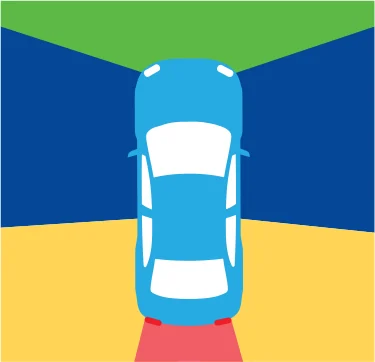
The areas around your vehicle

The areas around your vehicle
Color in the imageArea
GreenAhead of you
BlueNext to you
YellowBlind spots
RedBehind you
Handbook p. 63 ↗
Blind spot diagram
Areas around your vehicle: ahead, beside, blind spots, behind
10 seconds

Scan the road at least this far ahead of your vehicle

Handbook p. 63 ↗

Know the rule

Tailgating blocks your view of the road ahead and leaves you too little time to react if the driver ahead brakes suddenly.

Handbook p. 63 ↗

Three-second rule

When the vehicle ahead passes a point such as a sign, count three seconds. If you pass the same point before you finish counting, you are following too closely.

Handbook p. 90 ↗

Know the rule

If a vehicle merges in front of you too closely, take your foot off the accelerator to create space.

Handbook p. 63 ↗

Create more space in front of your vehicle when:

  • A tailgater is behind you: keep your course and speed, then merge right when safe to let them pass
  • Following motorcyclists on metal surfaces (bridge gratings, railroad tracks, etc.) and gravel
Handbook p. 63 ↗

Put it into practice

The car ahead passes a speed limit sign and you start counting: one-thousand-one, one-thousand-two. You reach the sign before you say three. You're following too closely, so ease off the accelerator until you get a full three seconds.

Check your understanding

Read the question, decide on an answer, then open it to check the explanation. These are Roadwise study questions based on the source handbook.

How far ahead should you scan the road to give yourself time to react?
  1. At least 2 seconds ahead
  2. At least 30 seconds ahead
  3. At least 1 minute ahead
  4. At least 10 seconds ahead

Answer: At least 10 seconds ahead

Scan the road at least 10 seconds ahead of your vehicle to avoid last-minute moves.
Handbook p. 63 ↗
What rule helps you maintain a safe following distance behind another vehicle?
  1. The three-second rule
  2. The five-car-length rule
  3. The one-second rule
  4. The half-block rule

Answer: The three-second rule

The three-second rule helps you judge and maintain a safe following distance.

Handbook p. 63 ↗
If a vehicle merges too closely in front of you, what should you do first?
  1. Brake hard immediately
  2. Ease off the gas
  3. Speed up to pass them
  4. Change lanes to the left

Answer: Ease off the gas

Ease off the accelerator to create space when a vehicle merges closely in front of you.

Handbook p. 63 ↗
If a tailgater is behind you, what should you do?
  1. Speed up to lose them
  2. Tap your brakes to warn them
  3. Keep course and speed, then merge right when safe
  4. Pull onto the shoulder and stop

Answer: Keep course and speed, then merge right when safe

With a tailgater behind you, keep your course and speed, then safely merge right to let them pass.

Handbook p. 63 ↗
On which surfaces does the handbook say to leave extra space when following a motorcyclist?
  1. Fresh asphalt and concrete
  2. Wide multilane freeways
  3. Bridge gratings, railroad tracks, and gravel
  4. Uphill grades

Answer: Bridge gratings, railroad tracks, and gravel

Create more space when following motorcyclists on metal surfaces (bridge gratings, railroad tracks) and gravel.

Handbook p. 63 ↗
The three-second rule is used to judge safe distance when passing on the highway only.
  1. True
  2. False

Answer: False

The three-second rule is a general following-distance tool, not limited to passing situations.

Handbook p. 63 ↗
Take the lesson checkpoint in the app

More in Safe Driving Fundamentals