roadwise.Open study app

California driving lesson · Safe Driving Fundamentals

Blind spots, your sides & behind you

A 3-minute lesson from the California course. Read the rules and examples, follow the handbook page references, and check your understanding before you move on.

Read time
3 minutes
Course unit
Safe Driving Fundamentals
Checkpoint questions
6
Source pages
64, 65

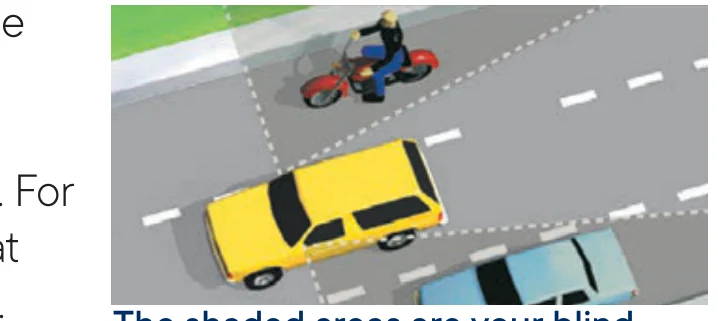
Every vehicle has blind spots, areas you can't see looking ahead or in the mirrors. For most vehicles they're at the sides, slightly behind you. A quick head turn is the only way to clear them.

Blind spots

Areas around the vehicle a driver cannot see when looking straight ahead or using the mirrors. For most vehicles, at the sides, slightly behind the driver.

Handbook p. 64 ↗

Know the rule

To check blind spots, look over your right and left shoulders out the side windows. Turn only your head, not your whole body or the steering wheel.

Handbook p. 64 ↗
Blind spot diagram (vehicle example)
Shaded areas are your blind spots

Check your blind spots before you:

  • Change lanes
  • Turn at an intersection
  • Merge with traffic
  • Back up
  • Leave a parking space or pull out from the curb
  • Parallel park
  • Open your car door
Handbook p. 64 ↗

To keep space at your sides:

  • Do not stay in another driver's blind spot
  • Avoid driving directly alongside other vehicles
  • Make space for vehicles entering freeways, even if you have the right-of-way
  • Keep space between your vehicle and parked vehicles
  • Look both ways, even where cross traffic has a red light or stop sign
Handbook p. 64 ↗

Check behind you (rearview mirror, side mirrors, and turning your head) when you:

  • Change lanes or check your blind spots
  • Reduce your speed
  • Turn into a side road or driveway
  • Stop to pull into a parking space
  • Pull up to and away from the curb
  • Back up
Handbook p. 65 ↗

Know the rule

Knowing what is behind you helps you avoid rear-end collisions.

Handbook p. 65 ↗

Put it into practice

You're about to open your door after parallel parking on a busy street. First look over your left shoulder: a cyclist in your blind spot could hit an opening door.

Check your understanding

Read the question, decide on an answer, then open it to check the explanation. These are Roadwise study questions based on the source handbook.

How should you check your blind spots before changing lanes?
  1. Check your side mirror
  2. Turn only your head to look over your shoulder
  3. Turn your body and the steering wheel
  4. Check your rearview mirror

Answer: Turn only your head to look over your shoulder

Check blind spots by turning your head to look over your shoulder; do not turn your whole body or the wheel.
Handbook p. 64 ↗
Besides changing lanes, when else should you check your blind spots?
  1. Before entering a tunnel
  2. Before dimming your high beams
  3. Before opening your car door
  4. Before speeding up on a straight road

Answer: Before opening your car door

Blind spot checks are needed before many actions, including opening your car door in traffic.

Handbook p. 64 ↗
What should you avoid doing to maintain space to maneuver safely on the road?
  1. Leaving space beside parked cars
  2. Making space for merging vehicles
  3. Looking both ways at a red light
  4. Lingering in other drivers' blind spots

Answer: Lingering in other drivers' blind spots

Avoid staying in another driver's blind spot so you have room to react and are visible to them.

Handbook p. 64 ↗
At an intersection where cross traffic has a red light or stop sign, what should you still do?
  1. Proceed without looking; you have priority
  2. Look only to your left
  3. Look both ways
  4. Watch only the traffic light

Answer: Look both ways

The handbook says to look both ways, even at intersections where traffic has a red light or stop sign.

Handbook p. 64 ↗
What helps you know what is directly behind your vehicle, in addition to mirrors?
  1. Listening for engine noise
  2. Watching the car ahead
  3. Turning your head to look
  4. Using your dashboard gauges

Answer: Turning your head to look

Check traffic behind you with your rearview mirror, side mirrors, and by turning your head.

Handbook p. 65 ↗
You should turn your entire body, not just your head, when checking blind spots.
  1. True
  2. False

Answer: False

Only turn your head to check blind spots; do not turn your whole body or the steering wheel.

Handbook p. 64 ↗
Take the lesson checkpoint in the app

More in Safe Driving Fundamentals