roadwise.Open study app

Arizona driving lesson · Weather, Night Driving & Crash Avoidance

Braking, stopping distance & the open road

A 3-minute lesson from the Arizona course. Read the rules and examples, follow the handbook page references, and check your understanding before you move on.

Read time
3 minutes
Course unit
Weather, Night Driving & Crash Avoidance
Checkpoint questions
6
Source pages
53, 54

Stopping takes much longer than most people think. Before your foot even reaches the brake, you spend time noticing the danger and reacting to it. The faster you go, the more ground you cover in that time — so choose a speed and gap that leave room to stop.

Braking distance is directly related to:

  • Speed of the vehicle
  • Driver perception time (seeing and recognizing a danger)
  • Driver reaction time (from perceiving danger to starting to brake)
  • Type and condition of the pavement
  • Type and condition of the tires
  • Vehicle weight, including when loaded or towing
  • Type and condition of the brakes
Handbook p. 53 ↗

Average driver timing

Average driver timing
StageAverage
Perception time0.75 seconds
Reaction time0.75 seconds
Perceive and react to a threat1.5 seconds
Handbook p. 53 ↗
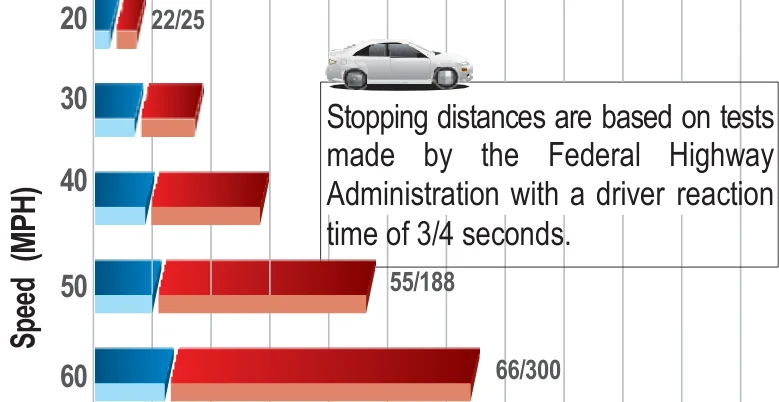
Stopping distance chart
Average stopping distance of cars on dry, level pavement by speed (FHWA tests, 3/4-second reaction time)

Know the rule

The chart is a guide only: your actual stopping distance depends on the factors listed above.

Handbook p. 53 ↗
3 seconds

Minimum following distance for most driving situations

Handbook p. 53 ↗

Use a longer (3 to 6 second) following distance when:

  • Driving on slippery roads — double it to 6 seconds or more
  • The driver behind you wants to pass — slowing lets them pass sooner and pull back in more easily
  • Following a large vehicle, like a tractor-trailer, that blocks your view ahead
Handbook p. 53 ↗

Know the rule

Empty rural highways can be as dangerous as city traffic: animals, slow farm equipment over a hill crest, or water-covered low spots. Slow down at curves or hills that block your view.

Handbook p. 54 ↗

Put it into practice

A driver behind you on a two-lane highway is trying to pass. Ease off the gas slightly — it lets them get by more quickly and gives them room to pull back in ahead of you.

Check your understanding

Read the question, decide on an answer, then open it to check the explanation. These are Roadwise study questions based on the source handbook.

About how long is the average driver's perception time when a hazard appears?
  1. 5 seconds
  2. 0.75 seconds
  3. 3 seconds
  4. 0.25 seconds

Answer: 0.75 seconds

The average driver perception time (time to see and recognize a danger) is about 0.75 seconds.
Handbook p. 53 ↗
About how long is the average driver's reaction time, from perceiving danger to starting to brake?
  1. 0.75 seconds
  2. 1.5 seconds
  3. 3 seconds
  4. 0.25 seconds

Answer: 0.75 seconds

The average driver reaction time is also about 0.75 seconds, combining with perception time for a total of roughly 1.5 seconds.

Handbook p. 53 ↗
Which of these factors directly affects your vehicle's braking distance?
  1. The posted speed limit
  2. Your headlight setting
  3. The time of day
  4. Vehicle weight, including loads

Answer: Vehicle weight, including loads

Braking distance depends on vehicle weight (including loaded or towing status), among other factors like speed and tire condition.

Handbook p. 53 ↗
On average, how long does it take a driver to perceive a threat in the roadway and react to it?
  1. 0.75 seconds
  2. 1.5 seconds
  3. 3 seconds
  4. 4 seconds

Answer: 1.5 seconds

It takes an average of 1.5 seconds to perceive a threat and react (about 0.75 s perception plus 0.75 s reaction).

Handbook p. 53 ↗
If the driver behind you wants to pass, what should you do to help them pass more quickly?
  1. Reduce your speed slightly
  2. Speed up to make room faster
  3. Move to the center of your lane
  4. Turn on your hazard lights

Answer: Reduce your speed slightly

Reducing your speed allows the passing motorist to complete the pass more quickly and safely.

Handbook p. 53 ↗
The combined average perception and reaction time for a driver is roughly 3 seconds.
  1. True
  2. False

Answer: False

False. Average perception time and average reaction time are each about 0.75 seconds, for a combined average of about 1.5 seconds.

Handbook p. 53 ↗
Take the lesson checkpoint in the app

More in Weather, Night Driving & Crash Avoidance